
 Verified text
— Look, look, my friends, what a cruel cabman, how he beats the little horse!.. Indeed, it runs very badly... Why is that? Ah, poor Gnedko, he's lame...
— Cabman, cabman! Aren't you ashamed: you'll ruin your horse completely; you'll beat it to death...
— "What do I care," answers the cabman. — "Either I or it must die! Today is a holiday."
— "That's just the point, my dear: because it's a holiday, you've been drinking and didn't notice that the horse lost a shoe; that's why it slipped, stumbled and hurt its leg. No wonder it can't run. The poor thing, every step hurts: you can't run like that. And you know you'll have to pay for its treatment, for the shoeing, and the master will scold you. So you want to get the money at any cost, make a killing, as you say; now it's good that it's a holiday, there's a lot of driving, they pay well... But what fault is the poor little horse? You're the guilty one, silly boy: why didn't you look after her, why didn't you see when she lost the shoe?"
But he doesn't listen to us, he's already far away. There he is on the Neva and keeps driving the poor horse, and the horse keeps stumbling, and every step hurts. Poor little horse! What suffering for her!
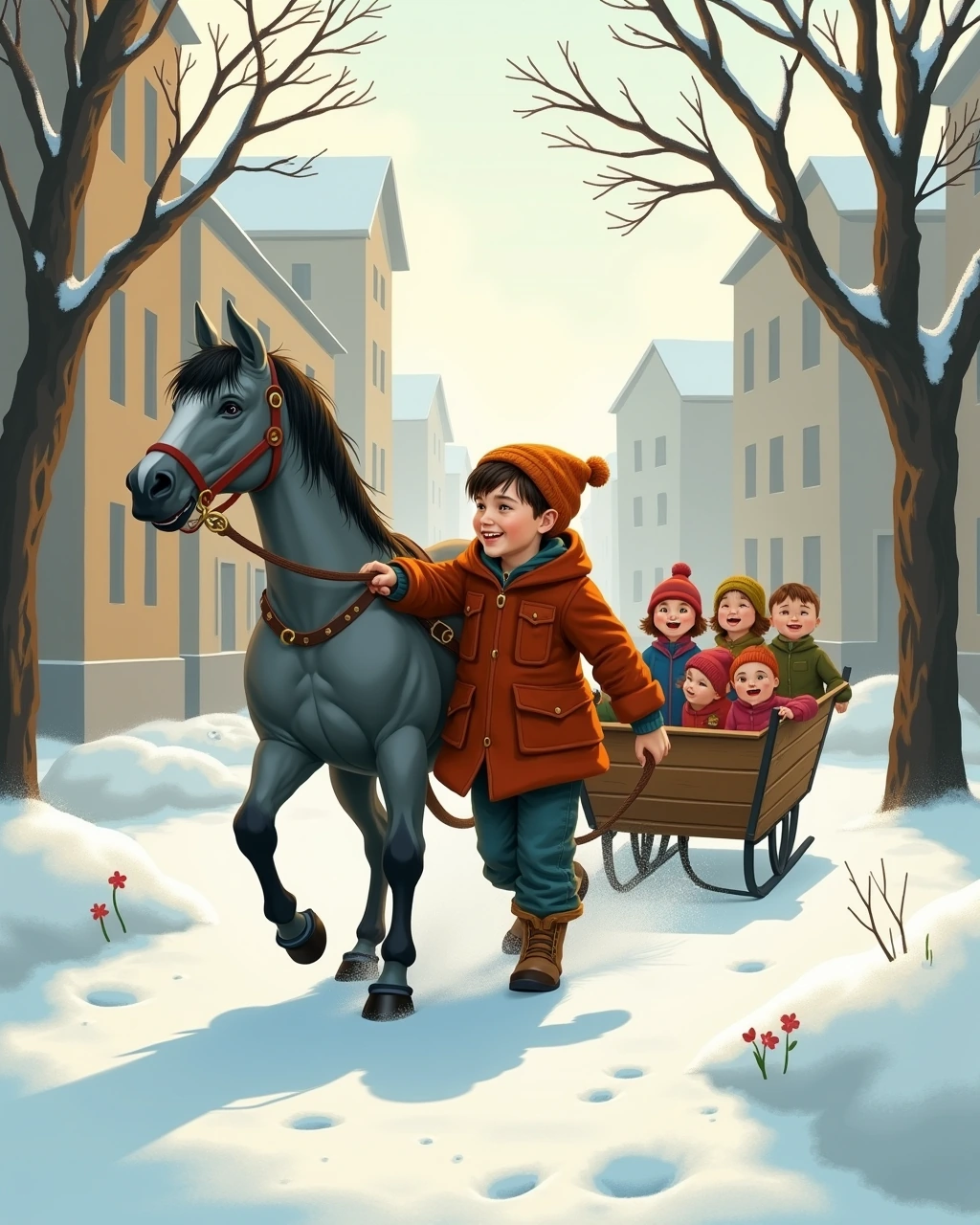
And the children run after the sledge and laugh both at the horse and at the cabman. And he gets angrier and takes out his anger on the little horse.
But tell me, do me a favor, how can this fat gentleman who sits in the sledge not be ashamed! Why doesn't he forbid the cabman to torture the poor little horse! This fat gentleman wrapped himself in a fur coat, pulled his hat down over his eyes and sits there as if nothing had happened.
— "What do I care," mutters the fat gentleman to himself, — "I'm in a hurry to get to dinner. Let the cabman kill his horse; it's not my horse, what do I care."
What do you think of this, my friends? Is it because it's not his horse that he should look indifferently at its suffering?
Poor Gnedko! How sorry I am for him! I've known this little horse for a long time. I remember when she was still a foal. Then, in spring, the sun shines, the birds chirp, dew glistens on the meadows, the air is fresh and fragrant. There Serko plows the earth, and our foal runs around its mother: now it runs up to her, now it jumps away, nibbles the young grass, and back to its mother again, and kicks again: what a happy life it had then! In the evening it returns home: Vanyusha and Dasha meet it, comb its short mane, rub it down with straw. How Vanyusha and Dasha loved their little foal! Sometimes, instead of running around doing nothing, they would pick young grass, put it in a box and feed their little foal; at night they would bring it bedding, and during the day they wouldn't eat a piece of bread without sharing it with their friend. And how the foal knew them! Sometimes, from afar it would see Vanyusha and Dasha, it would run to them at full speed, come running, stop and look at them like a little dog. In such care our little foal grew up, straightened out and became a stately horse. Then Vanyusha's father thought and thought, pondered: — "It's a pity to harness such a horse to a plow; I'll take it to the city and sell it; they'll give me the price of two horses for it." — Said and done: they took Gnedko to the Horse Market in Petersburg, sold him to a cabman. And how Vanyusha and Dasha cried, how they begged the cabman to take care of their Gnedko, not to make him pull heavy loads, not to torture him... They returned home very sad: something was missing. The father was glad that he got good money for Gnedko, but the children cried bitterly.
But in these conversations we walked almost the whole embankment... Look, look: what's that crowd there!.. Let's go. Ah, it's our poor Gnedko! Look: he has fallen and can't get up anymore; passersby help the cabman lift him; they lift him, he falls again. How swollen his leg is! The cabman himself is now crying his eyes out. "Serves him right," you'll say; no, don't say that: he already sees his guilt himself and is punished enough. How will he face the master? And what to do with the horse now? You can't leave it on the street; it can't walk by itself; you need to hire another horse with a sledge and put poor Gnedko on the sledge. But that requires money, and the cabman doesn't have any: the fat gentleman got angry about why the horse fell and didn't pay anything... Poor Gnedko! He can't move, he buried his head in the snow, breathes heavily and rolls his eyes, as if asking for help. Poor thing, he can't even cry, because horses don't cry, no matter how cruelly they suffer. "Cruel cabman! Why did you torture poor Gnedko so?" — But let's stop reproaching him, although he is very much to blame, and instead let's give him money, let him hire another cabman to take Gnedko to the apartment, and let's add advice: in the future don't drive a lame horse and don't demand that a sick one run like a healthy one. In a few days we'll send to find out if our little horse is better.
In general, my friends, it's a sin to torture poor animals that serve us for use or for pleasure. Whoever tortures animals without any need is a bad person. Whoever tortures a horse, a dog, is capable of torturing a person too. And sometimes this can be very dangerous. You've seen how sometimes naughty children tease dogs, cats on the street, beat them, tie sticks to their tails; listen to what once happened to such children, how they were cruelly punished for their malicious sport.