
 Verified text
About forty years ago in St. Petersburg, on Vasilievsky Island, in the First Line, there lived a keeper of a boys' boarding school, who probably still remains in the fresh memory of many, although the house where that boarding school was housed has long since given way to another, in no way resembling the former. At that time our Petersburg was already renowned throughout Europe for its beauty, though it was still far from being what it is now. Then there were no cheerful shady avenues on the avenues of Vasilievsky Island: wooden platforms, often nailed together from rotten boards, occupied the place of the present beautiful sidewalks. Isaac Bridge — narrow at that time and uneven — presented quite a different appearance than now; and Isaac Square itself was by no means as it is now. Then the monument to Peter the Great was separated from Isaac's Church by a canal; the Admiralty was not planted with trees; the Horse Guards Manege did not adorn the square with its present beautiful facade; in a word, Petersburg of that time was not what it is today. Cities have, among other things, the advantage that with the years they sometimes become more beautiful... however, that is not what we are talking about now. Another time and on another occasion I may perhaps speak with you more at length about the changes that have taken place in Petersburg during my lifetime — but now let us return again to the boarding school, which, forty years ago, was located on Vasilievsky Island, in the First Line.
The house, which now — as I already told you — you will not find, was two stories high, roofed with Dutch tiles. The porch by which one entered it was wooden and projected onto the street... From the entryway a rather steep staircase led to the upper dwelling, consisting of eight or nine rooms, on one side of which lived the keeper of the boarding school, and on the other were the classrooms. The dormitories, or sleeping rooms of the children, were on the ground floor, to the right of the entryway, and to the left lived two old women, Dutchwomen, each of whom was over a hundred years old and who had seen Peter the Great with their own eyes and even spoken with him. In the present time you would hardly meet in all of Russia a person who had seen Peter the Great: the time will come when even our traces will be wiped from the face of the earth! Everything passes, everything disappears in our frail world... But that is not what we are talking about now!
Among the thirty or forty children studying at that boarding school was one boy, named Alyosha, who was then no more than nine or ten years old. His parents, living far, far from Petersburg, had brought him to the capital about two years before, placed him in the boarding school, and returned home, having paid the teacher the agreed fee for several years in advance. Alyosha was a clever, sweet boy, studied well, and everyone loved and caressed him; however, despite that, he often felt bored at the boarding school, and sometimes even sad. Especially at first he could not get used to the thought that he was separated from his family; but then, little by little, he grew accustomed to his situation, and there were even moments when, playing with his companions, he thought that the boarding school was much more cheerful than his parents' home. In general, the school days passed quickly and pleasantly for him; but when Saturday came and all his companions hurried home to their families, then Alyosha bitterly felt his loneliness. On Sundays and holidays he remained alone all day, and then his only comfort was reading books, which the teacher allowed him to take from his small library. The teacher was a German by birth, and at that time German literature was dominated by the fashion for chivalric romances and fairy tales — and the library used by our Alyosha consisted for the most part of books of this kind.
Thus Alyosha, still at ten years of age, already knew by heart the deeds of the most glorious knights, at least as they were described in the romances. His favorite occupation on long winter evenings, on Sundays and other holidays, was to transport himself in thought to ancient, long-past centuries... Especially during vacation time — for example at Christmas or at Easter — when he was separated for a long time from his companions, when he often sat whole days in solitude, the young imagination wandered through knightly castles, through terrible ruins, or through dark primeval forests.
I forgot to tell you that the house had a fairly spacious yard, separated from the alley by a wooden fence of barge boards. The gate and wicket that led into the alley were always locked, and therefore Alyosha never managed to visit that alley, which strongly aroused his curiosity. Every time he was allowed during rest hours to play in the yard, his first movement was to run to the fence. There he would stand on tiptoe and peer intently through the round holes with which the fence was studded. Alyosha did not know that these holes came from the wooden nails with which barges had previously been nailed together, and it seemed to him that some kind fairy had deliberately bored these holes for him. He kept expecting that someday this fairy would appear in the alley and through the hole hand him a toy, or a talisman, or a little letter from his papa or mama, from whom he had long since received no news. But, to his extreme regret, no one even resembling a fairy ever appeared.
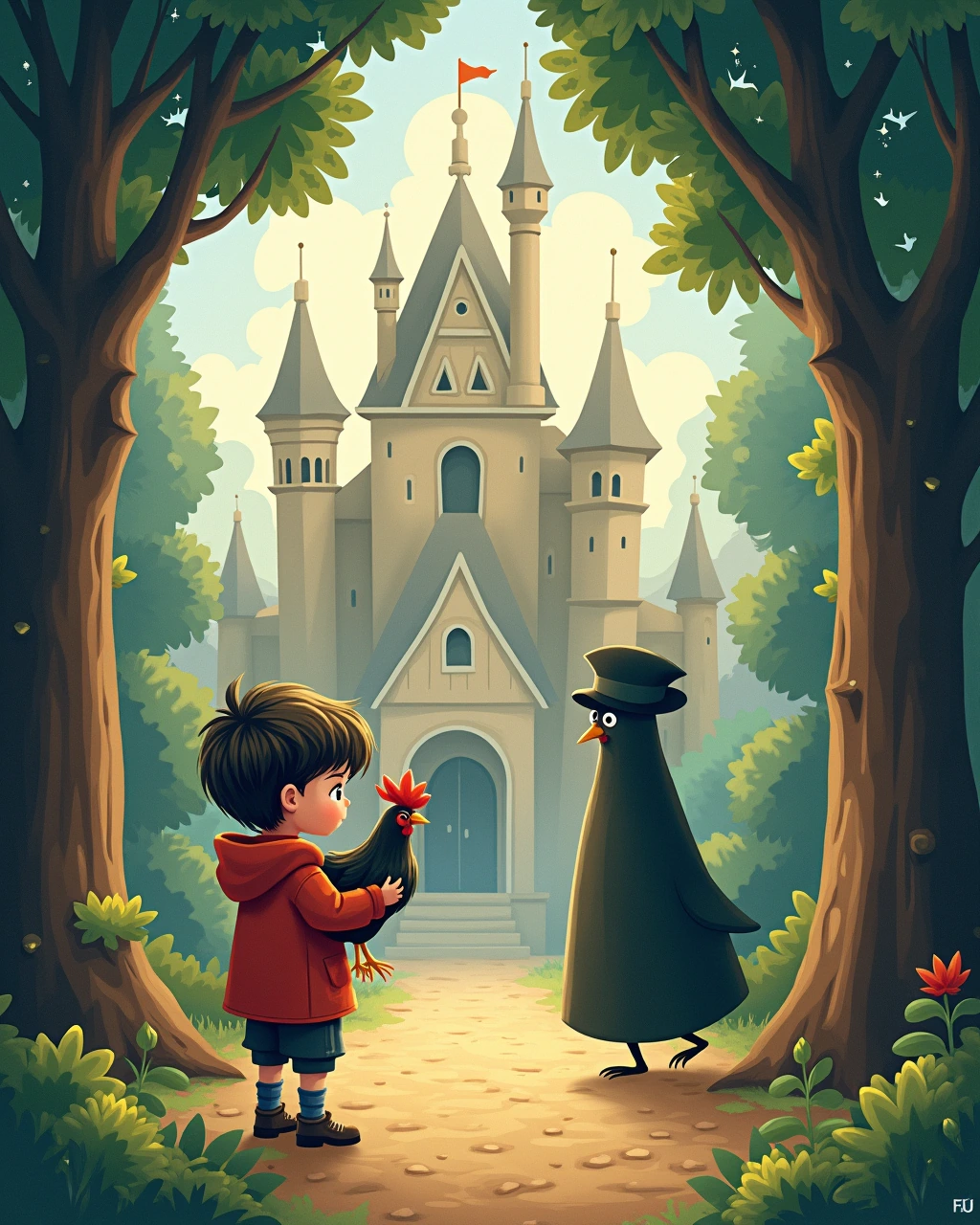
Alyosha's other occupation consisted in feeding the hens, which lived near the fence in a little house built especially for them and played and ran about the yard all day. Alyosha became very well acquainted with them, knew them all by name, broke up their fights, and punished the bullies by sometimes not giving them anything for several days in a row from the crumbs that he always collected from the tablecloth after dinner and supper. Among the hens he especially loved one black crested one, named Chernushka. Chernushka was more affectionate toward him than the others; she even sometimes allowed herself to be petted, and therefore Alyosha brought her the best morsels. She was of a quiet disposition; she rarely walked about with the others and seemed to love Alyosha more than her companions.