
 Verified text
In a certain village there lived a poor widow, and she had a son. They worked honestly, without sparing their hands, but all they earned was enough for bread: it is hard to manage peasant work if there is neither a horse nor cattle in the house. They struggled and struggled, and finally managed to scrape together a little money and bought a single ox.
The widow's son was a hardworking fellow: he went out to work before dawn and returned from the field late; that is why he did as much with one ox as another could not plow with a pair.
Once a peasant from another village, a very rich one, rode past him; he looked: the fellow was plowing with a single ox, and doing it well. And this rich man said to him: "Why do you plow with one ox?" "Well, there is no other, and for this one we barely scraped together the money." — "Well, come to me, I will give you another ox." — "Thank you, kind man." Now, that rich man had an ox, but such a vicious, unruly one that nothing could be done with him, no matter how they tried: he simply would not work. That was why he was giving him away, because he was tired of fussing with him.
The next day the widow's son came to the rich man, and the rich man gave him the ox: "He is not trained yet," he said, "train him and work with him for a whole year if you like."
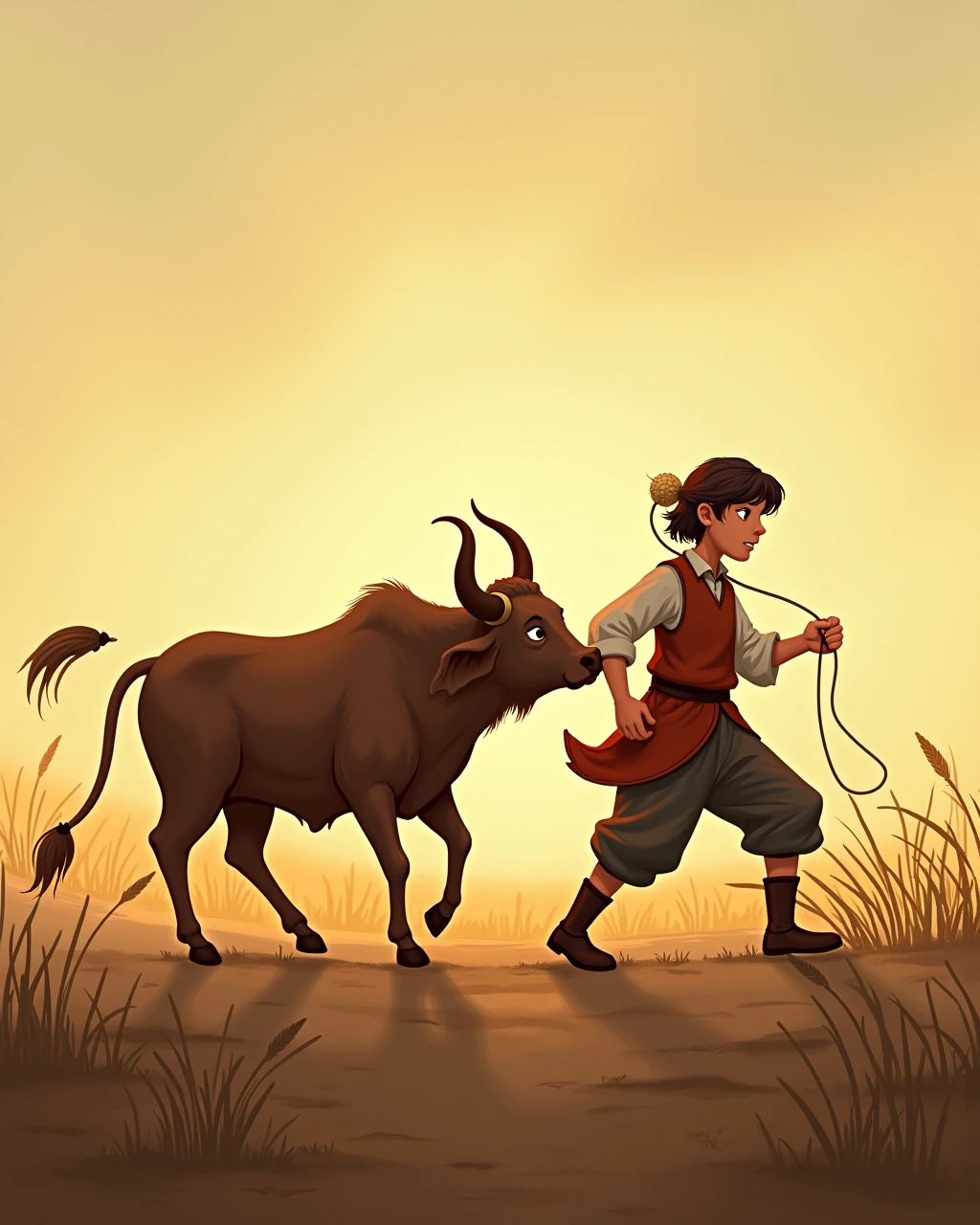
With great difficulty the widow's son drove the ox home, and was completely worn out by him: now the ox would lunge to the side, now he would rush headlong forward, now he would plant all four feet — and not budge an inch. And when they harnessed him to the plow — well, then it was a disaster indeed! The unruly ox broke the yoke, smashed the plow to pieces, and injured the old ox. You might as well give up the beast entirely! But it was a pity: the ox was big, sleek, and strong.
The widow and her son began to think: how to train the ox. They thought and thought; and the widow said: "Come now, let's teach him with hunger. He has too much strength in him."
Very well. The next morning the widow's son went out to plow again with the one old ox, and locked the new one in an empty barn, without hay and without water. In the evening he returned, led him out — he had already grown somewhat quieter — put him in the yoke, let him stand there for a while, and then fed him. They used their wiles with this ox... And what do you think, good people: the ox, though a dumb beast, understood that for work he would be fed, and for unruliness he would get neither food nor water — and he was tamed, and began to walk quietly in a pair.
Some time passed; the rich man went out to the field. He looks: the widow's son is already plowing with a pair of oxen. "Is it really," the rich man asks, "that my ox walks so well in a pair?" — "It is yours indeed!" The rich man looked, thought, and said: "Send the matchmakers; I will give you my daughter in marriage."
Now, the rich man had a daughter — so willful, stubborn, and unruly that, looking at her, her father sometimes clutched his head. He himself was seldom at home — he often went away on business — so his wife had spoiled the daughter. So he thought here: "If this fellow managed with an unruly ox, he will train my daughter too."
Having plowed until evening, the widow's son returned home and said to his mother: "That rich man who gave us the ox wants to give me his daughter in marriage." "Oh, you fool, you fool!" said the mother. "He is making fun of you. How could such a rich man give his daughter to you, a pauper." "Well, come what may," said the son, "let us send the matchmakers."
With difficulty the widow found two good people who agreed to go to the rich man as matchmakers. Everyone else refused: "The rich man will only make a mockery of the matchmakers!" However, he received the matchmakers with honor, entertained them properly, and set the date for the wedding... No matter how the daughter raged, how she dug in her heels, how she and her mother howled — the father stood his ground: he gave her in marriage to the widow's son. When they were wed, the father said to his son-in-law and daughter: "Well, go with God, to live in your own home."
And he gave his daughter no dowry at all, not even food for the journey; only her mother somehow managed to stuff some candies and gingerbread into her daughter's pockets.