
 Verified text
Just think how vast is God's world! Rich and poor people live in it, there is room for all, and the Lord watches over and judges them all. Those in luxury live and celebrate; the wretched live and toil; to each his own lot!
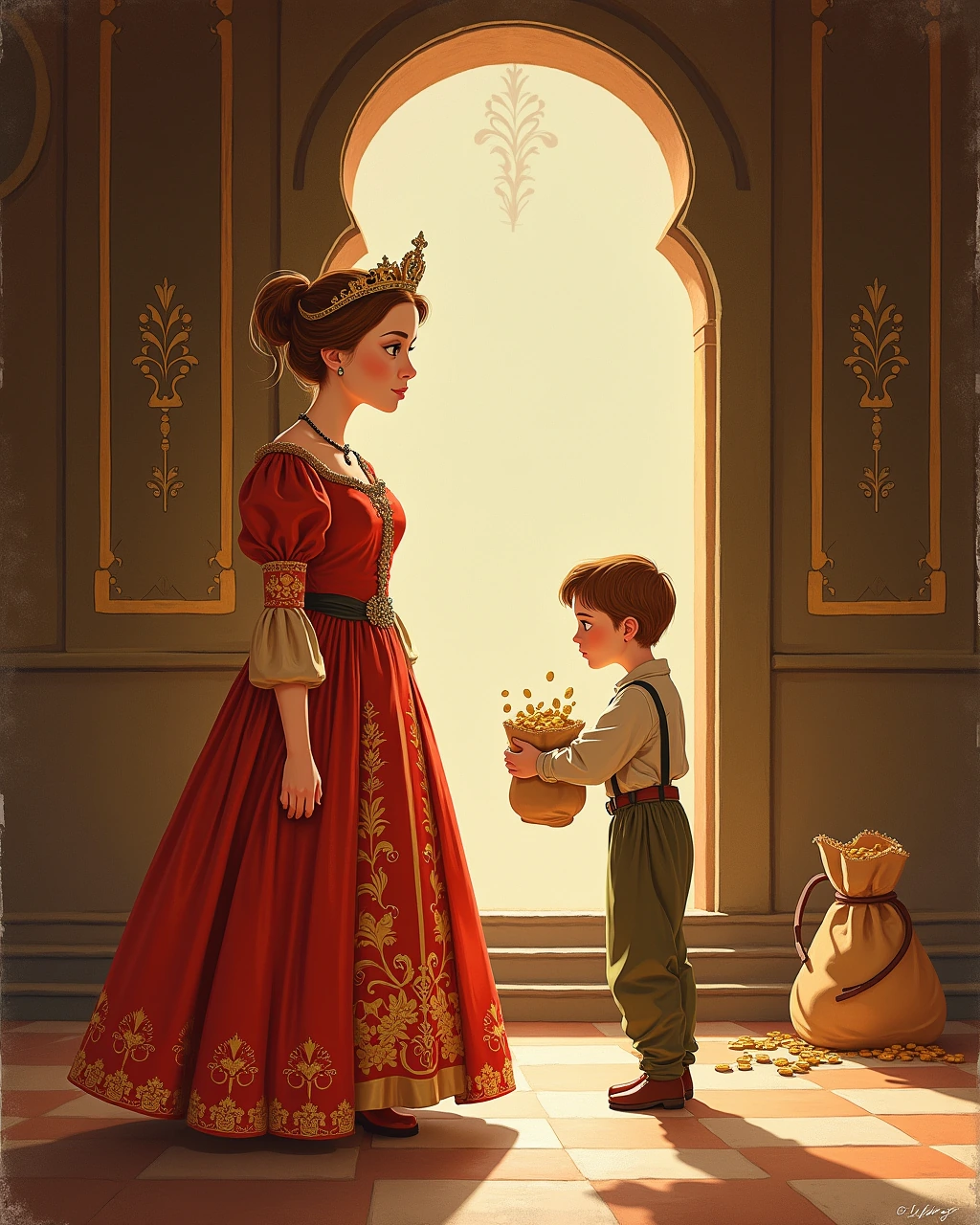
In the tsar's chambers, in the princes' halls, in the tall tower lived Nesmeyana the Tsarevna. What a life she had, what ease, what luxury! She had everything her heart desired; yet she never smiled, never laughed, as if her heart found joy in nothing.
It was bitter for the tsar-father to look upon his sad daughter. He opens his royal chambers to all who wish to be his guest. "Let them," he says, "try to cheer up Nesmeyana the Tsarevna; whoever succeeds shall have her for a wife." No sooner had he spoken than the crowd swarmed at the prince's gates! From all sides they ride and walk — tsareviches and princes, boyars and nobles, military men and common folk; feasts began, mead flowed — the tsarevna still did not laugh.
At the other end, in his own corner, lived an honest worker; in the mornings he swept the yard, in the evenings he tended the cattle, he was in unceasing toil. His master was a rich, truthful man, who did not stint him in wages. When the year had just ended, he put a bag of money on the table for him: "Take," he says, "as much as you want!" and himself went out the door. The worker approached the table and thinks: lest I sin before God, lest I take more than my due for my labor? He chose only one coin, clutched it in his fist and thought to drink some water, bent down to the well — the coin slipped from him and sank to the bottom.
The poor man was left with nothing. Another in his place would have wept, grieved, and thrown up his hands in despair, but not he. "All," he says, "God sends; the Lord knows whom to give what: whom He endows with money, from whom He takes the last. Evidently I have been negligent, worked little, now I shall be more diligent!" And again to work — every task blazes in his hands! The term ended, another year passed, the master put a bag of money on the table for him: "Take," he says, "as much as your soul desires!" and himself went out the door.
The worker again thinks not to anger God, not to take more than his due for his labor; he took a coin, went to drink and accidentally let it slip from his hand — the coin into the well and sank. He set to work still more diligently: he sleeps too little at night, eats too little by day. Look: whose bread dries and yellows, while his master's all thrives; whose livestock drag their feet, while his kicks about the street; whose horses are worn out going downhill, while his cannot be held in check. The master understood whom to thank, to whom to give thanks. The term ended, the third year passed, he put a pile of money on the table: "Take, worker, as much as your soul desires; your labor, your coin!" and himself went out.
The worker again takes one coin, goes to the well to drink water — look: the last coin is intact, and the previous two have floated to the top. He picked them up, realized that God had rewarded him for his labors; he rejoiced and thinks: "It is time for me to see the wide world, to get to know people!" He thought and went whither his eyes led him. He walks across the field, a mouse runs by: "Kovalek, dear friend! Give me a coin; I myself will be useful to you!" He gave her the coin. He walks through the forest, a beetle crawls: "Kovalek, dear friend! Give me a coin; I myself will be useful to you!" He gave him a coin too. He swam down the river, met a catfish: "Kovalek, dear friend! Give me a coin; I myself will be useful to you!" He did not refuse him either, gave away the last one.
He himself came to the city; there are people, there are doors! The worker looked around, turned in all directions, does not know where to go. And before him stand the royal chambers, adorned with silver and gold, at the window sits Nesmeyana the Tsarevna and looks straight at him. Where to go? His eyes grew dim, sleep came over him, and he fell right into the mud. Out of nowhere came the catfish with a big whisker, behind him the old little beetle, the shorn mouse; all ran up. They tend to him, comfort him: the mouse takes off his coat, the beetle brushes his boots, the catfish drives away the flies. Nesmeyana the Tsarevna looked and looked at their services and laughed. "Who, who cheered my daughter?" asks the tsar. One says: "I"; another: "I". — "No!" said Nesmeyana the Tsarevna. — "That man there!" — and she pointed at the worker. At once he was taken to the palace, and the worker stood before the tsar a true hero! The tsar kept his royal word; what he promised, he granted. I say: was this not a dream to the worker? They assure that no, it was true reality — so one must believe.