
 Verified text
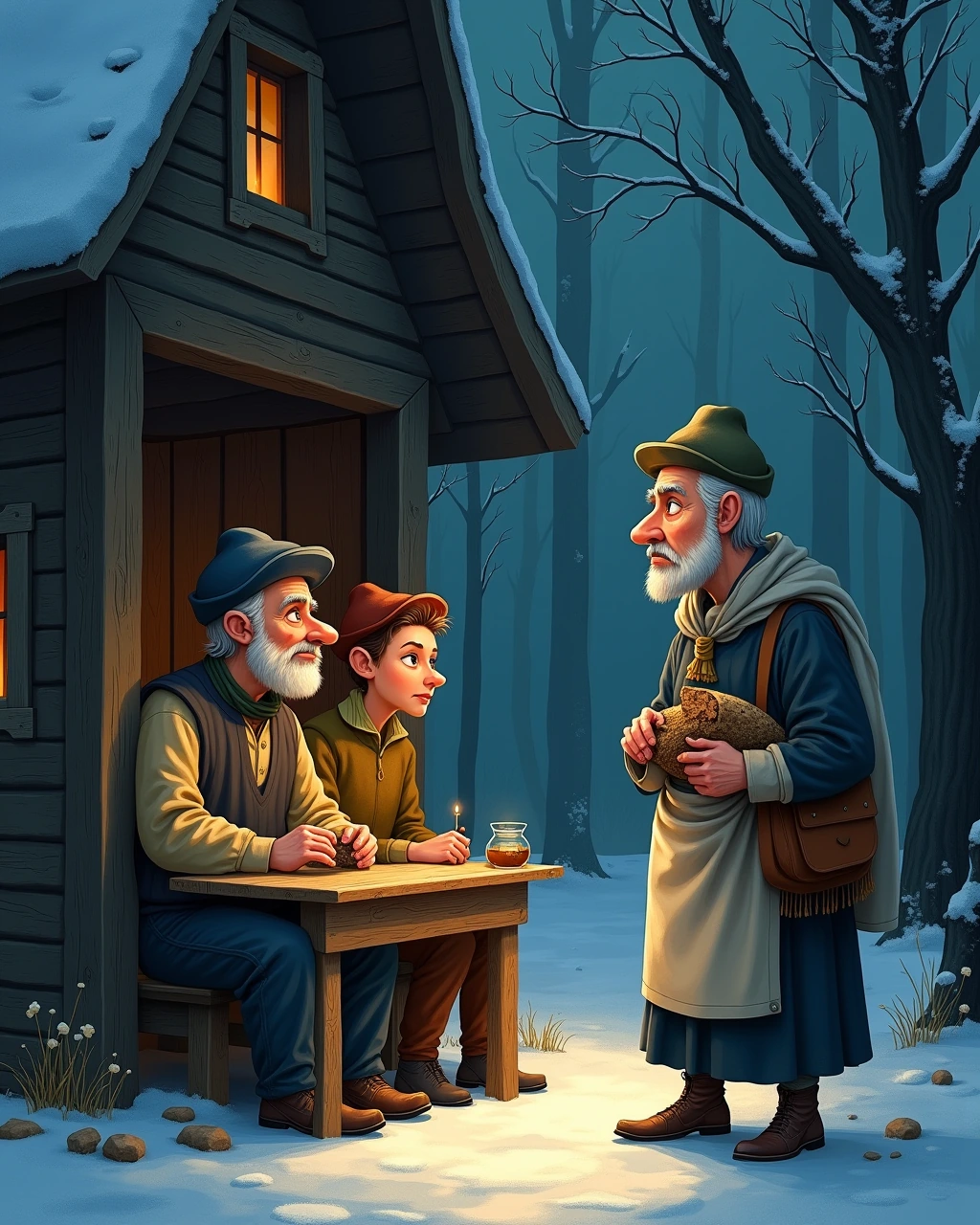
There once lived a blacksmith. "What," he says, "I haven't seen any trouble at all. They say there's misfortune in the world; I'll go look for some misfortune for myself." He took off and went, had a good drink, and went looking for misfortune. A tailor came toward him. "Hello!" — "Hello!" — "Where are you going?" — "Well, brother, everyone says there's misfortune in the world; I haven't seen any misfortune, I'm going to look for it." — "Let's go together. I also live well and haven't seen misfortune; let's go look." So they walked and walked, went into a forest, a dense, dark one, found a little path, and went along it — along a narrow path. They walked and walked along this path, and see: a big hut stands there. Night; nowhere to go. "Come on," they say, "let's go into this hut." They went in; no one was there, empty, not good. They sat down and sat. Here comes a tall woman, thin, crooked, one-eyed. "Ah!" she says. "I have guests. Hello." — "Hello, grandmother! We've come to spend the night at your place." — "Well, good; I'll have something to eat for supper!" They got scared. She went, brought a big bundle of firewood; brought the bundle of firewood, put it in the stove, and lit it. She came up to them, took one, the tailor, and killed him, put him in the stove, and put him away.
The blacksmith sits and thinks: what to do, how to be? She took her supper. The blacksmith looks into the stove and says: "Grandmother, I'm a blacksmith." — "What can you do — forge?" — "I can do everything." — "Forge me an eye." — "All right," he says, "but do you have a rope? I need to tie you up, otherwise you won't let me; I'd forge the eye into you." She went, brought two ropes, one thinner and the other thicker. So he tied her with the one that was thinner. "Come now, grandmother, turn around!" She turned and broke the rope. "Well," he says, "no, grandmother! This one won't do." He took the thick rope and with this rope tied her up tight. "Turn around, grandmother!" She turned — didn't break it. He took an awl, heated it red-hot, aimed it at her one good eye, took an axe and struck the awl hard with the butt. As soon as she turned — she broke the rope, and sat on the threshold. "Ah, villain, now you won't get away from me!" He sees that misfortune is upon him again, sits, thinks: what to do? Then sheep came from the field; she drove the sheep into her hut to spend the night. So the blacksmith spent the night.
In the morning she began letting the sheep out. He took a fur coat, turned it wool-side out, put it on his arms, and crawled to her like a sheep. She let them out one by one; as soon as she grabbed one by the back, she threw it out. And he crawled up; she grabbed him by the back too and threw him out. She threw him out, he got up and says: "Farewell, Misfortune! I've had my fill of trouble from you; now there's nothing you can do." She says: "Wait, you'll suffer more, you haven't left!"
And the blacksmith went again into the forest along the narrow path. He looks: in a tree an axe with a golden handle; he wanted to take it for himself. He grabbed this little axe, and his hand stuck to it. What to do? He can't tear it off. He looked back: Misfortune is coming toward him and shouting: "There you are, villain, you haven't left!" The blacksmith took out a little knife, which he had in his pocket, and started sawing at the hand; he cut it off and left. He came to his village and began showing the hand, that now he had seen misfortune. "Here," he says, "look — what it's like: I am without a hand, and my companion was eaten up completely." And that's the end of the tale.