
 Verified text
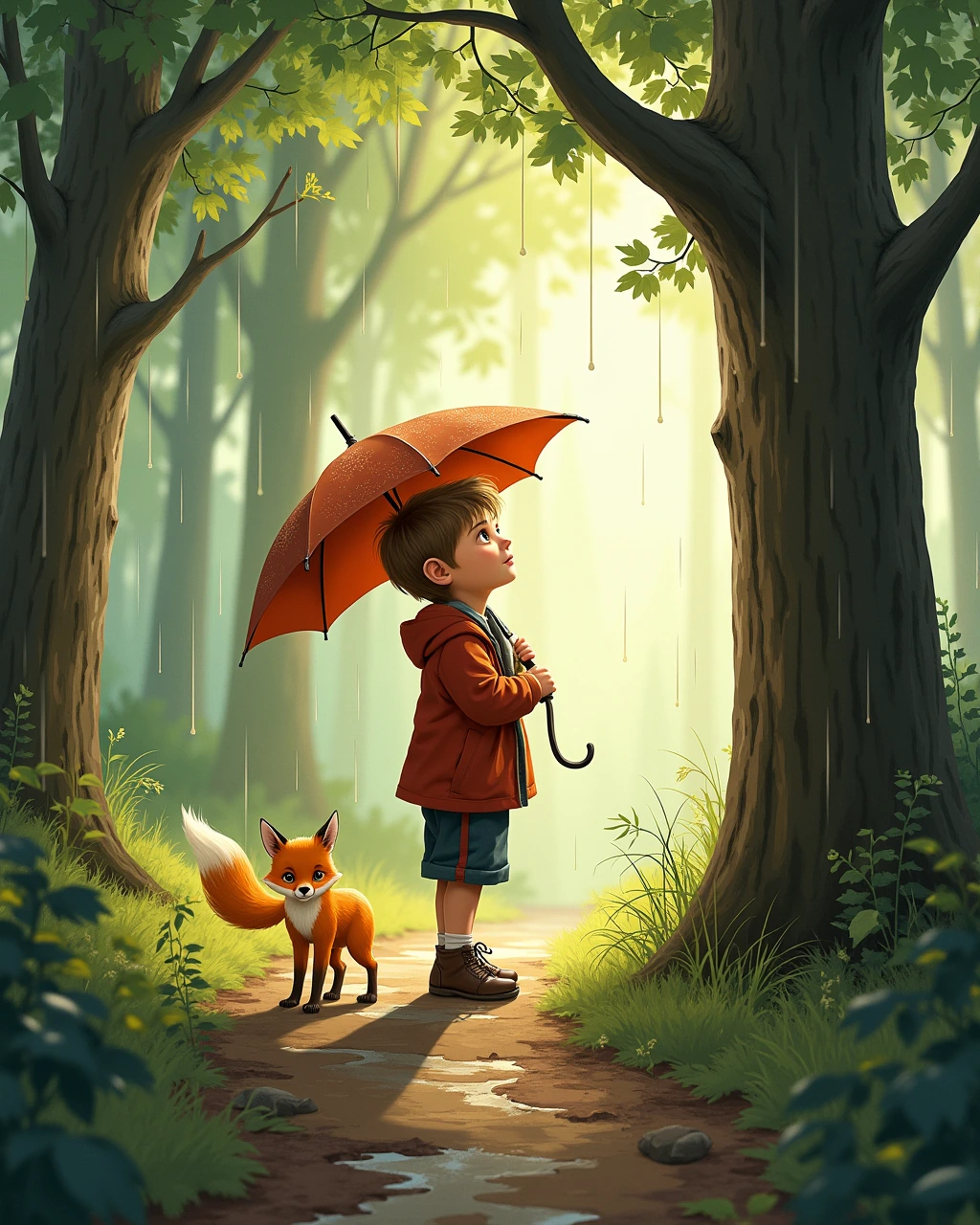
A rainy summer day. I love to wander through the forest in such weather, especially when there is a warm nook ahead where one can dry off and warm up. Besides, summer rain is warm. In the city in such weather there is mud, but in the forest the earth greedily absorbs the moisture, and you walk on a slightly damp carpet of last year's fallen leaves and shed pine and fir needles. The trees are covered with raindrops that shower down on you with every movement. And when the sun comes out after such rain, the forest turns so brightly green and is all ablaze with diamond sparks. There is something festive and joyful all around you, and you feel yourself a welcome, dear guest at this celebration.
It was on just such a rainy day that I was approaching Lake Svetloye, to the familiar watchman at the fishing stand, Taras. The rain was already thinning. On one side of the sky, clearings appeared; a little more and the hot summer sun would show itself. The forest path made a sharp turn, and I emerged onto a gentle cape jutting out in a broad tongue into the lake. Actually, this was not the lake itself, but a wide channel between two lakes, and the stand was tucked into a bend on the low bank, where fishing boats were huddled in a small cove. The channel between the lakes had been formed thanks to a large wooded island, spread out like a green cap opposite the stand.
My appearance on the cape provoked the watchdog bark of Taras's dog — at strangers she always barked in a special way, abruptly and sharply, as if angrily asking: "Who goes there?" I love such simple little dogs for their extraordinary intelligence and faithful service...
From afar the fishing hut seemed like a large boat turned upside down — the old wooden roof was hunched over, overgrown with cheerful green grass. All around the hut rose dense undergrowth of fireweed, sage, and "bear's trumpets," so that only the head of a person approaching the hut was visible. Such thick grass grew only along the lake shores, because there was enough moisture here and the soil was rich.
When I was already approaching the hut quite closely, a speckled little dog tumbled out of the grass at me and burst into desperate barking.
— Sobolko, stop... Don't you recognize me?
Sobolko paused in thought, but apparently still did not believe in the old acquaintance. He cautiously approached, sniffed my hunting boots, and only after this ceremony guiltily wagged his tail. As if to say: sorry, I made a mistake — but still I must guard the hut.
The hut turned out to be empty. The master was not there; that is, he had probably gone out onto the lake to check some fishing tackle. All around the hut everything spoke of the presence of a living person: a faintly smoking fire, an armful of freshly chopped firewood, a net drying on stakes, an axe stuck into a tree stump. Through the ajar door of the stand all of Taras's belongings were visible: a rifle on the wall, several pots on the stove shelf, a small chest under the bench, hanging tackle. The hut was quite spacious, because in winter during the fishing season a whole artel of workers could fit in it. In summer the old man lived alone. Regardless of the weather, he heated the Russian stove hot every day and slept on the loft. This love of warmth was explained by Taras's venerable age: he was about ninety years old. I say "about" because Taras himself had forgotten when he was born. "Even before the Frenchman," as he explained, that is, before the French invasion of Russia in 1812.
Having taken off my soaked jacket and hung my hunting gear on the wall, I set about making a fire. Sobolko fidgeted around me, sensing some tidbit. The little fire blazed up cheerfully, sending a blue stream of smoke upward. The rain had already passed. Torn clouds raced across the sky, dropping sparse drops. Here and there the sky showed blue. And then the sun appeared too, the hot July sun, under whose rays the wet grass seemed to smoke. The water in the lake lay very still, as happens only after rain. It smelled of fresh grass, sage, and the resinous aroma of the nearby pine grove. In general it was good, as good as it can possibly be in such a remote forest corner. To the right, where the channel ended, the smooth expanse of Lake Svetloye gleamed blue, and beyond the jagged edge rose mountains. A wonderful corner! And no wonder old Taras had lived here for a whole forty years. Somewhere in the city he would not have lived even half that long, because in the city you cannot buy for any money such pure air, and above all — this peace that enveloped one here. It is good at the stand!.. The bright little fire burns cheerfully; the hot sun begins to beat down, it hurts the eyes to look at the sparkling distance of the wonderful lake. One would sit here like this and, it seems, would not part with the wonderful forest freedom. The thought of the city flashes through the head like a bad dream.
While waiting for the old man, I attached a copper camping kettle with water to a long stick and hung it over the fire. The water was already beginning to boil, but the old man still had not come.
— Where could he have gone? — I wondered aloud. — Tackle is checked in the morning, and now it is noon... Maybe he went to see if anyone is fishing without permission... Sobolko, where has your master gone?
The clever dog only wagged his fluffy tail, licked his lips, and whined impatiently. In appearance Sobolko belonged to the type of so-called "hunting" dogs. Small in stature, with a sharp muzzle, erect ears, and an upward-curled tail, he perhaps resembled an ordinary mongrel, with the difference that a mongrel would not find a squirrel in the forest, would not be able to "bark down" a capercaillie, or track a deer — in a word, a real hunting dog, man's best friend. One must see such a dog precisely in the forest to fully appreciate all its virtues.