
 Verified text
In a department... but it is better not to name which department. There is nothing more irritable than all sorts of departments, regiments, offices, and, in a word, all sorts of official classes. Nowadays every private person considers all society insulted in his own person. They say that very recently a petition arrived from a certain captain-ispravnik, I don't remember of which town, in which he clearly sets forth that the state regulations are perishing and that his sacred name is pronounced quite in vain. And as proof he attached to the petition a huge volume of some romantic composition, where every ten pages the captain-ispravnik appears, in places even quite drunk. So, to avoid all unpleasantness, let us call the department in question simply one department.
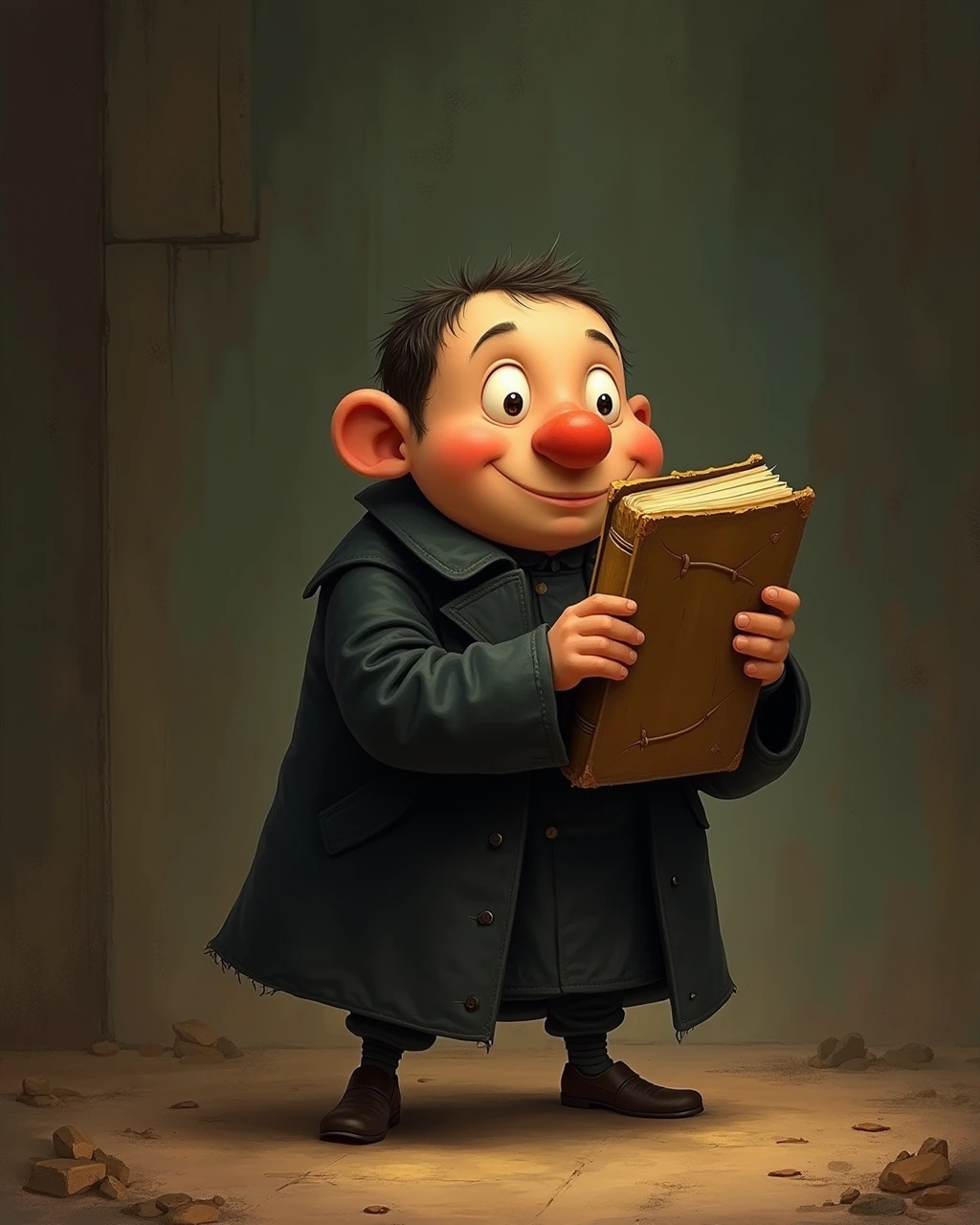
So, in one department served one official; an official not to be called very remarkable, of short stature, somewhat pockmarked, somewhat reddish, even somewhat bleary-eyed in appearance, with a small bald spot on his forehead, with wrinkles on both cheeks and a complexion that is called hemorrhoidal... What can be done! The Petersburg climate is to blame. As for his rank (for with us one must first of all declare the rank), he was what is called a perpetual titular counsellor, at whom, as is known, various writers have sufficiently mocked and whetted their teeth, having the praiseworthy habit of falling upon those who cannot bite. The official's surname was Bashmachkin. From the very name it is evident that it once derived from a boot; but when, at what time, and in what manner it derived from a boot, none of this is known. Both father, and grandfather, and even brother-in-law, and all the Bashmachkins without exception wore boots, changing only the soles three times a year. His name was Akaky Akakievich. Perhaps to the reader it will seem somewhat strange and sought out, but one can assure that it was not sought at all, but that circumstances happened by themselves such that it was impossible to give another name, and this happened exactly thus. Akaky Akakievich was born towards night, if memory does not deceive, on March 23. The deceased mother, a female official and a very good woman, prepared, as was proper, to baptize the child. The mother was still lying in bed opposite the door, and on the right hand stood the godfather, an excellent man, Ivan Ivanovich Yeroshkin, who served as head clerk in the Senate, and the godmother, the wife of the district police officer, a woman of rare virtues, Arina Semyonovna Belobryushkova. The woman in childbirth was offered the choice of any of the three, whichever she wished to choose: Mokkia, Sossia, or to name the child after the martyr Khozdatazat. "No," thought the deceased, "all these names are such." To please her, they opened the calendar in another place; again three names came out: Trifily, Dula, and Varakhasy. "This is a punishment," said the old woman, "what names they all are; I, really, have never heard such. Let it be at least Varadat or Varukh, but not Trifily and Varakhasy." They turned another page — out came: Pavsikakhiy and Vakhtisy. "Well, now I see," said the old woman, "that apparently such is his fate. If so, let him better be called as his father was. The father was Akaky, so let the son be Akaky too." Thus Akaky Akakievich came about. The child was baptized, at which he cried and made such a grimace as if he had foreseen that he would be a titular counsellor. So, this is how all this happened. We have related this so that the reader may see for himself that this happened quite by necessity and it was impossible to give another name. When and at what time he entered the department and who appointed him, no one could recall. No matter how many directors and various chiefs changed, he was always seen in the same place, in the same position, in the very same post, the same copying clerk, so that afterwards they became convinced that apparently he was born into the world already completely ready, in a frock coat and with a bald spot on his head. In the department no respect was shown to him. The watchmen not only did not rise from their places when he passed, but did not even look at him, as if a common fly had flown through the reception room. The superiors treated him in a coldly despotic manner. Some assistant head clerk would directly thrust papers under his nose, without even saying "copy this," or "here is an interesting, nice little matter," or something pleasant, as is customary in well-bred offices. And he would take them, looking only at the paper, not looking who had put it there and whether he had the right to do so. He took them and immediately set about writing. The young officials laughed at him and made jokes at his expense, as far as office wit allowed, telling right in front of him various stories made up about him; about his landlady, a seventy-year-old old woman, they said that she beat him, asked when their wedding would be, threw scraps of paper on his head, calling it snow. But not a word did Akaky Akakievich answer to this, as if no one were before him; this did not even affect his work: amid all these annoyances he made not a single mistake in his writing. Only if the joke became too unbearable, when they jostled his arm, hindering him from attending to his business, he would say: "Leave me alone, why do you offend me?" And something strange was contained in the words and in the voice with which they were uttered. In it was heard something so inclining to pity that one young man, recently appointed, who, following the example of others, had allowed himself to laugh at him, suddenly stopped, as if pierced, and from that time as if everything had changed before him and appeared in a different light. Some unnatural force repelled him from the comrades with whom he had become acquainted, having taken them for decent, genteel people. And long afterwards, amid the merriest moments, there appeared to him the short official with the bald spot on his forehead, with his penetrating words: "Leave me alone, why do you offend me?" — and in these penetrating words rang other words: "I am your brother." And the poor young man would cover his face with his hand, and many times afterwards he shuddered throughout his life, seeing how much inhumanity there is in man, how much hidden ferocious coarseness there is in refined, educated worldliness, and, God! even in that man whom the world acknowledges as noble and honest...