
 Verified text
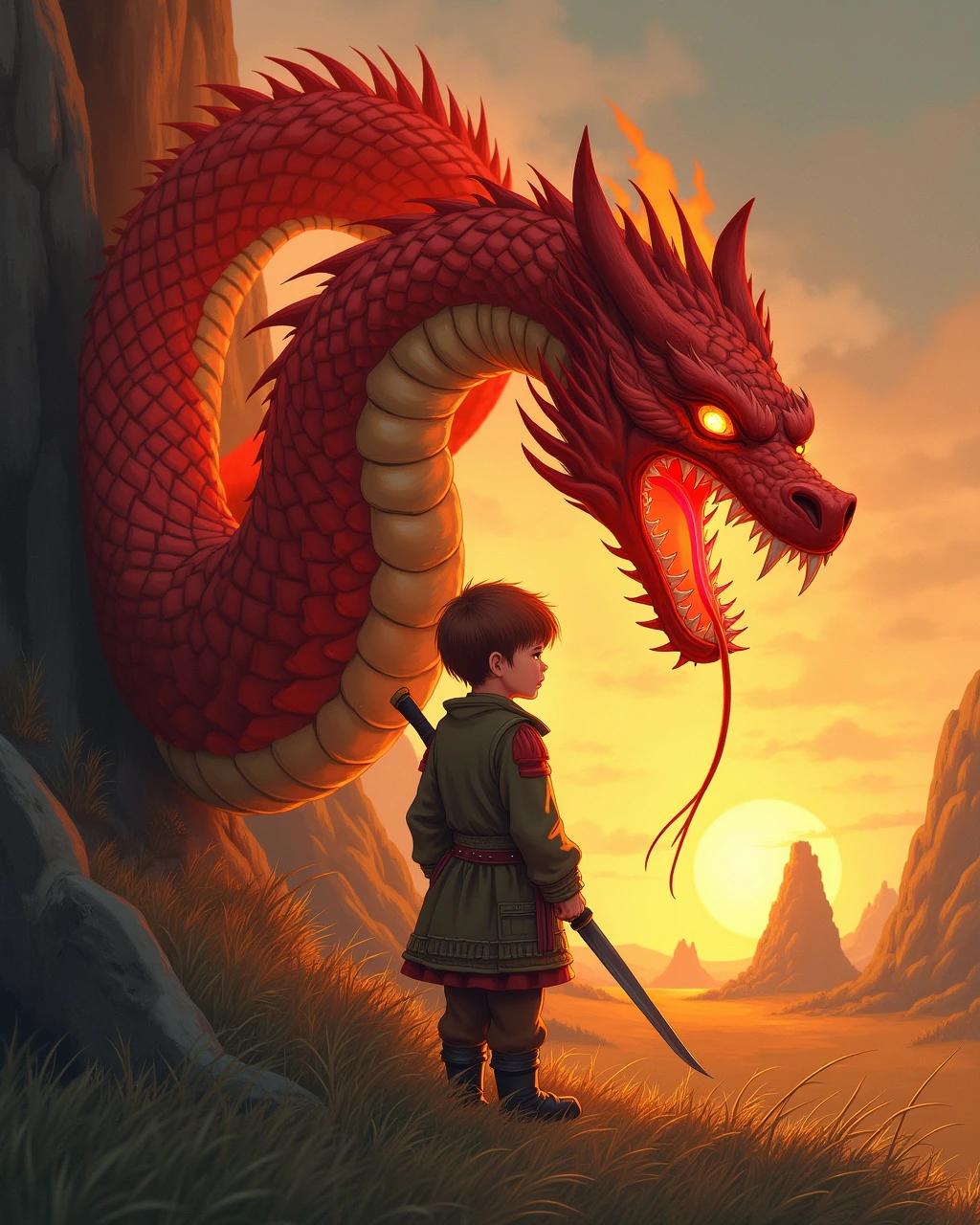
A Cossack was riding along the road and rode into a dense forest; in that forest, on a clearing, stood a haystack. The Cossack stopped to rest a little, lay down beside the haystack, and lit his pipe; he smoked and smoked and did not notice how he dropped a spark into the hay. The Cossack got on his horse and set off; he had not gone ten steps when flames burst forth and lit up the whole forest. The Cossack looked back and saw—the haystack was burning, and in the fire stood a beautiful maiden, saying in a loud voice: — Cossack, good man! Save me from death. — How can I save you? Flames all around, there is no way to reach you. — Thrust your pike into the fire, and I will climb out along it. The Cossack thrust his pike into the fire and turned away from the great heat. Immediately the beautiful maiden turned into a serpent, climbed onto the pike, slid onto the Cossack's neck, wrapped around his neck three times, and took its tail in its teeth. The Cossack was frightened; he could not think what to do or how to act. The serpent spoke in a human voice: — Do not be afraid, good fellow! Carry me on your neck for seven years and seek the tin kingdom, and when you arrive in that kingdom—stay and live there another seven years without going out. Serve this service, and you will be happy! The Cossack rode off to seek the tin kingdom. Much time passed, much water flowed; at the end of the seventh year he reached a steep mountain; on that mountain stood a tin castle, and around the castle a high white-stone wall. The Cossack galloped up the mountain, the wall parted before him, and he rode into a wide courtyard. At that very moment the serpent tore from his neck, struck the damp earth, turned into a beautiful maiden, and vanished from sight—as if she had never been. The Cossack put his good horse in the stable, entered the palace, and began to look around the rooms. Everywhere mirrors, silver, and velvet, yet nowhere could he see a single human soul. "Eh," thinks the Cossack, "where have I ridden to? Who will feed and water me? It seems I will have to die of hunger!" He had only just thought this when, lo and behold—a table stood before him covered with food, and on the table both drink and food—everything in abundance; he ate and drank and decided to go look at his horse. He comes to the stable—the horse stands in its stall eating oats. — Well, this is a good thing: I can live without want, then. Long, long the Cossack remained in the tin castle, and deadly boredom took him: it is no joke—always alone, all by himself! No one to exchange a word with. He decided to ride out into the open world; but wherever he turned—everywhere high walls, no entrance, no exit. In vexation he seized a stick, went into the palace, and began smashing the mirrors and glass, tearing the velvet, breaking chairs, hurling the silver: "Maybe the master will come out and let me free!" No, no one appears. The Cossack lay down to sleep. The next day he woke, walked about, and decided to have a bite; he looks here and there—nothing for him! "Eh," he thinks, "a slave beats herself if she reaps uncleanly! I made trouble yesterday, and now I must go hungry!" He had only just repented when immediately food and drink—everything was ready! Three days passed; the Cossack woke in the morning, looked out the window—his good horse stood by the porch, saddled. What could that mean? He washed, dressed, took his long pike, and went out into the wide courtyard. Suddenly, out of nowhere—the beautiful maiden appeared: — Greetings, good fellow! Seven years are over—you have saved me from final destruction. Know this: I am a king's daughter. Koschei the Deathless carried me off from my father and mother, wanted to take me as his wife, but I laughed at him; so he grew angry and turned me into a fierce serpent. Thank you for your long service! Now let us ride to my father; he will reward you with golden treasure and precious stones, but take nothing—ask for yourself the little barrel that stands in the cellar. — But what use is it? — Roll the barrel to the right—immediately a palace will appear; roll it to the left—the palace will vanish. — Very well, said the Cossack. He got on his horse, seated the beautiful princess beside him; the high walls parted of themselves before them, and they rode off along the road. Long or short—the Cossack arrives with the princess at the king's court. The king saw his daughter, rejoiced, began to thank him, and gives the Cossack full sacks of gold and pearls. The good fellow says: — I need neither gold nor pearls; give me for a keepsake that little barrel that stands in the cellar. — You ask for a lot, brother! Well, there is nothing to be done: my daughter is dearer to me than anything! For her sake I do not begrudge even the barrel. Take it. The Cossack took the royal gift and set off to wander the wide world. He rode and rode, and an ancient old man came to meet him. The old man begs: — Feed me, good fellow! The Cossack jumped down from his horse, untied the barrel, rolled it to the right—and at that very moment a wondrous palace appeared. They both entered the painted chambers and sat down at the set table. — Hey, my faithful servants! cried the Cossack. — Feed and give drink to my guest. He had not finished speaking when the servants brought a whole ox and three cauldrons of beer. The old man began to eat and praise; he ate the whole ox, drank three cauldrons of beer, gave a grunt, and said: — Not much, but there is nothing to be done! Thank you for bread and salt. They went out of the palace; the Cossack rolled his barrel to the left—and the palace was gone as if it had never been. — Let us trade, says the old man to the Cossack, — I will give you a sword, and you give me the barrel. — But what use is the sword? — Why, this is a self-cutting sword; just swing it—no matter how great an army, it will cut them all down! See, a forest grows there; want me to give a demonstration? The old man drew his sword, swung it, and said: — Go, self-cutting sword, chop down the dense forest! The sword flew off and began chopping the trees and laying them in fathoms; it chopped them all and flew back to its master. The Cossack did not deliberate long, gave the old man the barrel, took the self-cutting sword for himself, got on his horse, and decided to return to the king. And a mighty enemy had come up to the capital city of that king; the Cossack saw an innumerable host, swung his sword at it: — Self-cutting sword! Do me a service; chop down the enemy host. Heads flew... And not an hour had passed when the enemy force was no more. The king rode out to meet the Cossack, embraced him, kissed him, and right there decided to give the beautiful princess in marriage to him. The wedding was a rich one; at that wedding I was present, I drank mead and honey wine, it ran down my mustache but never reached my mouth.
Folk tale
The Serpent Princess
A Cossack was riding along the road and rode into a dense forest; in that forest, on a clearing, stood a haystack. The Cossack stopped to rest a little, lay down beside the haystack, and lit his pipe; he smoked and smoked and did not notice…
This text was translated with a language model. The source is listed below.