
 Verified text
Legend the Third.
P. 161.
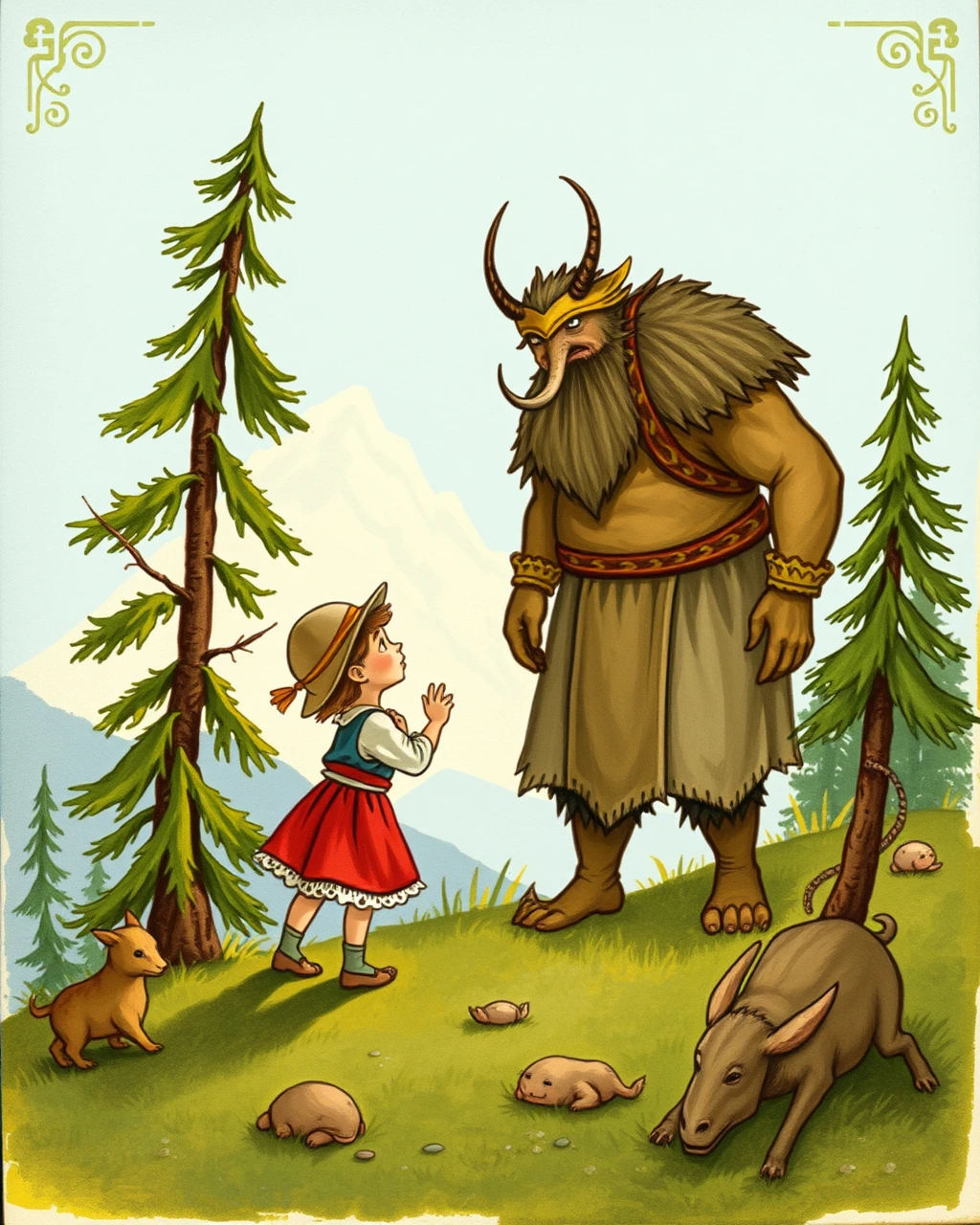
he mountain spirit has not always been so ready to make amends to those upon whom he has played off his pranks, as in the case of honest Benedix: too often he has tormented the people with whom he came in contact, simply for the amusement of doing so, never heeding whether the poor sufferer were a worthy man or a rogue. Sometimes, in the garb of a peasant, he would join himself to a solitary traveller on his way, and, pretending to direct him the shortest way, would send him ever so far out of his road; and then, perhaps, like an ignis fatuus, leading him into a morass, he would reveal himself suddenly in his proper form and vanish, amidst a peal of laughter. Another favourite trick of his was to waylay the countrymen returning from market, and suddenly to appear before them, and chace them in the form of some frightful monster, till the poor creatures were almost terrified out of their wits. However, to the credit of Rübezahl, it may be said, that he was tolerably just in his dealings, and that when he inflicted punishment it was upon those who in reality deserved it.
But there was one crime which never failed to call down the vengeance of the Giant-lord, even if the culprit was in other respects ever so innocent and praiseworthy. This crime was no other than calling the Mountain Spirit by the name of Rübezahl, and there were, of course, good reasons why he had strictly forbidden this cognomen. To have any chance, therefore, of being kindly treated by the gnome, it was necessary, above all things, to avoid this name, and to salute him respectfully as the “Lord of the Mountain.”
Tradition tells, that there was once a physician who went to gather herbs on the Riesengebirg, and who was frequently joined by Rübezahl, sometimes in one guise, sometimes in another, and was very courteously assisted by him in his botanical researches. One day he appeared as a woodcutter, and began by professing to instruct the doctor in the properties and uses of various herbs, of which the latter had never before heard. The learned physician, however, did not quite relish the idea of a poor woodcutter knowing more of these subjects than himself, and he exclaimed, with some warmth, “Sirrah, do you pretend to teach a physician the knowledge of herbs? Well, now, since you are so wise, tell me whether came first—the oak or the acorn?” “The oak,” answered the gnome, “for the fruit proceeds from the tree.” “Fool,” cried the physician, “how then came the first oak if not from an acorn, which is the germ of the tree?” “That,” replied the woodcutter, very humbly, “is a question beyond me, and which I leave to wiser heads to resolve. But let me also put a question to you. Who is the proprietor of this piece of ground where we now are? The King of Silesia or the Lord of the Mountain?” “The ground,” replied the doctor, “belongs of course to the King of Silesia. As to him you call the Lord of the Mountain, or, as I call him, Rübezahl, the Turnip Counter, there is, I assure you, no such person; he is a mere bugbear; a name to frighten children and ignorant people with, and nothing more.” Scarcely had he spoken when the form of the woodcutter rose into gigantic proportions, and the redoubtable spirit himself appeared before the astonished physician, and roared in a furious tone, “Rübezahl! scoundrel—I’ll teach thee to talk of Rübezahl;” and with this he laid hold of the unlucky doctor by the neck, shook him and beat him till life was hardly left in him, and then let him find his way home from the Giant Mountains as he best could. The poor fellow never fully recovered the effects of his drubbing, and as long as he lived he was never found botanizing again on the domains of the Lord of the Mountain.
We must give an instance, however, of the benevolent way in which the gnome could conduct himself when he chose. A countryman of Richenberg was once reduced from various causes to a state of great poverty, and even disposed of his farm and his flocks; and, to add to his distress, he had a wife and six children to support. “If we could contrive to borrow,” said he one day to his disconsolate wife, “a hundred dollars, we might purchase another farm, and thus retrieve our circumstances. You have wealthy relations on the other side of the mountains, what if I should go to them and ask them for assistance;—perhaps they may LEGENDS OF RUBEZAHL. compassionate us, and lend us the money we need, to be repaid with interest.”
The dejected wife assented to the proposal, because she knew of nothing better to be done. Whereupon Veit put a dry crust of bread into his pocket, and went his way. Worn and wearied by the heat of the day and the long journey, he reached, in the evening, the village, where the rich cousins dwelt, but none of them would acknowledge him; not one of them would receive him. With burning tears he related to them his misery; but the hard-hearted misers paid no heed to his words, and wounded the feelings of the poor man by reproaches and insulting proverbs. One said, “Young blood, spare your strength;” the second, “Pride comes before a fall;” the third, “Act well and you will fare well;” the fourth, “Every one forges his own fortune.” In this manner they scorned and mocked him; called him a spendthrift and a lazy fellow, and at last drove him out of the house, sending the house dog after him. Such a reception from the rich relations of his wife, the poor cousin had never contemplated; confounded and sad, he slunk away, and as he had nothing to pay for a lodging at the inn, he was obliged to pass the night in a field upon a hay-rick. Here he sleeplessly awaited the return of day, to begin his homeward journey.
As he again approached the mountains, grief and sorrow so overcame him that he was on the brink of despair. Two days’ wages lost, thought he to himself, languid and weakened by hunger and grief; without hope, without consolation! When you return home, and the six starving children stretch out their hands to you for bread, asking for food, when you have, instead, only a stone to offer; father-heart! father-heart! how wilt thou endure that? Break in two, poor heart, before thou feelest such anguish! Saying these words, he threw himself beneath a bush to indulge in his gloomy thoughts.
As the mind, however, at the moment of extremity, puts forth its most powerful energy, ransacking every corner of thought to find out some means of preservation, or to delay the coming evil; and as a sailor who sees his vessel fast sinking, quickly climbs the rope-ladder, seeking safety by the tall mast, or laying hold of plank or empty cask, in the hope of keeping himself afloat;—so it occurred to the unhappy Veit, in the midst of a thousand useless plans and projects, to turn for relief from his misery to the Spirit of the Mountain. He had heard many strange tales of him, how he had sometimes lured and tormented travellers, and done them much harm, yet, at the same time, how he had likewise shown kindness to others. It was well known to Veit that the spirit punished all those who called on him by his nickname; but he knew no other way of accosting him, so he therefore ventured at the risk of a cudgelling, and called out as loud as he could, “Rübezahl! Rübezahl!”
There immediately appeared at this call a form like that of a grim collier or charcoal burner, with a red beard reaching down to his waist, fiery, staring eyes, and armed with a huge cudgel like a weaver’s beam, now raised in wrath to strike the daring scorner. “Your favour, Master Rübezahl,” said Veit, quite undismayed, “pardon me if I do not give you your right title—only hear me, and then do whatever you like. This candid speech and the sorrowful appearance of the man, which betrayed neither insolence nor pertness, softened in some degree the anger of the spirit. “Earthworm,” he said, “what tempts you to disturb me? Do you not know that you must pay for your rashness with your neck and skin?” “Sir,” replied Veit, “it is trouble which compels me to this. I have a request to make, which you could easily grant. If you would lend me a hundred dollars I will repay them at the end of three years, with the usual interest, as sure as I am an honest man.” “Fool!” said the spirit, “am I a Jew, or an usurer, to lend money upon interest? Away to your brother man and borrow there what you need, but leave me in peace.” “Ah,” replied Veit, “it is all over with brotherly kindness. There is no brotherhood in mine and thine.” Upon this he related his story from the beginning, and painted his deep misery so touchingly, that the gnome could not refuse his petition. And even had the poor fellow been less deserving of compassion, there was something so novel and singular to the spirit in the idea of becoming a capitalist and lending out money, that he was inclined, for the sake of the confidence reposed in him, to grant the prayer of the man. “Come, follow me,” he said, leading him through the wood to a remote valley, and stopping at a steep rock, whose base was hid by thick bushes.
When Veit, with no small trouble, had forced his way through the thicket, by the side of his conductor, they reached the mouth of a dark cave. The good Veit was not over-well pleased to be obliged thus to grope in the dark: one cold shiver after another run through him, and his hair stood on end. He very soon, however, saw, to his great joy, a blue flame flickering in the distance; the cavern became enlarged to the size of a spacious hall, the flame burned clear, and floated as a pendant lamp in the centre of the rocky chamber. Upon the floor he espied a brewer’s copper, filled to the brim, with hard bright dollars. When Veit saw this treasure, all his fear fled, and his heart leapt for joy. “Take,” said the spirit, “what you need, be it little or be it much, only give me an acknowledgment for the sum, provided you are skilled in the art of writing.” The debtor assented, and counted out to himself, conscientiously, the hundred dollars, not one more, not one less. The spirit appeared to pay no attention to the counting out of the money, but turned himself away, and sought for his writing materials. Veit wrote the bond, and made it as binding as possible; the gnome then locked it up in an iron box, and said to Veit, on parting, “Go hence, and with diligent hand, make use of the money. Forget not that thou art my debtor, and mark well the entrance into the dell, and the cleft in the rock. As soon as three years are past, pay me back the capital with the interest. I am a stern creditor, and should you break faith, I will come in fury and demand it.” The honest Veit promised faithfully to pay on the very day, though without an oath, and without pledging his soul and happiness, as bad payers are accustomed to do, and then departed from his benefactor of the rock with a grateful heart, easily finding his way out of the cavern.
The hundred dollars had such a beneficial influence both on mind and body, that he needed no other strengthening; when he again saw the morning light, he felt as if he had inhaled the balsam of life whilst in the rocky cave. Joyful and strong he now stept towards his home, and entered the lonesome hut about nightfall; when the famishing children beheld him, they came all towards him, crying, “Bread, father! a morsel of bread! You have long let us want.” The sad mother sat weeping in a corner, fearing the worst, according to the manner of thinking of the weak and timid, and expected her husband to begin a melancholy tale. He, however, shook hands cheerily, commanded a fire to be kindled on the hearth, as he had brought groats and millet from Reichenberg in his wallet, with which the good woman was to make pottage so thick that the spoon could stand in it. Afterwards he gave her an account of the happy consequences of his journey. Your cousins, said he, are excellent people; they did not upbraid me with my poverty, did not misapprehend me, or drive me shamefully from their door; but they kindly took me in, opened to me heart and hand, and counted out to me on the table a hundred dollars in cash, as a loan. Upon this the heavy weight was taken from the heart of the poor woman, which had long oppressed her. Had we applied sooner, she said, to the right smith we might have been spared much misery. She now boasted of the relationship, of which she had never known any good before, and became quite proud of her rich cousins.