
 Verified text
Mute Love.
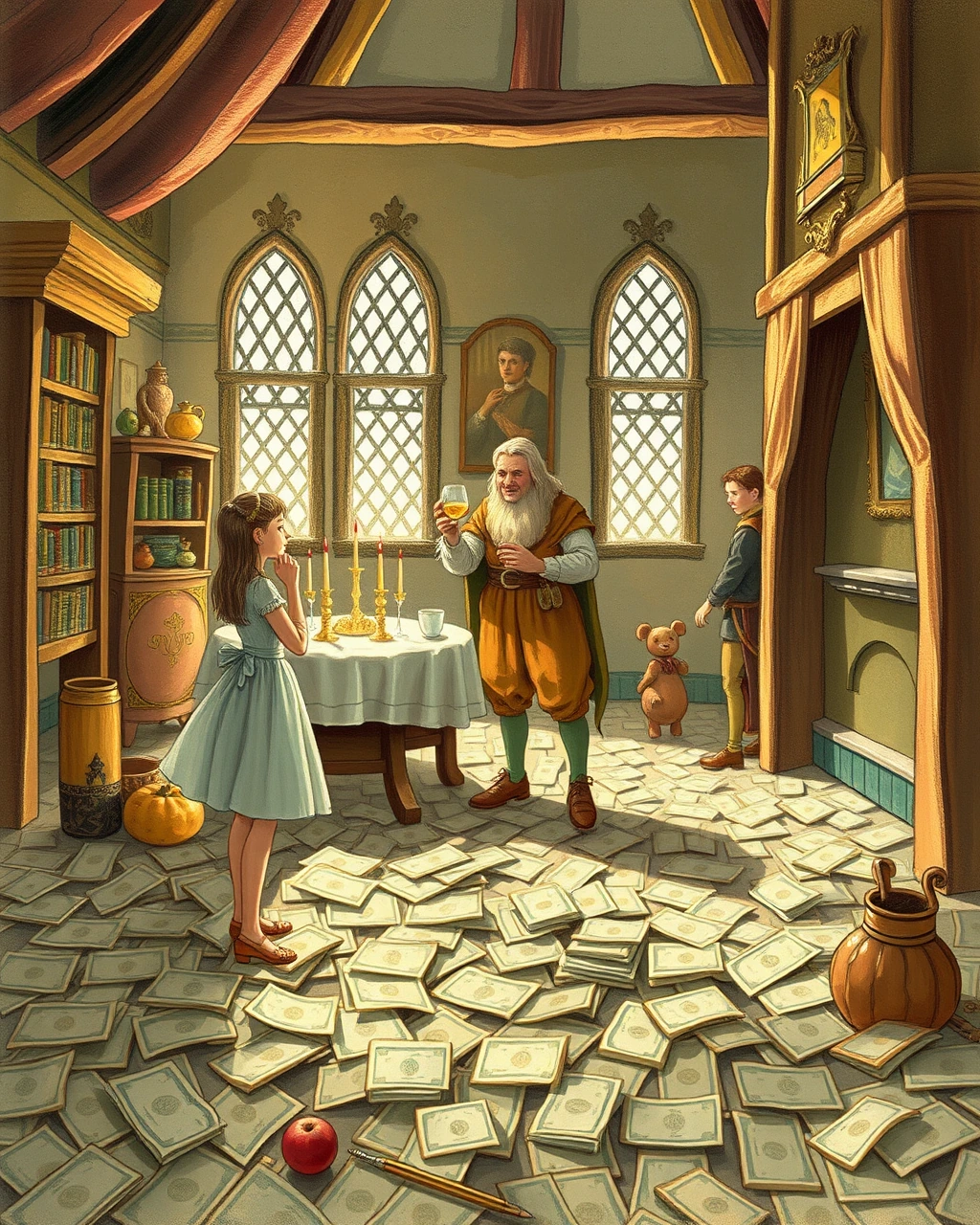
here was once a wealthy merchant, called Melchior of Bremen, who always used to stroke his chin with a kind of complacence when he heard the parable of the rich man in the Gospel read, whom, in comparison with himself, he considered but a poor shopkeeper. Such, indeed, was his wealth, that he had the floor of his banqueting-room paved with dollars; for luxury, though of a more substantial kind, was prevalent in those rude times, as well as now: and while his friends and fellow-citizens were not much pleased at such a proof of his ostentation, yet it was, in fact, intended more as a mercantile speculation than for idle display. He was sagacious enough to see that reports would go abroad of his excessive wealth, which would greatly add to his credit even among those who censured his vanity. This was exactly the case; his idle capital of old dollars, so prudently as well as ostentatiously employed, brought large returns of interest: it was a visible bond of payment which gave vigour to all the wily merchant’s undertakings. Yet, in the end, it proved the rock upon which the stability of his house was wrecked.
Melchior one day partaking rather too freely of a rich liquor at a city feast, died suddenly, without having time even to make his will. His son, however, having just attained the age of manhood, succeeded to the whole of the property. Franz was a noble-spirited youth, endowed with many excellent qualities. Health glowed on his cheek, while content and animation shone in his dark eyes. He grew like a vigorous plant, which only requires water and a hardier soil to bear noble fruit, but which shoots to waste in too luxuriant ground. The father’s prosperity, as is often the case, was unhappily the son’s ruin; for no sooner did Franz find himself possessed of so princely a fortune, than he contrived how he could best get rid of it: and instead of smiling in scorn at the rich man in the parable, he imitated his example only too closely. He feasted in the most sumptuous manner, and altogether forgot his duties in the continual round of pleasure into which he had plunged himself.
No feasts could be compared for superfluity and splendour with those he gave, nor will the good city of Bremen ever behold such substantial and magnificent proofs of hospitality, as long as it is a city, again; each citizen was presented with a fine joint of roast beef, with a flask of Spanish wine; the people drank to the health and long life of old Melchior’s son, and young Franz became the hero of the day.
In this giddy maze of delights, no wonder he never thought of a balance of accounts, then the “vade mecum” of our old merchants, but since unfortunately gone too much out of fashion. Hence the evident tendency of the modern system towards heavy losses and utter bankruptcy, as if the scale were drawn down by magnetic influence. Still the old merchant’s coffers had been so well stocked as to give his son no sort of uneasiness; hitherto his difficulty was rather how to dispose of his annual income. Open house, well-furnished tables, and throngs of parasites, loungers, &c., left our hero small time for reflection; one kind of pleasure followed another; his friends took care to provide a succession of extravagances lest he should pause, and think, and thus the prey should be snatched from their plundering grasp.
Suddenly the stream of prosperity ceased to flow; Franz found he had drained his father’s money-casks to their very lees. He ordered his steward one day to pay a large sum: he was not, however, in a condition to meet the demand, and he returned the bill. This was a severe reflection upon the young spendthrift; but he flew into a violent passion with his cashier, instead of blaming himself. He gave himself no kind of trouble to inquire into the cause; like too many thoughtless characters, he heaped reproaches upon his steward, and shrugging up his shoulders, ordered him, in very laconic style, to “find means!”
Now was the time for the old usurers and brokers of the city. They furnished Franz with means to continue his mad career, though on very exorbitant terms. In the eye of a creditor, a room well paved with dollars was then better security than bills upon an American house, or even upon the United Provinces. It served as a good palliative for a period; but it shortly got wind that the silver pavement had disappeared, and was replaced with one of stone. Judicial inquiry on the part of the creditors followed, and it was ascertained to be the fact. No one could deny that a floor of variegated marble, like mosaic, was more elegant for a banqueting-hall than one of old worn-out dollars; but the creditors, entertaining little reverence for his improved taste, one and all demanded their money. This not being paid, a commission of bankruptcy was issued against him; and forthwith an inventory was made of all the property,—the family mansion, the magazines, grounds, gardens, furniture, &c. All was then put up to auction, and Franz found himself deprived of all he possessed. He had saved a few of his mother’s jewels, however, from the general wreck, and with the help of these he contrived to prolong existence for a period, though not in a very enviable manner.
He now saw clearly through his past errors. He lamented and repented of his faults, and tried his best to resign himself to his altered lot. He took up his abode in a retired quarter of the city where the sunbeams seldom shone, except towards the longest day, when they occasionally glanced over the high-built roofs. Here he found all he looked for in his present reduced circumstances. He dined at his host’s frugal board; his fire-side was a protection against the cold; and he had a roof to shelter him from the effects of rain and wind: here, too, a new object awakened his attention and engaged his thoughts. Opposite his window, in the same narrow street, lived a respectable widow, who, in expectation of better times, gained a scanty livelihood, by means of her spinning-wheel, on which, with the assistance of a marvellously fair maiden, her only daughter, she produced every day such a quantity of yarn that it would have reached round the whole city of Bremen, ditch, walls, suburbs and all. These two spinners were not born for the wheel; they came of a good family, and had lived, at one time, in opulence and prosperity. The husband of Brigitta, and the father of young Mela, had been the owner of a merchant-vessel, which he freighted himself, and in which he made every year a voyage to Antwerp. But while Mela was yet a child, a dreadful storm buried him and his ship, with the crew and a rich cargo, in the waves.
Her mother, a sensible well-principled woman, bore the loss of her husband and of her whole property with wise composure. Notwithstanding her poverty, she refused, with a noble pride, all the offers of assistance which the compassion or benevolence of her friends and relations prompted them to make; deeming it dishonourable to receive alms, as long as she could hope to obtain the means of subsistence by the labour of her hands. She resigned her large house and its costly furniture to the hard-hearted creditors of her late husband, took her present humble dwelling, and spun from morning till night. At first this occupation appeared very irksome, and she often moistened the thread with her tears. By her industry, however, she was enabled to preserve herself independent, and to save herself from incurring unpleasant obligations; she accustomed her daughter to the same mode of life, and lived so sparingly that she even saved a small sum, which she laid out in buying lint; and, from that time, carried on a trade in that article on a small scale.
This excellent woman, woman, however, whilst doing her best in her poor circumstances, nevertheless ventured to look forward to better times, hoping one day to be restored to something of that prosperity she had been deprived of, and to enjoy, in the autumn of her life, some of that sunshine which had gladdened its spring. Nor was this hope altogether an empty dream; it sprung from rational observation. She saw her daughter’s charms unfold as she grew up, like a blooming rose, but not like it to fade and fall as soon as it is ripened into beauty. She knew her to be modest and virtuous, and gifted with such excellent qualities, that she already found in her society consolation and happiness. She therefore denied herself, sometimes, the common necessaries of life, to give her daughter the advantage of a respectable education; being convinced that, if a maiden only answered the description which Solomon has given of a good wife, such a costly pearl would be sought after, and selected as the brightest ornament an honest man could possess.
Virtue, united with beauty, were then quite as valuable in the eyes of young men, as powerful relations and a large fortune are at present. There were, likewise, a far greater number of competitors for a maiden’s hand, a wife being then considered as the most essential, and not as (according to the present refined economical theory) the most unnecessary part of the household. The beauteous Mela, it is true, bloomed more like a rare costly plant in a greenhouse, than a healthy shrub in the free air. She lived quietly, and in retirement, under her mother’s care and protection; visited neither the public walks, nor assembly-rooms, and, contrary to all the present principles of marrying policy, scarcely once in a twelvemonth went outside of her native city. Mothers, now-a-days, know better; they look upon their daughters as a capital, which must circulate to produce interest; in those times, they were kept under lock and key, like hoarded treasure; but bankers knew where it was hidden, and how to obtain it.
One day, as Franz was at the window, observing the weather, he saw the beautiful Mela returning from church, where she regularly accompanied her mother to service. In his days of prosperity, he had paid little or no attention to the other sex; the chords of his finer feelings had never yet been struck, his senses having been blunted and bewildered by the incessant intoxication of pleasure, in which his companions had kept him.