
Literary tale

The White Snake

A kind servant who gains the ability to understand animals after eating a white snake uses this gift and his compassion to overcome impossible tasks, clear his name, and win the hand of a proud princess.

PDF

The White Snake

Many years ago there lived a king who was renowned throughout his realm for his wisdom. Nothing remained unknown to him, and it seemed that news of the most secret affairs reached him of its own accord from everywhere.

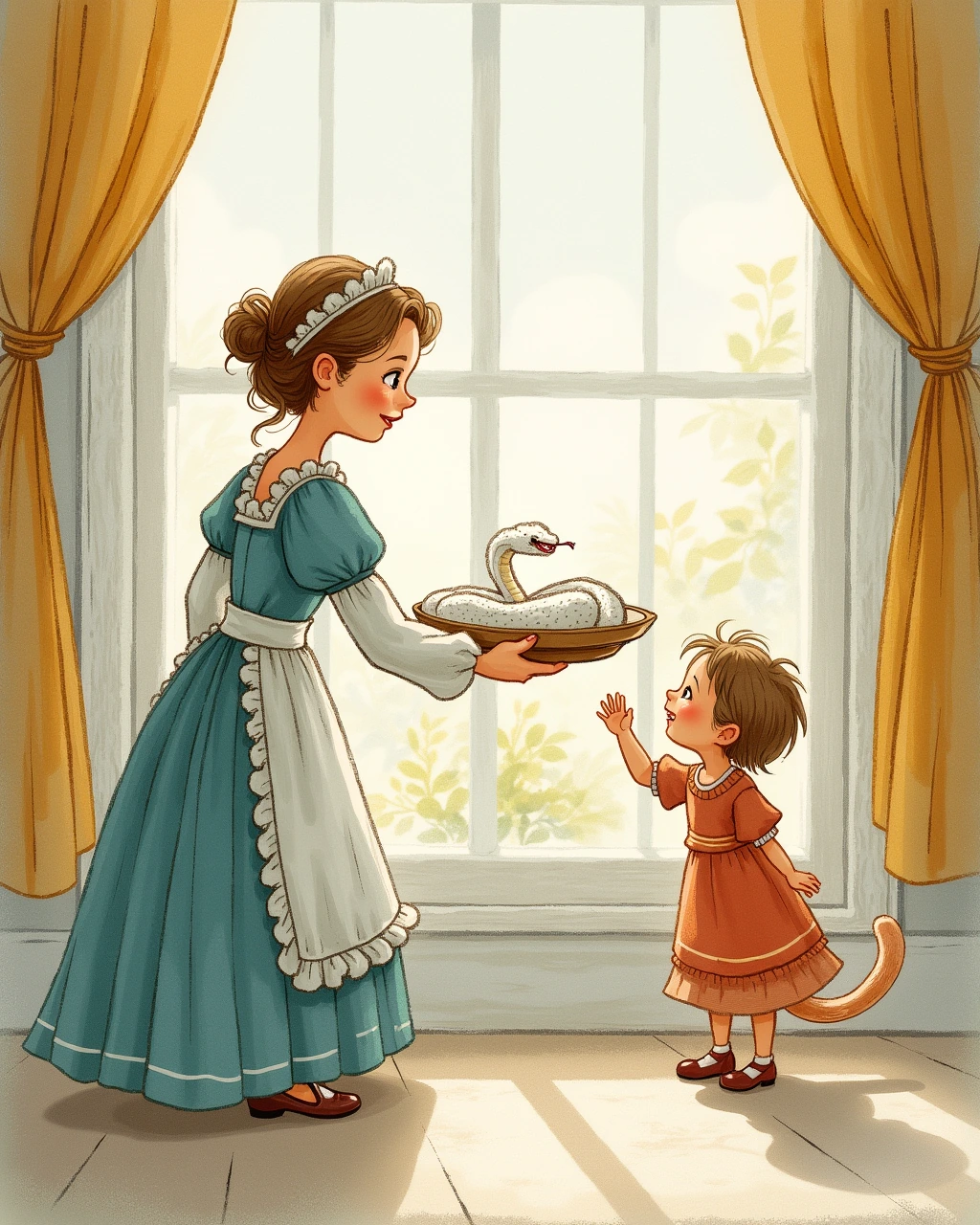
But this king had a strange custom: at every dinner, when everything had been cleared from the table and no one remained seated except himself, a trusted servant had to bring him one more dish. Yet this dish was covered, and the servant himself did not know what lay upon it, nor did anyone else know, because the king did not uncover the dish nor taste its contents until he was all alone in the room.

This went on for a long time, and it happened once that curiosity suddenly overcame the servant just as he was carrying the dish away from the king's table; it overwhelmed him so greatly that he could not resist it and took the dish to his own room.

Having carefully closed the door, he lifted the lid of the dish and saw that a white snake lay upon it. Hardly had he glanced at it when he could no longer refrain from tasting it; he cut off a piece and put it into his mouth.

And scarcely had his tongue touched this food when he heard outside the window a strange whistling of many tiny voices.

He went to the window and began to listen, and then he realized that these were sparrows talking among themselves and telling each other about everything they had seen in the fields and in the forest.

By tasting the flesh of the white snake, the servant had gained the ability to understand the language of animals.

Now it happened that on that very same day the queen lost her most precious ring, and suspicion of the theft fell precisely upon the trusted servant, who had access everywhere.

The king summoned him, began to scold him and shout at him, and threatened that if by the next day he did not name the culprit responsible for the loss, he himself would be accused of it and brought to trial. In vain the servant assured him that he was innocent—the king did not revoke his decision.

In anxiety and fear the servant went down into the castle courtyard and began to ponder how he might extricate himself from his predicament. Nearby, ducks sat quietly by running water, resting, now preening themselves, now smoothing their feathers with their broad bills; meanwhile they carried on an open conversation among themselves. The servant paused and listened.

They were recounting to one another where they had been that day and where they had found good fodder; and one of them said with vexation: "Something feels heavy in my stomach; in my haste I swallowed a ring that lay beneath the queen's window."

Then the servant immediately seized her by the neck, dragged her to the kitchen, and said to the cook: "Slaughter this one; she has fattened up enough."—"Yes," said the cook, weighing the duck in his hand, "this one has spared no effort to fatten herself: she ought to have been on the spit long ago." He cut her throat, and when he began to gut her, the queen's ring was found inside her.

After this it was not difficult for the servant to prove his innocence, and since the king wished to make amends for his injustice, he allowed him to request whatever reward he desired and promised to grant him any position, however honorable, at his court that he might wish for. The servant declined everything and asked only for a horse and some money for the road, because he wanted to see the wide world and wander about.

When his request was granted, he immediately prepared for the journey and set out into the wide world.

During these wanderings it happened to him once that he was passing by a pond, and he saw in that pond three fish which had become entangled in the reeds and were struggling there out of water. Although people say that fish are mute, nevertheless the servant clearly heard their lament that they were destined to perish so miserably.

The youth's heart was compassionate—he dismounted from his horse and released all three fish from the reeds into the water. They splashed about joyfully, raised their heads out of the water, and cried to him: "We shall remember this and repay you for the help you have shown us!"

He rode on, and a little while later it seemed to him that he heard a voice at his feet, in the sand. The youth began to listen and made out how the ant-king complained: "If only we could somehow get rid of these people and their clumsy animals! Just take this stupid horse—it tramples my ants with its heavy hooves without any mercy." The youth immediately turned off the road onto a side path, and the ant-king called after him: "We shall remember this and will not remain in your debt."

The road led him to a forest, and in that forest he saw an old raven and a raveness who were throwing their chicks out of the nest, saying: "Away from here, worthless ones! We can no longer feed you sufficiently. You have grown enough—you can surely feed yourselves now." The poor little chicks lay sprawled on the ground, fluttering, flapping their wings, and crying: "Wretched and helpless we are! How can we sustain ourselves when we do not yet know how to fly? Only one thing remains for us—to starve to death here." Then the kind youth dismounted from his horse, stabbed it with his sword, and tossed its carcass to the young ravens for food. They flew upon the carcass, satisfied themselves, and cried after him: "We shall remember this and will not remain in your debt!"

The good fellow continued on foot; he walked and walked until he came to a large city.

In that city the streets were noisy, and people crowded everywhere in throngs, and someone rode through the streets on horseback proclaiming that the princess was seeking a husband, and whoever wished to woo her must accomplish a difficult task, but if he failed to accomplish it, he must pay for it with his life. Many, they said, had already attempted to accomplish that task, yet had only lost their lives in vain.

But the youth, upon seeing the princess, was so blinded by her beauty that he forgot all dangers, appeared before the king, and declared his desire—to woo the princess.

So they led him to the sea and cast a golden ring into the waves in his presence. Then the king ordered him to retrieve that ring from the sea floor, adding to his command: "If you dive for it and surface without the ring, you will be thrown into the water again and again until you perish in the waves."

Everyone pitied the handsome youth and left him alone on the seashore. And he stood there on the shore, pondering what to do; suddenly he saw three fish rise from the sea floor, and those were the very fish whose lives he had saved. The middle one held a shell in its mouth, which it placed on the shore at the youth's feet; and when he picked up the shell and opened it, the golden ring was found inside.

The youth rejoiced, brought the ring to the king, and expected that the king would grant him the promised reward. But the proud princess, learning that he was not her equal by birth, turned away from him with contempt and demanded that he accomplish yet another task.

She went down into the garden and herself scattered there ten full sacks of millet. "By sunrise tomorrow," she said, "he must gather up all this millet, and in such a way that not a single grain is lost."

The youth sat in the garden under a tree and began to think how he might accomplish this task; yet he could devise nothing and grew sorrowful, expecting that at sunrise he would be led to execution.

But when the first rays of the sun fell into the garden, he saw that all ten sacks stood before him, filled to the brim, down to the last grain! The ant-king had come during the night with his thousands of ants, and the grateful insects had labored with great diligence to gather the millet and poured it into the sacks.

The princess herself went down into the garden and with amazement saw that the youth had accomplished the difficult task. Yet she still could not overcome her proud heart and said: "Although he has accomplished both tasks assigned to him, nevertheless he shall not become my spouse until he brings me an apple from the tree of life."

The youth did not even know where this tree of life grew, yet he prepared for the journey and resolved to travel across the wide world as long as his swift legs would carry him. But he did not hope to find this tree.

So he went and had already passed through three kingdoms when one evening he came to a forest, sat under a tree, and was about to fall asleep; suddenly he heard a rustling and whispering in the branches, and a golden apple fell straight into his hand. At that very moment three ravens flew down from the tree, settled upon his knee, and said: "We are those very three young ravens whom you saved from starving to death. When we grew up and heard that you were seeking an apple from the tree of life, then

"We flew across the sea, to the very edge of the world, where the tree of life grows—and here we have brought you this apple from there."

The goodly youth rejoiced, returned to the beautiful princess, and presented her with the golden apple. Then she had no more excuses left.

They divided the apple from the tree of life and ate it together; and her heart was filled with love for the young man, and in unbreakable happiness they lived until deep old age.