
Literary tale

Road Companion

A kind and impoverished young man named Johannes embarks on a journey after his father's death, befriends a mysterious stranger who is actually the spirit of a corpse he protected, and with this helper's aid, defeats an evil troll to break the curse on a wicked princess, ultimately marrying her and ruling a kingdom.

PDF

Road Companion

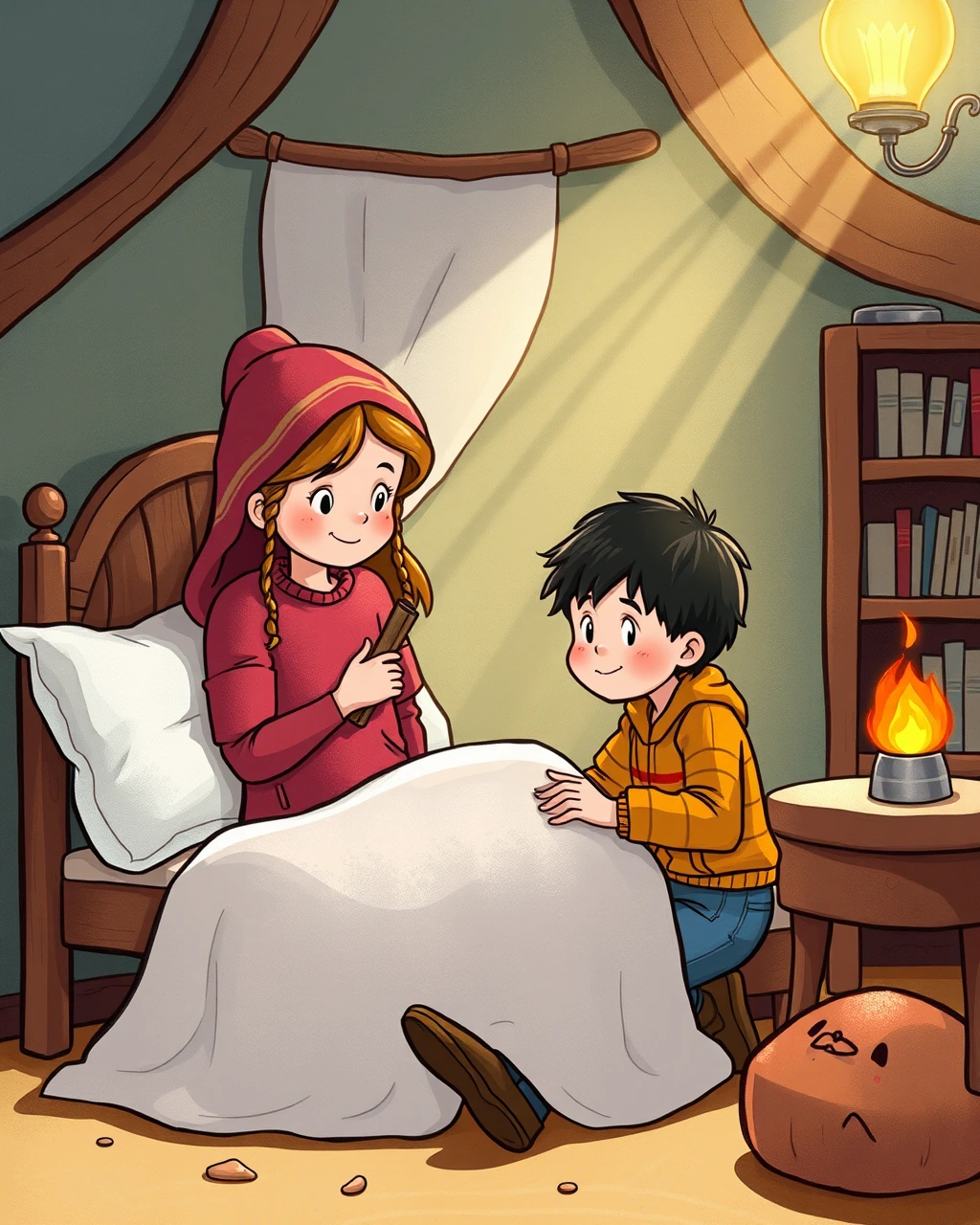
Poor Johannes was in great sorrow: his father lay at death's door. They were alone in their little room; the lamp on the table was burning low; night was approaching.

"You have been a good son to me, Johannes!" said the sick man. "God will not forsake you with His mercy!"

And he looked kindly yet seriously at Johannes, drew a deep breath, and died, as if falling asleep. Johannes wept. Now he remained completely orphaned: no father, no mother, no sisters, no brothers! Poor Johannes! Long he knelt before the bed and kissed the hands of the deceased, flooding them with bitter tears, but then his eyes closed, his head sank onto the edge of the bed, and he fell asleep.

And he dreamed a wonderful dream.

He saw the sun and moon bowing before him, saw his father again fresh and vigorous, heard his laughter, just as he always laughed when especially cheerful; a lovely girl with a golden crown upon her marvelous long hair stretched out her hand to Johannes, while his father said, "See what a bride you have? The most beautiful girl in the world!"

Then Johannes woke up, and farewell to all that splendor! His father lay dead and cold, and Johannes had no one! Poor Johannes!

A week later they buried the deceased; Johannes walked behind the coffin. He would never see again his father, who had loved him so much! Johannes heard the earth striking against the lid of the coffin, saw how the grave was filled in: now only one edge was visible, another handful of earth—and the coffin disappeared entirely. Johannes's heart nearly burst from grief. Psalms were sung over the grave; the wonderful singing moved Johannes to tears, he wept, and his soul felt lighter. The sun shone so warmly upon the green trees, as if saying, "Do not grieve, Johannes! Look at the beautiful blue sky—there your father prays for you!"

"I shall live a good life!" said Johannes. "And then I too shall go to heaven to my father. What joy it will be when we meet again! How many stories I shall have to tell! And he will show me all the wonders and beauty of heaven and teach me again, just as he used to teach me here on earth. What joy it will be!"

And he imagined all this so vividly that he even smiled through his tears. The little birds sitting on the branches of the chestnut trees chirped and sang loudly; they were happy, although they had just attended a burial, but they knew that the deceased was now in heaven, that he had grown wings far more beautiful and larger than theirs, and that he was perfectly happy, since he had lived a good life here on earth.

Johannes saw how the little birds fluttered up from the green trees and soared high, high into the sky, and he himself wished to fly away somewhere far off. But first he had to place a wooden cross upon his father's grave. In the evening he brought the cross and saw that the grave was entirely covered with sand and adorned with flowers,—this had been cared for by strangers who had greatly loved his kind father.

Early the next morning Johannes tied all his belongings into a small bundle, hid in his belt his entire capital inherited from his father,—fifty thalers and several silver coins,—and was ready to set out on his journey. But first he went to the cemetery, to his father's grave, recited over it the Lord's Prayer, and said:

"Farewell, Father! I shall try always to be good, and you pray for me in heaven!"

Then Johannes turned toward the fields. In the fields grew many fresh, beautiful flowers; they warmed themselves in the sun and nodded their heads in the wind, as if saying, "Welcome! Is it not wonderful here?" Johannes turned once more to look at the old church where he had been baptized as a child and where he used to go on Sundays with his kind father to sing psalms. High, high up, at the very top of the bell tower, in one of the round windows, Johannes saw a tiny house spirit in a red pointed cap, standing with his right hand shielding his eyes from the sun. Johannes bowed to him, and the tiny house spirit waved his red cap high in reply, pressed his hand to his heart, and blew Johannes several air kisses—so fervently did he wish Johannes a happy journey and all good things!

Johannes began thinking about the wonders awaiting him in this vast, beautiful world and walked briskly forward, farther and farther, to places where he had never been before; now came foreign cities, unfamiliar faces,—he had wandered far, far away from his homeland.

The first night he had to spend in the field, in a haystack,—there was nowhere else to find a bed. "Well, what of it," he thought, "even the king himself could not find a better bedroom!" Indeed, a field with a brook, a haystack, and the blue sky overhead—what more could one ask for a bedroom? Instead of a carpet—green grass with red and white flowers; instead of bouquets in vases—bushes of elder and wild rose; instead of a washbasin—a brook with crystal-clear fresh water, overgrown with reeds that bowed kindly to Johannes and wished him both a good night and a good morning. High above the blue ceiling hung an enormous night-lamp—the moon; this lamp would certainly not set the curtains on fire! And Johannes could fall asleep quite peacefully. So he did, sleeping soundly all night and waking only early in the morning, when the sun already shone brightly and the birds sang:

"Good morning! Good morning! Are you not up yet?"

The bells called people to church; it was Sunday; the folk went to hear the priest; Johannes went with them, sang a psalm, listened to God's word, and it seemed to him as though he were in his own church, where he had been baptized and where he used to go with his father to sing psalms.

In the churchyard there were many graves, completely overgrown with weeds. Johannes remembered his father's grave, which in time might take on the same appearance,—for there was no one left to care for it! He sat down on the ground and began pulling up the weeds, straightened the leaning crosses, and replaced the wreaths torn off by the wind, thinking meanwhile, "Perhaps someone will do the same at my father's grave."

At the cemetery gate stood an old crippled beggar; Johannes gave him all his small silver coins and cheerfully continued onward across the wide world.

By evening a thunderstorm gathered; Johannes hurried to find shelter for the night, but soon complete darkness fell, and he managed to reach only a small chapel, standing alone on a roadside hill; fortunately, the door was unlocked, and he entered to wait out the bad weather.

"Here I shall sit in a corner!" said Johannes. "I am very tired and need to rest."

And he lowered himself onto the floor, folded his hands, recited the evening prayer and whatever others he knew, then fell asleep and slept peacefully while lightning flashed and thunder roared in the fields.

When Johannes awoke, the storm had passed, and the moon shone directly through the windows. In the middle of the chapel stood an open coffin with a corpse not yet buried. Johannes was not frightened at all,—his conscience was clear, and he knew well that the dead do harm to no one, unlike wicked living people. Two such men were standing precisely beside the dead man, who had been placed in the chapel awaiting burial. They intended to insult the poor deceased—to throw him out of the coffin onto the threshold.

"Why are you doing this?" Johannes asked them. "This is very wrong and sinful! Let him rest in peace!"

"Nonsense!" said the wicked men. "He cheated us! He took our money, did not repay it, and died! Now we shall get not a penny from him; so let us at least take revenge on him—let him lie like a dog outside the door!"

"I have only fifty thalers," said Johannes, "that is my entire inheritance, but I willingly give it to you if you promise to leave the poor deceased in peace! I can manage without money; I have a pair of healthy hands, and God will not forsake me!"

"Well," said the wicked men, "if you pay us for him, we shall do him no harm, rest assured!"

And they took Johannes's money, mocked his simplicity, and went their way, while Johannes carefully arranged the corpse in the coffin, crossed its hands, bid it farewell, and with a joyful heart set out again on his journey.

He had to pass through a forest; among the trees illuminated by moonlight, lovely little elves frolicked; they were not at all afraid of Johannes; they knew well that he was a good, innocent person, for only wicked people cannot see elves. Some of the little ones were no bigger than a pinky finger and combed their long blond hair with golden combs, others swung upon large drops of dew lying on leaves and blades of grass; sometimes

A drop rolled down, and with it the elves, straight into the thick grass, and then among the other little ones such laughter and frolicking arose! It was terribly amusing! They sang, and Johannes learned all the pretty songs he had sung as a child. Large colorful spiders with silver crowns on their heads had to sling hanging bridges from bush to bush for the elves and weave entire palaces which, if a dewdrop fell upon them, sparkled in the moonlight like pure crystal. But then the sun rose, the little elves climbed into the cups of flowers, and the wind caught up their bridges and palaces and carried them through the air just like simple gossamer threads.

Johannes had already left the forest when suddenly behind him a resonant man's voice rang out:

"Hey, comrade, where are you heading?"

"Wherever my eyes lead!" said Johannes. "I have neither father nor mother; I am a complete orphan, but God will not abandon me!"

"I too am wandering across the wide world wherever my eyes lead," said the stranger. "Shall we go together?"

"Let us go!" said Johannes, and they walked on together.

Soon they grew very fond of each other: both were fine people. But Johannes noticed that the stranger was much cleverer than he, had traveled almost all over the world, and knew how to tell stories about everything.

The sun was already high when they sat down under a large tree to eat. And there appeared a decrepit old woman, entirely bent over, with a staff in her hand; on her back was a bundle of brushwood, and from her highly tucked-up apron hung three large bunches of fern and willow twigs. When the old woman drew level with Johannes and his companion, she suddenly slipped, fell, and cried out loudly: the poor thing had broken her leg.

Johannes immediately offered his companion to carry the old woman home, but the stranger opened his knapsack, took out a small jar, and told the old woman that he had an ointment which would heal her at once, and she would go home as if nothing had happened. But for this she must give him those three bunches which she had in her apron.

"That is good payment!" said the old woman, shaking her head strangely. She did not wish to part with her twigs, but lying with a broken leg was also unpleasant, so she gave him the twigs, and he immediately smeared her leg with the ointment; one, two—and the old woman jumped up and walked faster than before. What an ointment that was! You could not get such a thing in any pharmacy!

"What do you need those twigs for?" asked Johannes of his companion.

"And why not bouquets?" said the other. "I liked them very much: I am indeed an odd fellow!"

Then they walked another good distance.

"Look how it is becoming overcast," said Johannes, pointing ahead with his finger. "What clouds!"

"No," said his companion, "those are not clouds, but mountains, high mountains by which one can reach the very clouds. Ah, how wonderful it is there! Tomorrow we shall be far, far away!"

The mountains were not at all as near as they seemed: Johannes and his companion walked the whole day before they reached the place where the dark forests began, climbing almost to the sky itself, and where lay stone masses as large as a city; to climb the mountains was no joke, and therefore Johannes and his companion went into an inn situated below to rest and gather strength.

On the ground floor, in the beer hall, many people had gathered: the puppet-master had set up his little theater there in the middle of the room, and the people sat before it in a semicircle to enjoy the performance. In front of everyone, in the very best seat, sat a fat butcher with a huge bulldog. Oh, how fiercely the bulldog looked! It too sat on the floor and stared at the performance.

The performance began and went splendidly: upon a velvet throne sat the king and queen with golden crowns on their heads and dresses with long—very long trains—their means allowed them such luxury. At all the entrances stood most wonderful wooden dolls with glass eyes and large mustaches, opening the doors to air the rooms. In short, the performance was marvelous and not at all sad; but then the queen rose, and hardly had she taken a few steps when goodness knows what happened to the bulldog: its master was not holding it; it leaped straight onto the stage, seized the queen by her slender waist with its teeth and—crack!—bit her in half. What horror that was!

The poor puppet-master was terribly frightened and distressed for the poor queen: she was the most beautiful of all his dolls, and suddenly the nasty bulldog had bitten off her head! But then the crowd dispersed, and Johannes's companion said he would mend the queen, took out the jar with the same ointment with which he had smeared the old woman's broken leg, and anointed the doll; the doll immediately became whole again and moreover began to move all its limbs by itself, so that it no longer needed to be pulled by strings; it turned out that the doll was quite like a living being, only it could not speak. The puppet-master was very pleased with this: now he did not need to manage the queen; she could dance by herself, unlike the other dolls!

At night, when all the people in the inn had gone to bed, someone suddenly began to sigh so deeply and drawn-out that everyone got up to see what had happened and to whom, and the puppet-master approached his little theater,—the sighs came from there. All the wooden dolls, both the king and the bodyguards, lay mixed together, sighing deeply and staring with their glass eyes; they too wished to be anointed with the ointment like the queen,—then they too could move by themselves! The queen knelt down and held out her golden crown, as if saying: "Take it, only anoint my spouse and my courtiers!" The poor fellow could not restrain his tears, so much did he pity his dolls; he went to Johannes's companion and promised to give him all the money he would collect from the evening performance if he would anoint four or five of his best dolls with the ointment. Johannes's companion said he would take no money, but let the master give him the great saber which hung at his side. Having received it, he anointed six dolls, which immediately began to dance, and so merrily that, watching them, all the living, real girls began to dance too; the coachman danced, and the cook, and the footmen, and the maids, all the guests, and even the poker and the tongs; well, those two stretched out flat from their very first leap. Yes, it was a merry night!

The next morning Johannes and his companion left the inn, climbed the high mountains, and entered the boundless pine forests. The travelers finally ascended so high that the church steeples below seemed to them like little red berries in the greenery, and wherever one looked, one could see for several miles around. Johannes had never seen such beauty; the warm sun shone brightly from the blue transparent sky, the sounds of hunting horns echoed in the mountains, everywhere was such bliss that tears of joy started to Johannes's eyes, and he could not help exclaiming:

"My God! How I would kiss you for being so kind and creating for us this entire wonderful world!"

Johannes's companion also stood with his arms crossed over his chest, looking at the forests and cities illuminated by the sun. At that moment a wonderful singing sounded above their heads; they raised their heads—a large, beautiful white swan was floating in the air and singing as no bird ever sings; but its voice grew weaker and weaker, it bowed its head and gently, gently descended to the ground: the beautiful bird lay dead at the feet of Johannes and his companion!

"What wonderful wings!" said Johannes's companion. "So large and white, they are priceless! They may be useful to us! See, it was well that I took the saber with me!"

And with one blow he cut off both wings of the swan.

Then they walked many, many miles more across the mountains and finally saw before them a large city with hundreds of towers which glittered in the sun like silver; in the middle of the city stood a magnificent marble palace with a roof of pure gold; here lived the king.

Johannes and his companion did not wish to go immediately to inspect the city, but stopped at an inn to clean themselves a little from the journey and dress up before appearing in the streets. The innkeeper told them that the king was a very kind man and would never do anyone any harm, but that his daughter was wicked—extremely wicked. Of course, she was the first beauty in the world, but what good was that if she was at the same time an evil witch, because of whom so many handsome princes had perished. The fact was that everyone—and

To the prince and to the beggar alike, it was permitted to woo her: the suitor had only to guess three things that the princess thought of; if he guessed them, she would marry him, and upon her father's death, he would become king over the whole land; if not, he faced execution. Such a vile beauty was this princess! The old king, her father, grieved deeply about this but could do nothing with her, and once and for all refused to deal with her suitors—let her manage them herself as she wished. And so suitor after suitor appeared; they were made to guess, and for failure they were executed—let them not meddle, for they had been warned beforehand!

The old king, however, grieved so much that once a year he spent an entire day on his knees in church, he along with all his soldiers, praying to God that the princess might become kinder, but she wanted to know nothing of it. Old women who loved to drink dyed their vodka black—how else could they express their sorrow?

"The wicked princess!" said Johannes. "She ought to be whipped. If I were the king-father, I would give her a good lesson!"

At that very moment, the people in the street shouted "hurrah." The princess was passing by; indeed, she was so beautiful that everyone forgot how evil she was and shouted "hurrah" to her. The princess was surrounded by twelve beauties on black horses; all wore white silk dresses and held golden tulips in their hands. The princess herself rode a horse white as snow; all the tack was sprinkled with diamonds and rubies; her dress was of pure gold, and the riding crop in her hand sparkled like a sunbeam; on the beauty's head shone a crown seemingly made of real little stars, and over her shoulders was thrown a cloak sewn from a hundred thousand transparent dragonfly wings, yet the princess herself was still more beautiful than all her attire.

Johannes looked at her, blushed red as a poppy, and could not utter a word: she was the spitting image of the girl in the golden crown he had seen in his dream on the night of his father's death. Ah, she was so beautiful that Johannes could not help loving her. "It cannot be," he said to himself, "that she is truly such a witch and orders people hanged and executed if they fail to guess what she has thought. Everyone is allowed to woo her, even the lowest beggar; then I too shall go to the palace! One cannot escape fate, it seems!"

Everyone tried to dissuade him, for the same thing would happen to him as to the others. Johannes's traveling companion decided that, God willing, all would go well; he cleaned his boots and coat, washed himself, combed his beautiful blond hair, and went all alone into the town, and then to the palace.

"Come in!" said the old king when Johannes knocked at the door. Johannes opened the door, and the old king met him dressed in a dressing gown; on his feet were embroidered slippers, on his head a crown, in one hand a scepter, in the other an orb.

"Wait!" he said, taking the orb under his arm to offer Johannes his hand.

But as soon as he heard that before him stood a new suitor, he began to weep, dropped both scepter and orb from his hands, and started wiping his tears with the skirts of his dressing gown. Poor little old king!

"Better not even try!" he said. "The same will happen to you as to all the rest! Just look!"

And he led Johannes into the princess's garden. Brr... what horror! On every tree hung three or four princes who had once wooed the princess but failed to guess what she had thought. Whenever a breeze blew, the bones clattered loudly against one another, frightening the birds, who dared not even peek into this garden. Human bones served as stakes for flowers, and skulls with bared teeth stuck out of flowerpots—such was the princess's garden!

"You see!" said the old king. "The same will happen to you as to them! Better not try! You distress me terribly; I take this so much to heart!"

Johannes kissed the good king's hand and said that he would try nevertheless, for he had fallen so deeply in love with the beautiful princess.

Just then the princess arrived in the courtyard with her ladies, and the king and Johannes went out to greet her. She was indeed lovely; she extended her hand to Johannes, and he loved her even more than before. No, certainly she could not be such an evil, vile witch as people said.

They went into the hall, and little pages began serving them jam and honey cakes, but the old king was so sorrowful that he could eat nothing, and besides, the cakes were too hard for his teeth!

It was decided that Johannes should come to the palace the next morning, and that the judges and the entire council would assemble to hear him make his guesses. If he succeeded the first time, he would come two more times; but no one had yet managed to guess even once, and all paid with their heads on the very first attempt.

Johannes was not at all troubled by thoughts of what would become of him; he was very cheerful, thinking only of the lovely princess and firmly believing that God would not abandon him without help; how God would help him, Johannes did not know, nor did he wish to think about it, but walked along the road, skipping happily, until finally he returned to the inn where his companion awaited him.

But Johannes's traveling companion shook his head sadly and said:

"I love you so much; we could have spent many happy days together, and suddenly I must lose you! My poor friend, I am ready to weep, but I do not wish to distress you: today may be the last day we spend together! Let us at least enjoy ourselves today! I shall have time enough to weep tomorrow, when you go to the palace!"

Soon the whole town learned that the princess had a new suitor, and everyone became terribly sorrowful. The theater closed, the sweet-sellers tied black crape around their sugar pigs, and the king and the priests gathered in church and prayed to God on their knees. Grief was universal: for the same thing must happen to Johannes as to the other suitors.

In the evening, Johannes's companion prepared punch and invited Johannes to cheer up properly and drink to the princess's health. Johannes drank two glasses, and he felt terribly sleepy; his eyes closed of their own accord, and he fell into a deep sleep. His companion lifted him from the chair and laid him in bed, and then, waiting until night, took two large wings which he had cut from a dead swan, fastened them to his shoulders, put into his pocket the largest bundle of birch rods he had received from the old woman who broke her leg, opened the window, and flew straight to the palace. There he sat in a corner beneath the window of the princess's bedroom and waited.

In the town it was quiet, quiet; then three quarters past eleven struck, the window flew open, and out flew the princess in a long white cloak, with great black wings on her back. She headed straight for the high mountain, but Johannes's traveling companion became invisible and flew after her, whipping her with the rods until blood flowed. Brr... what a flight! Her cloak billowed in the wind like a sail, and the moon shone through it.

"What hail! What hail!" cried the princess at every stroke of the rods, and serve her right.

At last she reached the mountain and knocked. Then, as if thunder rolled, the mountain split apart; the princess entered, and after her came Johannes's companion—for he had become invisible, no one saw him. They passed through a very, very long corridor with walls that shimmered strangely; thousands of fiery spiders ran across them, burning like embers. Then the princess and her invisible companion entered a great hall of silver and gold; on the walls bloomed large red and blue flowers resembling sunflowers, but God forbid anyone to pick them! Their stems were loathsome poisonous snakes, and the flowers themselves were flames issuing from their mouths. The ceiling was studded with fireflies and bluish bats, which incessantly flapped their delicate wings; it was an astonishing sight! In the middle of the hall stood a throne supported on four horse skeletons instead of legs; the harness on the horses was made of fiery spiders, the throne itself of milky-white glass, and the cushions upon it of little black mice biting each other's tails with their teeth. Above the throne hung a canopy of bright-red spiderweb, sprinkled with pretty green flies that sparkled no less than precious gems. Upon the throne sat an old troll; his ugly head was crowned with a crown, and in his hands he held a scepter. The troll kissed the princess on the forehead and seated her beside him on

precious throne. Music began to play; large black grasshoppers played on mouth organs, and the owl beat its wings against its belly—it had no other drum. What a concert it was! Little gnomes, with will-o'-the-wisps on their caps, danced about the hall. No one saw Johannes's traveling companion, yet he stood behind the throne and saw and heard everything!

There were many splendid and important courtiers in the hall; but anyone with eyes would have noticed that these courtiers were nothing more nor less than simple sticks with cabbages for heads—the troll had brought them to life and dressed them in garments embroidered with gold; however, what does it matter if they served only for parade!

When the dancing ended, the princess told the troll about her new suitor and asked what she should guess the next morning when he came to the palace.

"Here is what," said the troll, "we must choose something very simple, something that would never occur to him. Think, for example, of your shoe. He will never guess it! Then order his head to be cut off, but do not forget to bring me his eyes tomorrow night; I shall eat them!"

The princess bowed low and said she would not forget. Then the troll opened the mountain, and the princess flew home, while Johannes's companion flew after her again and whipped her so hard with rods that she groaned and complained of a heavy hailstorm, hastening with all her might to reach the window of her bedroom. Johannes's traveling companion flew back to the inn; Johannes was still asleep; his companion untied his wings and also lay down to bed—indeed, he was quite tired!

As soon as dawn broke, Johannes was already up; his traveling companion rose too and told him that during the night he had seen a strange dream—as though the princess had thought of her shoe—and therefore begged Johannes to name the shoe to the princess without fail. He had indeed heard it in the mountain from the troll, but had not wished to tell Johannes anything.

"Well, it is all the same to me what I name!" said Johannes. "Perhaps your dream will come true: I have always thought that God would help me! But I shall still bid you farewell—if I do not guess correctly, we shall never see each other again."

They kissed, and Johannes set off for the palace. The hall was packed full of people; the judges sat in armchairs, leaning their heads against pillows of eiderdown—for they had so much thinking to do! The old king stood wiping his eyes with a white handkerchief. But then the princess entered; she was even more beautiful than yesterday, bowed gracefully to everyone, and gave her hand to Johannes, saying:

"Well, greetings!"

Now it was time to guess what she had thought of. Good heavens, how kindly she looked at Johannes! But as soon as he uttered the word "shoe," she turned white as chalk and trembled all over. There was nothing to be done—Johannes had guessed correctly.

Ah me! The old king even turned a somersault for joy, and everyone dropped their jaws! And they began clapping for the king, and for Johannes too—for having guessed correctly.

Johannes's companion positively glowed with pleasure when he learned how well everything had turned out, while Johannes folded his hands devoutly and thanked God, hoping He would help him in the trials to come. For the next day he would have to return again.

The evening passed just as the previous one had. When Johannes fell asleep, his companion once more flew after the princess and whipped her even harder than the first time, since he had taken two bundles of rods with him; no one saw him, and he again overheard the troll's advice. This time the princess was to think of her glove, which the companion then conveyed to Johannes, again referring to his dream. Johannes guessed correctly for the second time as well, and such merriment broke out in the palace that it was barely containable! The entire court began turning somersaults—for the king himself had set the example yesterday. Meanwhile, the princess lay upon the sofa and would not even speak. Now everything depended on whether Johannes would guess correctly the third time: if yes, he would marry the beautiful princess and inherit the entire kingdom upon the old king's death; if no, he would be executed, and the troll would eat his lovely blue eyes.

That evening Johannes went to bed early, recited his bedtime prayer, and fell peacefully asleep, while his companion fastened his wings, buckled a sword at his side, took all three bundles of rods, and flew toward the palace.

It was so dark one could not see one's hand before one's face; such a storm raged that tiles fell from the roofs, and trees in the garden bent with skeletons like reeds in the wind. Lightning flashed every minute, and thunder merged into one continuous roll. And then the window opened, and the princess flew out, pale as death; yet she laughed at the bad weather—it was still not enough for her; her white cloak billowed in the wind like a huge sail, while Johannes's traveling companion whipped her until she bled with all three bundles of rods, so that in the end she could hardly fly and barely managed to reach the mountain.

"The hail cuts like knives! A terrible storm!" she said. "Never in my life have I flown from home in such weather."

"Yes, it seems you have had your share!" said the troll.

The princess told him that Johannes had guessed correctly twice already; should the same happen a third time, he would win the contest, she would no longer be able to fly to the mountain and practice sorcery. There was indeed cause for sorrow.

"He will not guess again!" said the troll. "I shall find something that could never possibly occur to him, otherwise he is a troll far greater than I. And now let us dance!"

And he took the princess by the hands, and they began dancing together with the gnomes and the will-o'-the-wisps, while spiders jumped merrily up and down the walls like living flames. The owl beat the drum, crickets whistled, and black grasshoppers played on mouth organs. It was a merry ball!

Having danced to their heart's content, the princess hurried to return home, lest she be missed there; the troll said he would escort her, so that they might spend a little more time together.

They flew, while Johannes's companion whipped her with all three bundles of rods; never before had the troll flown in such a hailstorm.

Before the palace he took leave of the princess and whispered in her ear:

"Think of my head!"

Johannes's companion, however, overheard his words, and at the very moment the princess slipped through the window and the troll intended to turn back, he seized him by his long black beard and sliced off his hideous head right down to the shoulders with his sword!

The troll had no time even to blink! The traveling companion threw the troll's body into the lake, dipped the head in water, then wrapped it in a silk handkerchief and flew home with this bundle.

Next morning he gave the bundle to Johannes, but forbade him to untie it until the princess asked what she had thought of.

The great palace hall was packed full of people; folks pressed against one another like herrings in a barrel. The council sat in armchairs with soft pillows beneath their heads, while the old king had dressed in new clothes, his crown and scepter polished to perfection; yet the princess was pale and dressed in mourning, as if going to a funeral.

"What have I thought of?" she asked Johannes.

He immediately untied the handkerchief and himself grew frightened at the troll's ugly head. Everyone shuddered with horror, while the princess sat as if turned to stone, speaking not a word. Finally she rose, gave Johannes her hand—for he had guessed—and, looking at no one, said with a deep sigh:

"Now you are my master! Tonight we shall be married!"

"That is what I like!" said the old king. "That is proper!"

The people shouted "hurrah," the palace guard played a march, bells rang, and confectioners removed the mourning crape from their sugar pigs—now joy was everywhere! In the square three roasted oxen stuffed with ducks and chickens were displayed—everyone could approach and cut themselves a piece; fountains poured forth the finest wine, and in bakeries, whoever bought pretzels for two pence received additionally six large buns with raisins.

In the evening the whole city was illuminated, soldiers fired cannons, boys popped crackers, and in the palace they ate, drank, clinked glasses, and danced. Noble cavaliers and beautiful maidens danced with one another and sang so loudly that it could be heard in the street:

Many fair maidens here, Glad are they to dance and sing! So play a lively measure, Let no maiden sit idle! Hey, maiden, merrier be, Spare not your little shoes!

But the princess remained a witch and did not love Johannes at all; his traveling companion had not forgotten this, gave him three swan feathers and a vial containing some drops, and instructed him to place a tub before the princess's bed

with water; then Johannes was to pour those drops into it and throw in the feathers, and when the princess lay down to bed, push her into the vat and plunge her into the water three times—then the princess would be freed from the spell and love him dearly.

Johannes did everything exactly as he had been told. The princess, falling into the water, cried out loudly and struggled in Johannes's hands, turning into a large swan, black as coal, with glittering eyes; the second time she surfaced, she was already a white swan, with only a narrow black ring remaining around her neck; Johannes called upon God and plunged the bird in for the third time—in that very instant she became again the beautiful princess. She was even more lovely than before and, with tears in her eyes, thanked Johannes for freeing her from the enchantment.

In the morning the old king appeared before them with his entire retinue, and congratulations began. Last of all came Johannes's traveling companion, with a staff in his hand and a knapsack on his back. Johannes kissed him warmly and begged him to stay—for it was to him he owed his happiness! But the man shook his head and said gently:

"No, my hour has come! I have only paid you my debt. Do you remember the poor dead man whom wicked people wanted to dishonor? You gave them all you had, so they would not disturb him in his grave. That dead man was I!"

In that same moment he vanished.

The wedding festivities lasted a whole month. Johannes and the princess loved each other dearly, and the old king lived many more happy years, rocking grandchildren on his knees and amusing them with his scepter and orb, while Johannes ruled the kingdom.