
Literary tale

Thumbelina

A tiny girl born from a flower endures abduction, rejection, and the threat of an unwanted marriage before finding her true home and love among the flower elves with the help of a rescued swallow.

PDF

Thumbelina

Once upon a time there was a woman who very much wanted to have a child, but where could she get one? So she went to an old witch and said to her:

"I so want to have a little child; won't you tell me where I can get one?"

"Why not!" said the witch. "Here is a barleycorn for you; it is no ordinary grain, not one of those that peasants sow in the field or throw to the chickens; plant it in a flowerpot—you will see what happens!"

"Thank you!" said the woman, and gave the witch twelve shillings; then she went home, planted the barleycorn in a flowerpot, and suddenly there grew out of it a large, wonderful flower like a tulip, but its petals were still tightly closed, just like an unopened bud.

"What a lovely flower!" said the woman, and kissed the beautiful variegated petals.

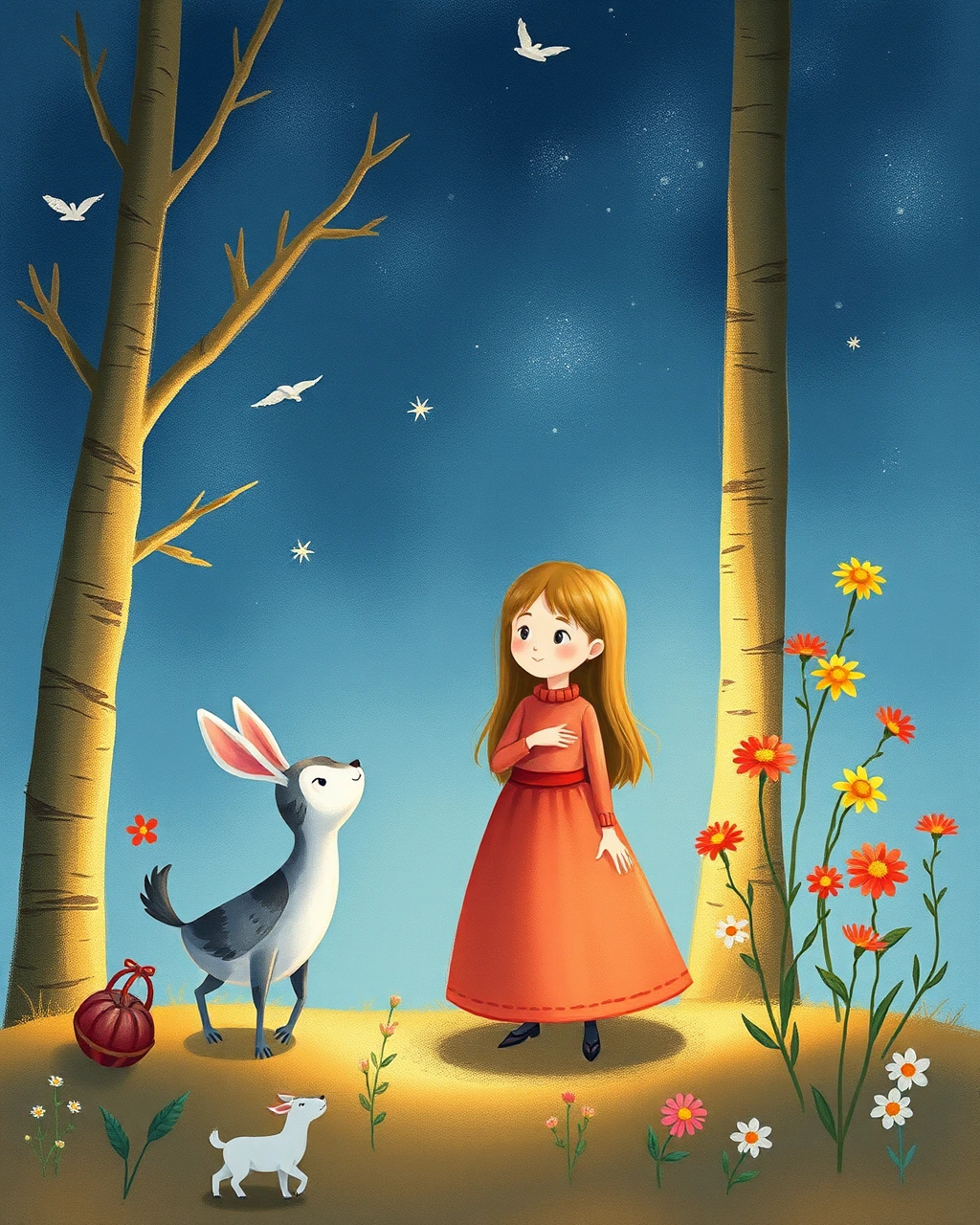
Something clicked, and the flower opened. It was exactly a tulip, but right inside the cup, on a little green chair, sat a tiny girl. She was so delicate, so small—only an inch tall—and so they called her Thumbelina.

A shiny lacquered walnut shell was her cradle, blue violets served as her mattress, and a rose petal as her blanket; into this cradle they put her at night, while during the day she played upon the table. On the table the woman placed a plate with water, and on the rim of the plate laid a wreath of flowers; the long stems of the flowers bathed in the water, and right at the edge floated a large tulip petal. Upon it Thumbelina could cross from one side of the plate to the other; instead of oars she had two white horsehairs. All this was charmingly delightful! Thumbelina could sing too, and no one had ever heard such a tender, beautiful voice!

One night, while she lay in her cradle, a huge toad, wet and ugly, crawled in through a broken windowpane! It hopped straight onto the table where Thumbelina slept beneath the rose petal.

"There now, a wife for my son!" said the toad, took the walnut shell with the girl in it, and jumped out of the window into the garden.

There flowed a big, wide river; right by the bank the ground was marshy and sticky; here, in the mud, lived the toad with her son. Oh! How ugly and disgusting he was too! Exactly like his mother.

"Koax, koax, brekke-ke-kex!" was all he could say when he saw the lovely little creature in the walnut shell.

"Hush! She might wake up and run away from us," said the old toad. "She is lighter than swan's down! Let us set her out in the middle of the river on a broad water-lily leaf—that is quite an island for such a tiny thing; from there she cannot escape, while we meanwhile tidy up our little nest down below. You are to live and dwell there."

In the river grew many water-lilies; their broad green leaves floated upon the surface of the water. The largest leaf was farthest from the shore; to this leaf the toad swam and placed upon it the walnut shell with the girl inside.

The poor little thing woke early in the morning, saw where she had landed, and began to weep bitterly: water was on all sides, and there was no way for her to reach dry land!

Meanwhile the old toad sat below in the mud, decorating her dwelling with reeds and yellow water-lilies—for surely everything must be made pretty for the young bride! Then she swam with her ugly son to the leaf where Thumbelina sat, in order first to take away her pretty little bed and place it in the bride's bedroom. The old toad bowed very low in the water before the girl and said:

"Here is my son, your future husband! You will live splendidly with him here in our mud."

"Koax, koax, brekke-ke-kex!" was all the son could say.

They took the pretty little bed and swam away with it, leaving the girl all alone on the green leaf, weeping bitterly—for she had no wish at all to live with the ugly toad or marry her disgusting son. The little fishes swimming beneath the water had surely seen the toad with her son and heard what she said, for they all popped their heads out of the water to look at the tiny bride. And when they saw her, they felt terribly sorry that such a sweet little girl should have to go and live with the old toad in the mud. That must not happen! The fishes crowded together below, around the stem that held the leaf, and quickly gnawed through it with their teeth; the leaf with the girl upon it drifted away with the current, farther, farther... Now the toad could never catch up with the little one!

Thumbelina floated past various delightful spots, and the little birds sitting in the bushes, seeing her, sang:

"What a pretty little girl!"

And the leaf kept floating on, until Thumbelina crossed the border. A beautiful white butterfly fluttered around her all the time and finally settled upon the leaf—he liked Thumbelina so much! And she was terribly glad: the ugly toad could no longer catch her, and everything around was so lovely! The sun blazed like gold upon the water! Thumbelina took off her sash, tied one end around the butterfly, and fastened the other to her leaf, and the leaf sailed even faster.

A May beetle flew by, saw the girl, grasped her slender waist with his leg, and carried her up into a tree, while the green leaf floated onward, and with it the butterfly—for he was tied and could not free himself.

Oh, how frightened the poor little thing was when the beetle seized her and flew with her up the tree! Especially she pitied the pretty little butterfly whom she had tied to the leaf: he would now have to starve to death if he could not get loose. But the May beetle cared nothing about it.

He settled with the tiny girl upon the largest green leaf, fed her sweet flower nectar, and said she was wonderfully pretty, though quite unlike a May beetle.

Then other May beetles who lived in the same tree came to visit. They examined the girl from head to foot, and the lady beetles moved their antennae and said:

"She has only two legs! Pity to look at!"

"She has no antennae!"

"What a thin waist she has! Fie! She is just like a human being! How ugly!" cried all the female beetles in one voice.

Thumbelina was extremely pretty! The May beetle who had brought her had liked her very much at first, but now suddenly he too found her ugly and would keep her no longer—let her go wherever she wished. He flew down from the tree with her and set her upon a daisy. There the girl began to weep because she was so ugly: even the May beetles would not keep her! Yet in truth she was the loveliest creature: delicate and clear, just like a rose petal.

All summer long Thumbelina lived all alone in the forest. She wove herself a cradle and hung it under a great burdock leaf—there the rain could not reach her. The little one ate sweet flower pollen and drank the dew which every morning she found upon the leaves. Thus passed summer and autumn; but then winter approached, long and cold. All the singing birds flew away, bushes and flowers withered, the great burdock leaf under which Thumbelina had lived turned yellow, dried up completely, and curled into a tube. The little creature herself froze with cold: her little dress was all torn, and she was so small, so delicate—freeze, that was all! Snow began to fall, and each snowflake was for her what a whole shovel-full of snow is for us; for we are big, while she was only an inch tall! She wrapped herself in a dry leaf, but it did not warm her at all, and the poor thing trembled like a leaf herself.

Near the forest where she had arrived lay a large field; the grain had long been harvested, only bare, dry stalks stuck out of the frozen earth; for Thumbelina this was a whole forest. Oh! How she shivered with cold! And so the poor thing came to the door of a field mouse; the door was a little hole covered with dry stalks and blades of grass. The field mouse lived in warmth and plenty: all the granaries were packed full of grain kernels; the kitchen and pantry were bursting with provisions! Thumbelina stood at the threshold like a beggar and asked for a piece of barleycorn—for she had eaten nothing for two days!

"Oh, you poor thing!" said the field mouse; she was, in fact, a kind old lady. "Come in here, warm yourself and eat with me!"

The girl pleased the mouse, and the mouse said:

"You may live with me all winter, only you must tidy my rooms nicely and tell me stories—I am very fond of them."

And Thumbelina did everything the mouse ordered, and lived excellently.

"Soon, perhaps, we shall have guests," said the field mouse one day. "My neighbor usually visits me once a week. He lives even better than I do: he has enormous halls, and walks

He wears a wonderful velvet fur coat. If only you could marry him! You would live in splendor! The only trouble is that he is blind and cannot see you; but you can tell him the finest fairy tales you know.

But the little girl cared little for all this: she had no desire at all to marry the neighbor—for it was a mole. Indeed, he soon came visiting the field mouse. True, he wore a black velvet fur coat, was very rich and learned; according to the field mouse, his dwelling was twenty times more spacious than hers, but he did not love the sun or beautiful flowers at all and spoke very badly of them—for he had never seen them. The little girl had to sing, and she sang two songs: "May beetle, fly, fly" and "A monk wanders through the meadows," so sweetly that the mole fell quite in love with her. But he said not a word—he was such a dignified and serious gentleman.

The mole had recently dug a long gallery underground from his home to the field mouse's door and allowed the mouse and the little girl to walk along this gallery as much as they wished. The mole asked only that they not be frightened by the dead bird lying there. It was a real bird, with feathers and a beak; it must have died recently, at the beginning of winter, and had been buried in the earth precisely where the mole dug his gallery.

The mole took a piece of rotten wood in his mouth—in the darkness, after all, it serves just as well as a candle—and went ahead, lighting the long dark gallery. When they reached the place where the dead bird lay, the mole pierced a hole in the earthen ceiling with his broad snout, and daylight streamed into the gallery. Right in the middle of the gallery lay a dead swallow; its pretty wings were pressed tightly to its body, its little feet and head tucked into its feathers; the poor little bird had surely died from the cold. The little girl felt terribly sorry for it; she loved these dear little birds very much, who had sung such wonderful songs for her all summer long, but the mole nudged the bird with his short paw and said:

"Suppose it doesn't whistle anymore! What a bitter fate to be born a little bird! Thank God my children have nothing to fear from this! Such a bird knows only how to chirp—one is bound to freeze in winter!"

"Yes, yes, you are right; it is pleasant to hear wise words," said the field mouse. "What good comes from this chirping? What does it bring the bird? Cold and hunger in winter? Much indeed, one must say!"

Thumbelina said nothing, but when the mole and the mouse turned their backs on the bird, she bent down to it, parted its feathers, and kissed it right on its closed eyes. "Perhaps this is the very one who sang so wonderfully in summer!" thought the little girl. "How much joy you gave me, dear, good little bird!"

The mole plugged up the hole in the ceiling again and escorted the ladies back. But the little girl could not sleep that night. She rose from her bed, wove a large, fine carpet from dry stalks of grass, carried it into the gallery, and wrapped the dead bird in it; then she found some down at the field mouse's and lined the whole swallow with it, so that it might lie warmer upon the cold earth.

"Farewell, dear little bird," said Thumbelina. "Farewell! Thank you for singing so wonderfully for me in summer, when all the trees were so green and the sun shone so kindly!"

And she bowed her head onto the bird's breast, but suddenly she grew frightened—something began beating inside. It was the bird's heart beating: it had not died, but only grown stiff from the cold; now, having warmed up, it had come back to life.

In autumn, swallows fly away to warm regions, but if one lingers, it grows stiff from the cold, falls dead upon the ground, and is covered by cold snow.

The little girl trembled all over with fright—the bird, after all, was simply a giant compared to the tiny creature—but still she gathered her courage, wrapped the swallow even more warmly, then ran off and fetched a mint leaf, which she herself used instead of a blanket, and covered the bird's head with it.

The following night, Thumbelina again crept quietly to the swallow. The bird had now completely revived, though it was still very weak and barely opened its eyes to look at the little girl, who stood before it holding a piece of rotten wood in her hands—for she had no other lantern.

"Thank you, dear little one!" said the sick swallow. "I have warmed up so nicely. Soon I shall recover entirely and fly out again into the sunshine."

"Oh," said the little girl, "it is so cold now, the snow is falling! Better stay in your warm little bed; I will take care of you."

And Thumbelina brought the bird water in a flower petal. The swallow drank and told the little girl how it had wounded its wing against a thorn bush and therefore could not fly away with the other swallows to the warm regions. How it fell to the ground and... but it remembered nothing more beyond that, nor did it know how it had come here.

The swallow lived there all winter, and Thumbelina took care of it. Neither the mole nor the field mouse knew anything about this—for they did not like birds at all.

When spring arrived and the sun began to warm the earth, the swallow took leave of the little girl, and Thumbelina unplugged the hole the mole had made.

The sun shone so kindly, and the swallow asked whether the little girl wished to go away with it—she could sit on its back, and they would fly to the green forest! But Thumbelina did not wish to abandon the field mouse—for she knew the old woman would be greatly grieved.

"No, I cannot!" said the little girl to the swallow.

"Farewell, farewell, dear kind little one!" said the swallow, and flew out into the sunshine.

Thumbelina watched it depart, and tears even came to her eyes—she had grown so fond of the poor little bird.

"Tweet-tweet, tweet-tweet!" chirped the bird, and vanished into the green forest. The little girl felt very sad. She was not allowed to go out into the sunshine at all, and the cornfield had become so overgrown with tall, thick ears of grain that it had turned into a dense forest for the poor tiny creature.

"In summer you must prepare your dowry!" the field mouse told her. It turned out that the boring neighbor in the velvet fur coat had proposed marriage to the little girl.

"You must have everything in abundance, and once you marry the mole, you certainly shall lack for nothing!"

And the little girl had to spin all day long, while the old mouse hired four spiders for weaving, and they worked day and night.

Every evening the mole came visiting the field mouse and talked of nothing but how summer would soon end, the sun would cease scorching the earth—for it had already become hard as stone—and then they would hold the wedding. But the little girl was not happy at all: she did not like the boring mole. Every morning at sunrise and every evening at sunset, Thumbelina went out to the threshold of the mouse's burrow; sometimes the wind parted the tops of the grain stalks, and she managed to catch a glimpse of a patch of blue sky. "How bright, how lovely it is out there, in freedom!" thought the little girl, remembering the swallow; she very much wished to see the bird again, but the swallow was nowhere to be seen: surely it was flying far, far away, in the green forest!

By autumn, Thumbelina had prepared all her dowry.

"In a month, your wedding!" the field mouse told the little girl.

But the tiny creature burst into tears and said she did not want to marry the boring mole.

"Nonsense!" said the old mouse. "Just don't be capricious, or I shall bite you—do you see what a white tooth I have? You will have a most wonderful husband. Not even the queen possesses such a velvet fur coat as he does! And his kitchen and cellar are never empty! Thank God for such a husband!"

The wedding day arrived. The mole came for the little girl. Now she had to go with him into his burrow, live there, deep, deep underground, and never go out into the sun—for the mole could not bear it! And it was so heavy for the poor tiny creature to say farewell forever to the red sun! At the field mouse's, at least, she could occasionally admire it.

So Thumbelina went out to look at the sun one last time. The grain had already been harvested from the field, and only bare, dried stalks stuck out of the earth again. The little girl stepped farther from the doorway and stretched her hands toward the sun:

"Farewell, bright sun, farewell!"

Then she embraced with her little arms a small red flower growing there and said to it:

"Greet the dear swallow for me, if you see it!"

"Tweet-tweet, tweet-tweet!" suddenly sounded above her head.

Thumbelina raised her eyes and saw the swallow flying past. The swallow also saw the little girl and grew very glad, and the little girl wept and told the swallow how unwilling she was to marry the disagreeable mole and live with him deep underground, where never

the sun will not peek in.

"Soon the cold winter will come," said the swallow, "and I am flying far, far away, to warm lands. Do you want to fly with me? You can sit on my back—just tie yourself tightly with your belt—and we shall fly far away from the ugly mole, far beyond the blue seas, to warm lands where the sun shines brighter, where it is always summer and wonderful flowers bloom! Fly with me, dear little one! After all, you saved my life when I was freezing in the dark, cold hole."

"Yes, yes, I will fly with you!" said Thumbelina. She sat on the bird's back, pressed her little feet against its outstretched wings, and tied herself firmly with her belt to the largest feather.

The swallow shot upward like an arrow and flew over dark forests, over blue seas, and over high mountains covered with snow. It was terribly cold there; Thumbelina burrowed deep into the swallow's warm feathers, sticking out only her head to admire all the beauties they encountered along the way.

But here were the warm lands! Here the sun shone much brighter, and green and black grapes grew along ditches and hedges. In the forests lemons and oranges ripened, the air smelled of myrtle and fragrant mint, and lovely children ran along the paths catching large, colorful butterflies. But the swallow flew farther and farther, and the farther it went, the more beautiful everything became. On the shore of a lovely blue lake, amidst green curly trees, stood an ancient white marble palace. Grapevines twined around its tall columns, and up above, under the roof, swallows' nests were built. In one of them lived the swallow that had brought Thumbelina.

"There is my home!" said the swallow. "And you choose yourself some beautiful flower down below; I will place you inside it, and you will live wonderfully!"

"Oh, that would be splendid!" said the little girl, clapping her hands.

Down below lay large pieces of marble—the top of one column had fallen and broken into three pieces, and between them grew large white flowers. The swallow descended and placed the girl upon one of the broad petals. But what a wonder! Right in the very cup of the flower sat a tiny man, white and transparent, just like crystal. Upon his head shone a lovely golden crown, behind his shoulders fluttered glittering little wings, and he himself was no bigger than Thumbelina.

This was an elf. In every flower lives an elf, a boy or a girl, and the one sitting beside Thumbelina was the king of the elves himself.

"Oh, how handsome he is!" whispered Thumbelina to the swallow.

The little king was quite frightened at the sight of the swallow. He was so tiny and delicate, and she seemed to him simply a monster. But he was very glad to see our little girl—he had never before seen such a pretty girl! And he took off his golden crown, placed it upon Thumbelina's head, and asked what her name was and whether she wished to be his wife, queen of the elves, and empress of the flowers? Now that was a husband! Not like the toad's son or the mole in his velvet coat! And the girl agreed. Then from every flower flew out elves—boys and girls—so pretty that it was simply delightful! They all brought Thumbelina gifts. The best of all was a pair of transparent dragonfly wings. These were fastened to the girl's back, and now she too could fly from flower to flower! What joy that was! And the swallow sat up above in its little nest and sang to them as best it could. But it felt very sad itself, for it had grown very fond of the girl and would have liked never to part from her.

"You shall no longer be called Thumbelina!" said the elf. "That is an ugly name, and you are so pretty! We shall call you Maia!"

"Farewell, farewell!" chirped the swallow, and again it flew from the warm lands to Denmark. There it had a little nest right above the window of a man who was a great master at telling fairy tales. To him it sang its "tweet-tweet, tweet-tweet," and thus we too learned the whole story.