
 Verified text
If you don't like it, don't listen, but don't hinder the lying.
An old man had three sons: one was lame—he was terribly fond of racing; another was legless; and the third, though club-footed, did nothing but count crows.
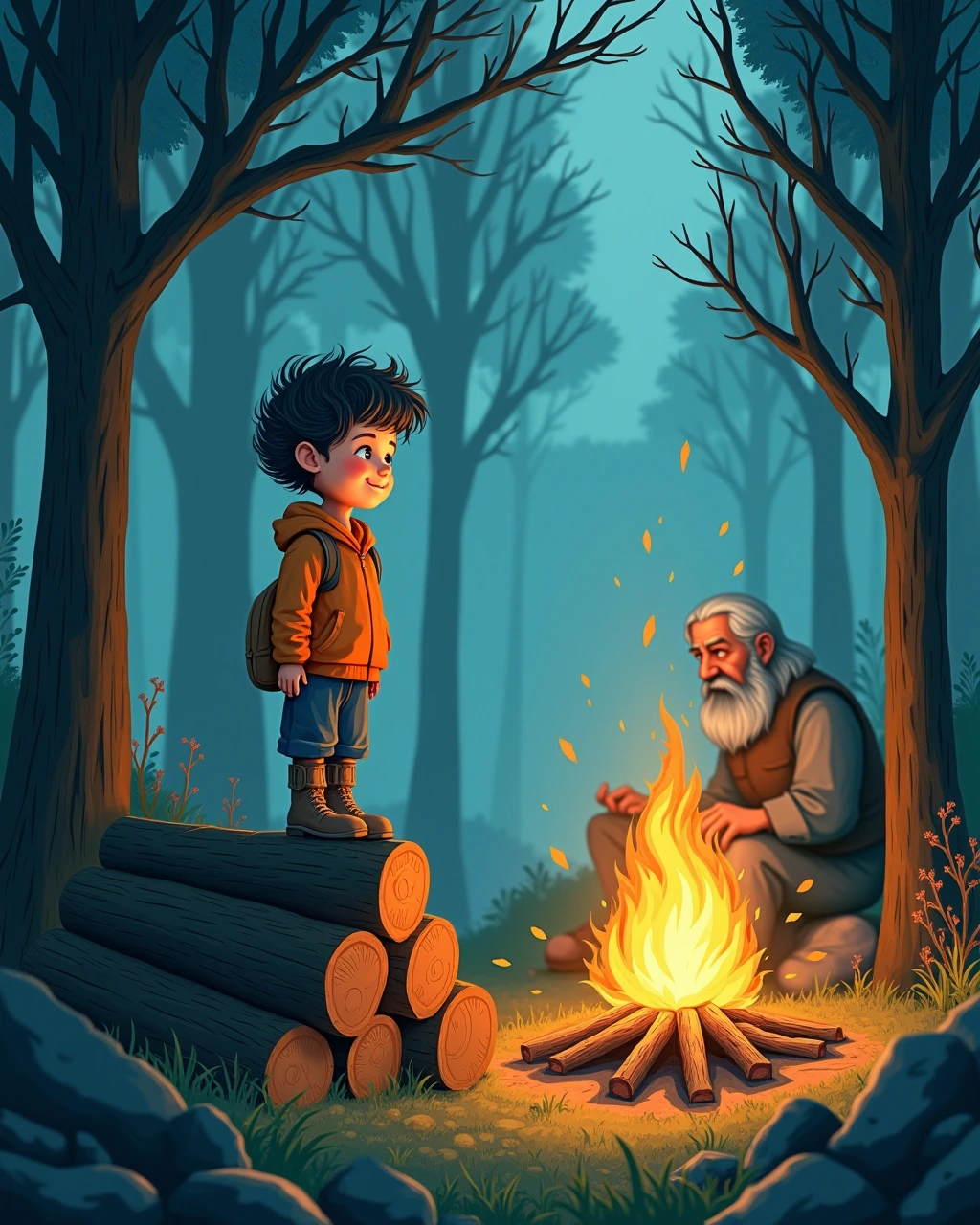
Once the old man's sons went into the forest to chop wood. While the lame one was getting ready to work, while the legless one was scratching himself, and the club-footed one counted all the crows, look—evening had fallen. It was time to cook supper, but there was no fire... What to do, how to help in this trouble? The lame one was clever, the legless one was cunning, and the club-footed one was resourceful: the three brothers felled a great pine tree two fathoms thick, split it into logs, piled them high, and the club-footed one climbed to the very top to look around for where he might get some fire and kindle a bonfire.
He looked and looked—and indeed saw that in one direction, in the middle of the forest, a little light was glowing. The eldest brother, the lame one, went for the fire. An old man sat by the bonfire. "Greetings, grandfather, give us some fire." "Dance, then I'll give it." "But I don't know how." "Well, sing a song." "I haven't learned." "Well, tell a tale." "I'm not good at that." "If that's so," said the old man, "go back where you came from; you shall have no fire!" The lame one returned empty-handed. "Ah, you feeble thing!" said the legless one to him. "I suppose I must go." The legless one went—and also returned with empty hands.
It was the youngest brother's turn, the club-footed one. He too came to the old man. "Greetings, grandfather!" "Greetings, neighbor." "Give us some fire, grandfather." "Then dance, cheer me up, an old man." "I cannot; what can a cripple like me do?" "Well, sing a merry song." "Alas, I am not good at singing." "If that's so, at least tell a tale." "That is my forte. Only one condition: I will tell, and you must not interrupt. If you interrupt or say that I am speaking untruthfully, you owe me a hundred rubles." "Agreed!" said the old man, and he sat down beside the club-footed one, turning his bald head toward the fire—such a large and shining bald head! Then the club-footed one began to tell:
"I lived with my younger grandfather when he was not yet married and my father was not yet born, precisely because when the world began, I was seven years old. At that time we lived exceedingly richly: our poles were bursting with nakedness and barefootedness. Our hut was huge: the threshold was on the ground, and right there was the ceiling—you couldn't sit inside the hut, but it was fine to look at. As for birds, we had just one hen; as for copperware, a cross and a button; as for livestock, a cockroach and a woodlouse; and for harness, two bald cats and one pacing tomcat. And as for land, there was so much you couldn't take it all in with a glance: the floor and the benches sowed themselves, while the stove and the sleeping loft we rented out. We sowed barley on the floor, but we didn't have enough seed for the benches. Our barley grew tall and thick; a rat appeared in it; when our bald cat tried to catch it, she got so lost that she is still wandering to this day... We harvested that barley, but had nowhere to store it. I, though the youngest, was great in wisdom—I figured out how to stack the sheaf on the stove post... And my grandmother was exceedingly nimble—she climbed onto the stove for three years, climbed and climbed, leaned over, broke in two, and dropped our sheaf into a washbasin. Grandfather wailed, I cried out... We stitched Grandmother back together with bast strips—she walked around like that for another ten years—and we took the barley out of the washbasin, dried it, threshed it, and brewed beer. We brewed two beers: one was thin, and the other was like water. Drink a jug of either, and you become a complete fool; but if you offer a guest a glass, shake him by the hair, and whack him on the back of the head with a log—he'll fall flat on his face... But are you listening, grandfather?" And he slapped the old man on his bald head with his mitten! "I am listening, dear one!"
"Well, good. We had plenty of everything: ninety short of a hundred in money—we simply couldn't count it. And besides, there was nothing to put such money in, and no money to buy a sack... We also had a dapple-gray horse, and such a marvel happened to me: once I rode her into the forest to chop wood, with my axe behind me at my belt. I trot along: clip-clop, clip-clop, and the axe hits the horse: thump-thump! It thumped and thumped until it chopped off the entire hindquarters of the horse... Are you listening, grandfather?" And he tapped the old man on his bald head with his mitten! "I am listening, dear one."
"For three years I rode on the front part. Once I was riding through the forest, when look—the hindquarters of my horse were grazing in a clearing. I caught them, bridled them, and then sewed them back onto the front part with a birch twig. The birch began growing upward so fiercely that the horse could hardly bear its weight—it grew higher and higher. I decided to climb up the birch. I climbed and climbed, and it kept growing and growing until it bumped into a cloud. I grabbed hold of the cloud and climbed onto it. I walked around and looked: there was nothing there... Are you listening, grandfather?" And he tapped the old man on his bald head with his mitten! "I am listening, dear one!"
"Well, I decided to climb back down to earth. Look, and my grandfather had led my horse away to water: there was nothing left to climb down on. So I began living on the cloud, starving: I grew completely emaciated. And from that thinness, fairly large fleas appeared on me. At that time I was resourceful: I began catching the fleas, skinning them, and twisting their hides into a rope; I twisted a long rope, tied one end to the cloud, and began descending. Unfortunately, the rope wasn't long enough: the ground was far below, the cloud high above—what to do? But I devised a plan: I'd cut a piece from the top and attach it to the bottom, cut and attach, cut and attach...
But are you listening, grandfather?" And he slapped the old man on his bald head with his mitten! "I am listening, dear one; and all your words are the absolute truth!"
"I cut and cut; it came to the point that there was nothing left to attach. I sat there, not worrying, looking around: a peasant was winnowing oats, and the chaff flew upward. I quickly caught the chaff and began twisting a rope; I twisted and twisted and twisted, and twisted a dead rat into it. Suddenly, for no reason at all, the rat came back to life and gnawed through the rope. How I flew downward... I flew and flew, flew and flew, flew and flew... Are you listening, grandfather?" "I am listening, dear one." "Ah, confound you!... Very well. How long I flew, I wouldn't tell even for a hundred rubles, and I fell into a swamp, sank into the mire up to my mouth; I wanted to drink some water, but I couldn't bend my neck. A fox ran up, made a nest on my head, and brought seven fox cubs. A wolf passed by, carried off the cubs, but I managed to grab him by the tail. As soon as I held on tight and shouted: tyu-tyu-tyu! The wolf pulled me out of the swamp."
Trouble was truly coming upon the club-footed one: soon he would have nothing left to tell, yet the old man still did not argue, still did not interrupt. He had to keep telling the story, no matter what, to achieve his goal.