
 Verified text
To give to a beggar is to lend to God
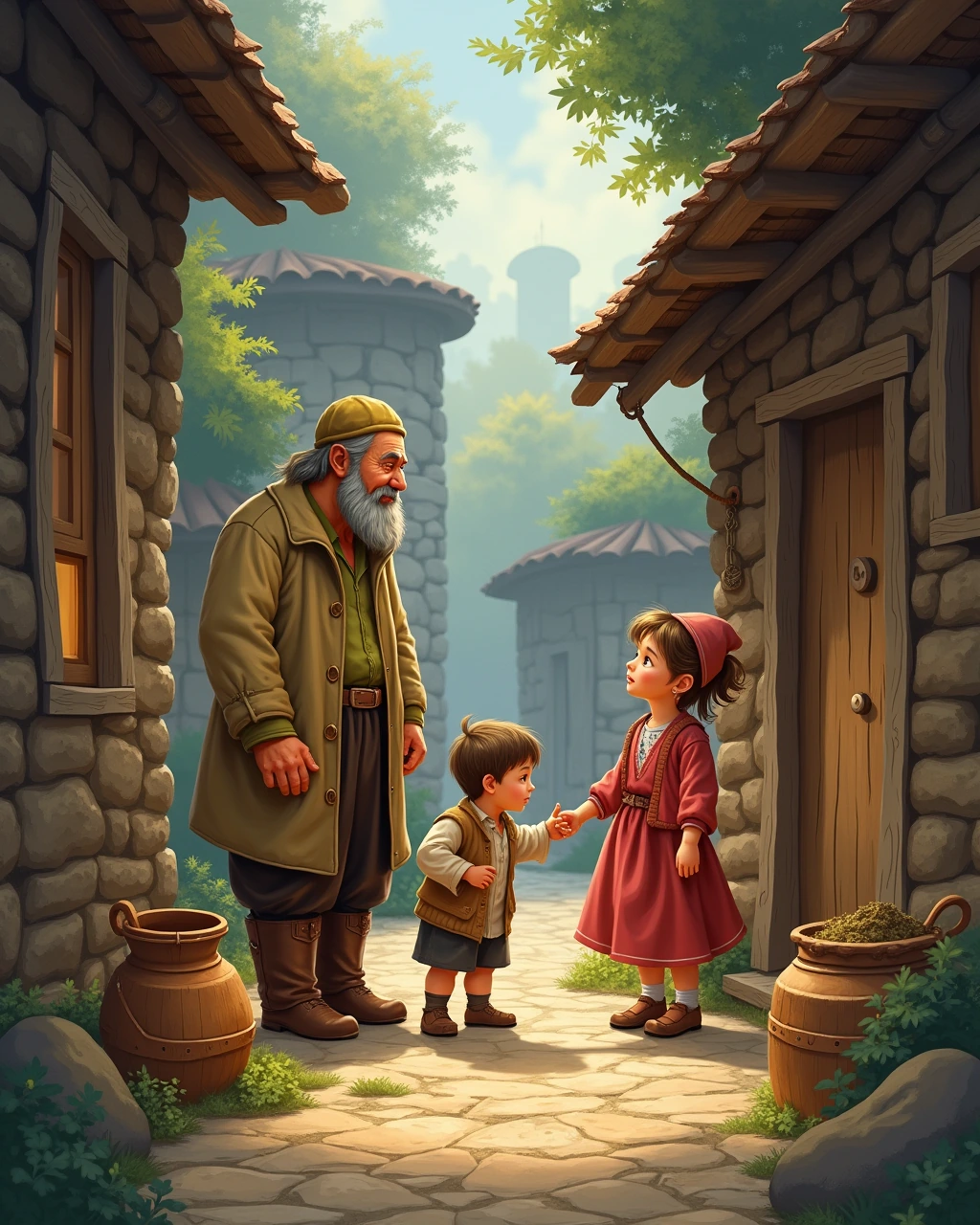
In one city there lived a Tatar. He was a poor man, a widower, with small children. All day long he was not at home—he went out to work as a day laborer, and the little ones were left all alone: there was no one to tidy them up, no one to feed them, no one to watch over them. He might have married again, but who would take such a poor man, to nurse another's children? So the Tatar decided to take a housekeeper into his home. Though it was hard for the poor fellow to feed an extra mouth, what could he do? He pitied the children.
A suitable housekeeper was found. A certain very, very poor peasant had died, leaving behind an orphan daughter. The Tatar arranged with her to serve him for bread. So they began to live together. The girl—her name was Masha—managed the house, looked after the children, cooked dinner, while the Tatar worked as a day laborer. And this Masha fitted so well into his household, and cared for his Tatar children so tenderly, as though she were their own mother, that life became better and calmer for him with her than it had been even with his own wife: he trusted her in everything and consulted her about all his affairs. Moreover, his earnings increased: firstly, because profitable work turned up, and secondly, because he could work faster once he stopped worrying every hour about his children.
One evening, when the Tatar was at home, a beggar, an old old man, approached the window and asked for alms. Masha gave him a loaf of bread. "What is this you are doing, girl," said the Tatar to Masha, "giving bread away to beggars? We barely have enough for ourselves." "Never mind, we shall somehow be full; it is our duty to give to beggars, because to give to a beggar is just the same as to lend to God. And our God repays good a hundredfold," Masha told him.
The Tatar had saved up a silver ruble for a rainy day. And a strange thing happened: from the moment he acquired this ruble, an extra worry appeared as well. At night the Tatar began to wake up, afraid someone might steal his money; during the day he kept thinking how to put this ruble to work, so that it would not lie idle but bring profit.
Masha's words stuck in the Tatar's mind; he thought and thought, and finally resolved: to lend his ruble to the Russian God. On Sunday he came to the church porch and gave the money to the first beggar he saw.
Whether much time passed or little, suddenly the Tatar's housekeeper fell ill, and so severely that she could not rise from her bed—she burned like fire and wasted away day by day like a candle. People speak truly: trouble comes and brings another trouble with it. As if on purpose, at the very same time Masha's master injured his hand with an axe, so that he could not work either. Then inevitable disaster befell them: the hungry children cried and wept, asking for food, yet there was not a scrap of bread in the house, nor any way to get some. The Tatar remembered his reserve ruble, which he had lent to the Russian God, and said to Masha: "Here, girl, now our spare ruble would come in handy. I gave it, as you taught me, as a loan to your God—now we must take it back. We need it badly."
But Masha could not answer him—she was too ill. The Tatar went to the church porch and began searching for the beggar to whom he had given his ruble—but the beggar was gone. He saw people coming out of the church—it was during Mass then—giving alms to beggars, so he stretched out his hand too. He stood and stood; people passed by, but no one gave him anything; everyone said, "God will provide!" Finally, even the Mass ended. Last of all, an old old man in poor clothes came out of the church and gave the Tatar a single kopeck.
The Tatar returned home and said to Masha: "See, I believed you that your God repays debts a hundredfold; yet for my ruble He has given me only one kopeck. How am I now to feed you all with a kopeck?"
He went to the market; whatever he asked for cost more than a kopeck, so he bought nothing. Walking home with his head bowed—the road ran along the riverbank—he saw a fisherman who had just pulled up his seine net and was sorting the large fish from the small. So he said to the fisherman: "Give me, kind man, some fish for a kopeck: at home my children have not eaten for three days." The fisherman took pity on him and gave him a fish for the kopeck, a small one.
At home the Tatar began cleaning this fish to boil it for the children; he cut it open—and look! Inside was a little stone, like a piece of glass, only it sparkled very brightly in the sun, shimmering with rainbow colors. He showed it to Masha, and she said to him—she was feeling somewhat better: "It looks like a precious stone. Go to the Jew, the goldsmith—perhaps he will give something for it." The Tatar went to the Jew. The Jew hardly glanced at the stone before his eyes ignited. "Where did you get this?" he asked. The Tatar told him. "Well," said the Jew, "this is worth nothing, just a bit of glass." "If it is worth nothing, then I don't need it; I'll give it to the children to play with." The Tatar put the stone in his pocket and started to leave, but the Jew grabbed him by his kaftan: "Wait, wait," he said, "my children also like to play. Give me your stone; for your poverty's sake, I'll give you three rubles for it!"
"The Jew is offering too much at once," thought the Tatar. "Perhaps the thing is valuable..." "No," he said aloud, "that won't do! You Jews won't give to strangers out of pity. I'll go elsewhere to learn the stone's value." "Why elsewhere? No one will give you more than I. Do you want ten rubles?" "I do not!" "Well, twenty." "I wouldn't take even a hundred." "Take a hundred rubles."