Literary tale

The Last Dream of the Old Oak

An ancient oak tree, reflecting on the brevity of a mayfly's life while boasting of its own longevity, experiences a transcendent dream on Christmas Eve where it ascends to the heavens with all creatures great and small, only to be uprooted and destroyed by a storm at the moment of its greatest joy, illustrating that a life filled with love and connection is complete regardless of its duration.

PDF

The Last Dream of the Old Oak

(A Christmas Tale)

In the forest, high on a steep slope, on the open shore of the sea, stood an ancient, very ancient oak, and it was exactly three hundred and sixty-five years old—a considerable term, yet for a tree it is just as much as so many days are for us humans. We are awake by day, we sleep and dream at night. With a tree, matters are different: a tree is awake for three seasons and falls asleep only toward winter. Winter is the time of its slumber, its night after the long day of spring, summer, and autumn.

On warm summer days, mayflies danced around its crown; they lived, fluttered, and were happy, and whenever one of these tiny creatures, in quiet bliss, settled down to rest upon a large fresh leaf, the oak would always say:

"Poor little thing! Your whole life is but a single day! So short... How sad!"

"Sad?" replied the mayfly. "What do you mean? Everything around is so bright, so warm, so wonderful! I am so glad!"

"But only one day—and then the end!"

"The end?" said the mayfly. "The end of what? And of you too?"

"No, I, perhaps, shall live thousands of your days; my day lasts entire seasons! You cannot even count how long that is!"

"No, I do not understand you! You have thousands of my days, while I have thousands of moments, and in each there is joy and happiness! Well, will all the beauty of the world die with your death?"

"No," answered the oak. "The world will exist far longer, endlessly; I cannot even imagine how long!"

"Then, it seems, an equal share has been given to you and me; we simply count differently!"

And the mayfly danced and whirled in the air, rejoicing in its delicate, graceful, translucent-velvety little wings, rejoicing in the warm air imbued with the scent of clover, wild rose, elderberry, and honeysuckle. And how fragrant were woodruff, primroses, and mint! The air was so aromatic that one might well become intoxicated by it. What a long and marvelous day, full of joy and sweet sensations! And when the sun set, the little fly felt such pleasant weariness that its wings refused to carry it; it gently descended onto a soft, swaying blade of grass, bowed its head, and fell sweetly asleep. That was death.

"Poor little things!" said the oak. "Their lives are far too short!"

And every summer day the same dance repeated itself, the same conversation, the same answer, and the same falling asleep; thus it went on with whole generations of mayflies, and they were all equally cheerful, equally happy.

The oak lived through its morning—spring, its noon—summer, and its evening—autumn; the time came for it too to fall asleep, its night approached—winter.

Then the storms began to sing: "Good night! Good night! Here a leaf has fallen, there a leaf has fallen! We tear them off, we tear them off! Try to fall asleep! We will lull you, we will rock you! Is it not wonderful for your old branches? They ache with delight! Sleep sweetly, sleep sweetly! This is your three hundred and sixty-fifth night, for you are still like a year-old infant! Sleep sweetly! The clouds sprinkle snow; it will lie like a sheet, a soft blanket around your feet! Sleep sweetly, and pleasant dreams to you!"

And the oak shed its leaves, preparing for repose, getting ready to sleep, to spend the entire long winter in dreams, to see in sleep the pictures of what it had experienced, just as people see them in their dreams.

It too had once been small, and its cradle had been an acorn. By human reckoning, it was now in its fortieth decade. There was no tree in the forest greater or more magnificent than it. Its summit rose high above all other trees and could be seen from the sea from afar, serving as a landmark for sailors. Yet the oak knew nothing of how many eyes sought it out. In its green crown nested woodland pigeons, the cuckoo cooed, and in autumn, when its leaves seemed forged from copper, migratory birds alighted upon its branches to rest before setting off across the sea. But now, in winter, the oak stood leafless, and one could see how gnarled and knotted its boughs were; ravens and jackdaws took turns perching upon them, speaking of what a heavy time had arrived, how difficult it would be to find sustenance during winter.

On Christmas Eve, the oak dreamed the most wonderful dream of its life. Let us listen to it!

It seemed to feel that a festive time had come; it heard bell ringing all around, it dreamed of a warm, quiet summer day. It spread wide its mighty green crown; between its branches and leaves played sunbeams, the air was filled with the aroma of herbs and bushes; colorful butterflies chased one another; mayflies danced, as though everything existed solely for their dancing and merriment. All that the oak had experienced and witnessed around itself year after year now passed before it as if in a festive procession. It saw mounted knights and ladies of times past, with feathers in their hats and falcons on their arms. They rode through the forest, hunting horns blew, dogs barked. It saw enemy soldiers in shining armor and variegated garments, with pikes and halberds; they pitched tents, and then struck them. Campfires blazed, people sang and slept beneath the widely spreading branches of the oak. It saw happy lovers meeting here in the moonlight and carving the first letter of their names into its ash-green bark. Cheerful wandering journeymen, long, long ago, used to hang citherns and aeolian harps upon its branches, and now they hung there again and sounded again so invitingly. Woodland pigeons cooed, as if wishing to tell what the tree felt thereby; the cuckoo called out how many summer days it still had left to live.

And then, as though a new stream of life began to flow within it, from the tiniest rootlets up to the highest branches and leaves. It seemed to itself that it was stretching; life and warmth were felt in the roots down there beneath the earth; it felt strength increasing. It grew higher and higher; the trunk swiftly, ceaselessly stretched upward; the crown became denser, more lush, more widespread. And the more the tree grew, the more there grew within it a joyful longing to grow even higher, to rise toward the sun itself, glittering and hot.

The summit of the oak had already risen above the clouds, which rushed below like flocks of migratory birds or white swans.

The oak saw with every one of its leaves, as though each possessed eyes. It saw stars even in daytime, and they were so large, so brilliant! Each shone like a pair of clear, gentle eyes, reminding it of other familiar eyes—the eyes of children and lovers who had met beneath its crown.

The oak experienced wonderful, blissful moments. And yet it missed its forest friends... It so wished that all other trees, all bushes, grasses, and flowers might rise together with it, feel the same joy, behold the same splendor that it did. Even in these minutes of blissful sleep, the mighty oak was not entirely happy: it wished to share its happiness with everyone—small and great alike, and this feeling trembled in every branch, every leaf, passionately and ardently, as in a human breast.

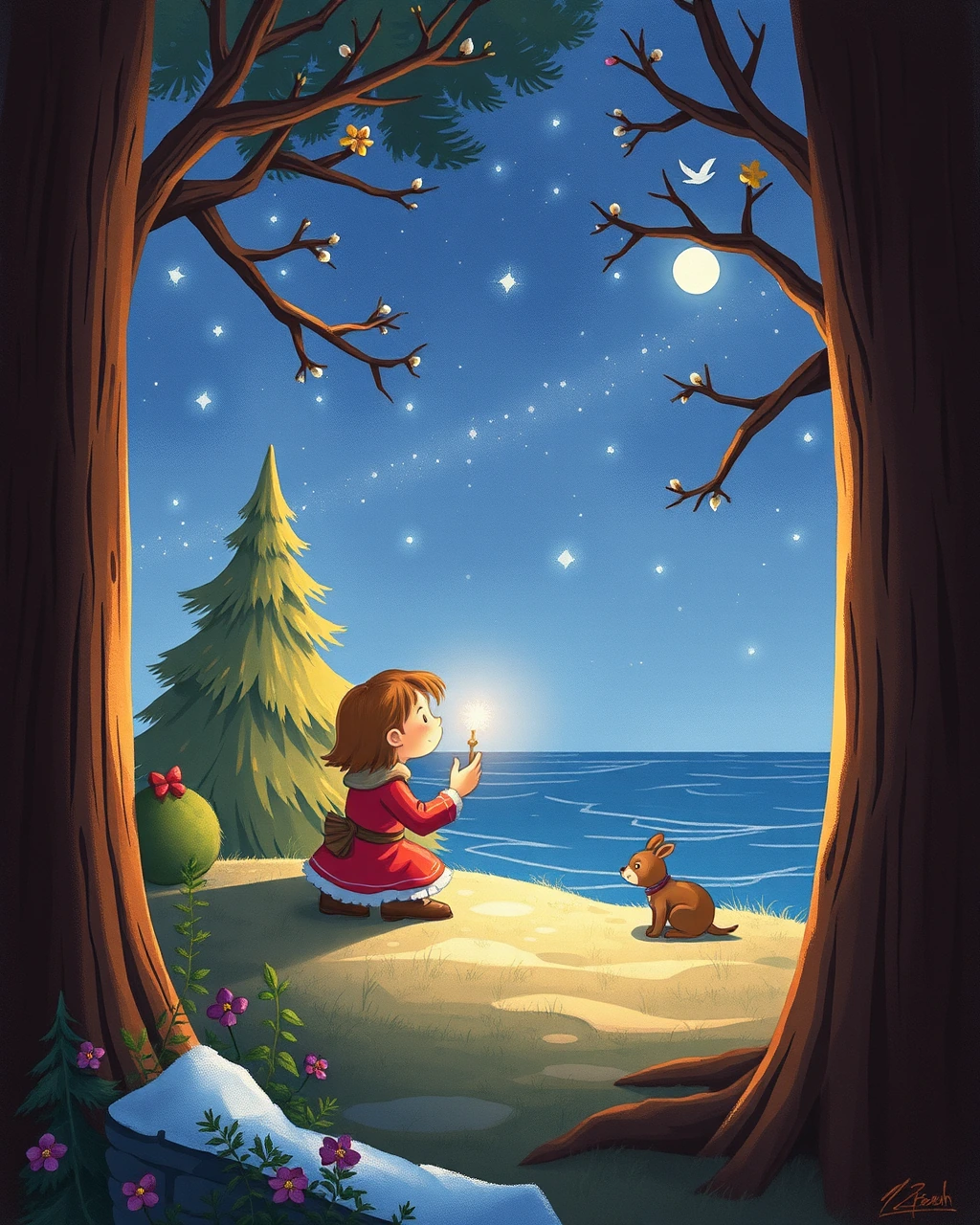
The crown of the oak stirred, as if searching for something, as if something were lacking; it looked downward and suddenly caught the scent of woodruff, and then an even stronger fragrance of honeysuckle and violets, and it even seemed to hear the cuckoo.

And then, through the clouds, the green treetops of the forest appeared. The oak saw beneath itself other trees; they too were growing and stretching upward; bushes and grasses likewise. Some even tore themselves from the earth with their roots to fly faster. Ahead of all was the birch; like a white lightning bolt, its slender trunk shot upward, its branches streaming like green veils and banners. All forest plants, even the brown plumes of reeds, rose toward the clouds; birds flew after them with songs, and upon a blade of grass swaying in the wind like a long green ribbon sat a grasshopper, playing with its wing upon its slender leg. May beetles hummed, bees buzzed, birds poured forth their throats in song; everything in the sky sang and rejoiced.

"And where is the red water-lily? Let it be with us too!" said the oak. "And the bluebell, and little daisy!"

The oak wished to see everyone beside it.

"We are here, we are here!" rang out from all sides.

"And the lovely woodruff of last year? And the carpet of lilies-of-the-valley that spread here a year ago? And the wonderful wild apple tree, and all those who adorned the forest for many, many years? If they had lived until this moment, they would be with us!"

"We are here, we are here!" rang out from above, as though those answering had flown just over it.

"No, how good it is, simply

"It's unbelievable!" rejoiced the old oak. "They are all here with me, the small and the great! Not one is forgotten! Is such happiness possible?"

"Everything is possible!" came the reply.

And the old oak, which had never ceased growing, suddenly felt that it was completely separating from the earth.

"Nothing could be better!" it said. "Now no bonds hold me! I can fly up to the very source of light and brilliance! And all my dear friends are with me! Both small and great—all!"

"All!"

This is what the old oak dreamed. And while it dreamt, a terrible storm raged over land and sea—it was Christmas night. The sea rolled heavy waves onto the shore; the oak creaked and cracked and was torn up by its roots at the very moment it dreamed it was separating from the earth. The oak crashed down... Its three hundred and sixty-five years of life now became like a single day for a mayfly.

On Christmas morning, when the sun rose, the storm subsided. Bells rang festively; from every chimney, even from the chimney of the poorest hut, blue smoke curled upward like sacrificial incense on the Druids' holiday. The sea grew ever calmer, and aboard a large ship that had weathered the night's storm, festive Christmas flags were hoisted.

"But the tree is no more! The night storm has shattered the old oak, our landmark on the shore!" said the sailors. "Who will replace it for us? No one!"

With this funeral speech, brief yet spoken from the heart, the sailors honored the old oak, laid low by the storm upon the snowy cover. An ancient song sung by the sailors also reached the oak. They sang of Christmas, and the sounds of the song soared high, high into the sky, just as the old oak had soared toward it in its final dream.