
Folk tale

A Tale of the Rogue Yermoshka

A cunning trickster named Ermolai uses deception and wit to survive poverty and exploit others, but his relentless dishonesty ultimately leads to his exile and imprisonment in Siberia.

PDF

A Tale of the Rogue Yermoshka

There once lived in a village a peasant named Ermolai—such a rogue, so cunning, a master of all sorts of inventions and tricks, that it seemed one could not find in the whole wide world a person he could not deceive. His fellow villagers disliked him greatly; they called him to his face nothing but "the rogue Ermoshka." And he was always sniffing around, contriving schemes to trick someone and gain something dishonestly; that was how he lived. As for working properly, like a true peasant—he had no habit of that since childhood. So he lived somehow, poorly: whatever he obtained easily, he squandered even more easily.

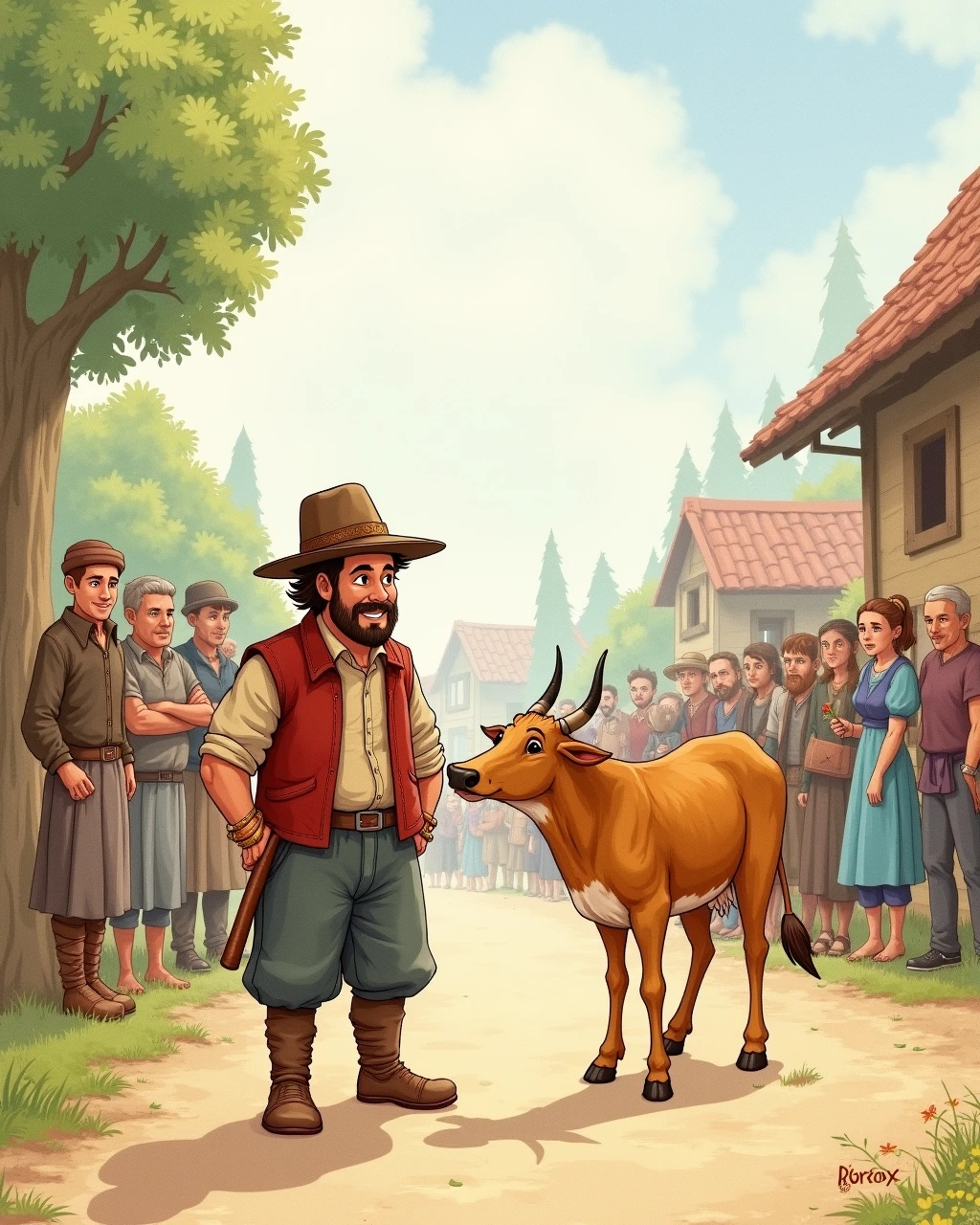
All of Ermoshka's property consisted of one little cow, a scrawny thing; he had somehow acquired her—most likely simply stolen her, put her into the herd, and then forgotten about her. Well, after all his scheming and deceiving, the peasants, his fellow villagers, finally gathered at an assembly and decided: to drive the rogue Ermoshka out of their community, so that not even his spirit would remain in the village—he had become utterly loathsome to everyone. Ermoshka said: "Well, that's just fine; give me my passport. I'll leave on my own anyway; what can I possibly gain from you, you beggars? But hand over my cow!" See, he remembered about the cow.

They gave him what he demanded and drove him out. He walked along the main road, wherever his eyes led him, and by dinnertime wandered into a large village. Ermoshka was hungry, had no money to buy anything, yet felt sorry to sell his cow: he thought he might contrive some trick and make a good profit from her. So he noticed that in one hut a woman was busy by the stove, with no men present, and went inside. A woman, he figured, would be easier to deceive.

"Good day," he said, "auntie; feed a traveler." The woman gave him a piece of bread: "There's nothing else." But the rogue Ermoshka smelled with his nose that roasted goose was coming from the stove. He went out into the yard, rummaged through a haystack, and told the woman: "Auntie, oh auntie, come take a look: your livestock has scattered your hay." The woman went out, while he rushed to the stove—snatched the roasted goose from the pan, put some old bast shoe in its place, stuffed the goose into the sack he carried on his back, and sat down chewing bread. The woman fixed the haystack, returned to the hut, and being a cheerful sort, decided to play a trick on Ermoshka regarding the goose she believed she had fooled him with: "Tell me," she said, "traveler, do you know that in the town of Pechinsk, in the village of Skovorodinsk, there is an official named Gagatei Gagateevich Guseev?" "Of course I know! Only he isn't there anymore: he has been transferred to the town of Sumin, to the village of Zaplechansk. And in his place they appointed Lipan Pletukhanovich Laptev," replied Ermoshka. Then he grabbed his cap and hurried out of the hut.

Ermoshka walked along the road, ate the goose, and looked for a place to spend the night. Suddenly a wealthy peasant from a nearby village caught up with him. "Where are you coming from and where are you going, good man?" he asked. Ermoshka named his village. "And now I'm going," he said, "to the village of Nebyvalovo in the Neznamovsk volost. Do you know it?" "No, I don't. Do you have relatives there?" "What relatives!" answered Ermoshka. "Last year a girl from our village was married off there; perhaps I'll make it to the christening, or at least get some beer, or maybe have a fight..." "Well," said the peasant, "you're going on a worthy errand. As for me, I went looking for a hired hand: I have a distant meadow that needs mowing, but it's busy season now, and I couldn't find anyone." "Well then," said Ermoshka, "let me help you; I'm in no hurry. How much will you pay?" They agreed on one ruble per day.

At the peasant's house, Ermoshka had supper, spent the night; and early next morning the master sent him with another hired hand to mow the distant meadow. When they arrived, "Come on, God bless us, let's start mowing," said the hired hand. But Ermoshka replied: "Oh, you simpleton! Straight from the road into work? First we must rest." They lay down and rested. The hired hand got up and woke Ermoshka. "Enough sleeping, brother; time to mow!" "What are you talking about? First we must have lunch. What work can a hungry man do?" They cooked porridge and ate. "Well," said Ermoshka, "after lunch one must nap a little; that's customary among all Christians." Three hours passed; Ermoshka slept and slept. "Get up," the hired hand woke him, "time to work!" "Work, brother, isn't a wolf; it won't run off into the forest, but it's truly time for afternoon snack. Cook some porridge. And listen, brother," said Ermoshka, "put enough groats right away for both the afternoon snack and supper. Let's have supper now, and afterward we'll start working." So after their afternoon snack and supper, the hired hand again insisted: "Let's mow." "Just look at this fool!" said Ermoshka. "Where has it ever been seen that people work after supper? After supper, all Christians sleep." They lay down to sleep and slept until morning. The hired hand woke Ermoshka. "Get up; let's start working!" Ermoshka lifted his head, looked around, and said: "Look, what dew! Can one possibly mow in such dew? Let's wait an hour until the dew dries, then we'll begin." He turned onto his other side and began snoring; the hired hand didn't want to wait—"There's no dew; let's get to it."—"What nonsense!" They woke up—the sun was already high. "Well, brother," said the hired hand, "there's no dew; let's get to it."—"What nonsense! Do you see how the sun burns? How much can you mow in this heat? Let the heat subside; then when we start swinging our scythes, we'll cut all the grass at once. But now it's time for dinner; set the pot and cook some porridge!"

Thus Ermoshka and the hired hand lounged around for three whole days. They did absolutely nothing, only ate up all the provisions. "Ermolai, oh Ermolai," said the hired hand, "there are no more provisions left; what shall we eat?" "Well, if there's nothing to eat, we must go home." "And what shall we tell the master?" "Just say it's on me."

They came to the master: "Did you really mow everything?" "Would I leave any behind?" said Ermoshka. "After all, what kind of worker am I? I'm worth ten men. Come on, master, settle accounts; it's time for me to go." The peasant was rather stingy; he gave Ermoshka two rubles and fifty kopecks for three days. "And the fifty kopecks," he said, "are for feeding your cow." Ermoshka started arguing and swearing. No, the peasant wouldn't give back the fifty kopecks. Ermoshka took his cow, stopped under the peasant's window, and said: "I ask you one last time, master, give me my fifty kopecks. I am a poor man, and we poor folks pray to God on behalf of you rich ones." "I said, I won't give it!" "Well, if that's so, I'll look up to heaven, stretch out my hand, invoke God: just as the grass stood in your meadow, so let the grass stand forever!.." And he left.

The next day the peasant rode to the distant meadow to inspect the mowing; he looked—and goodness gracious!—indeed the grass stood unmown. "Did you mow the grass?" he asked the hired hand. "Of course we mowed it and stacked it into sheaves." "Ah," said the master, "I must have encountered a sorcerer; better to have given him that fifty kopecks, but now we must mow again. Come on, let's get to it." "No, master, settle accounts; I won't work for you anymore, nor will I approach that meadow: I fear witchcraft," said the hired hand. And he thought to himself: "Rather than breaking my back as a hired hand, I'd better join Ermolai as a partner; with him it's easy to earn bread."

Ermoshka walked along the road, dragging his little cow behind him. Near a large village, the hired hand with whom they had supposedly mowed the grass caught up with him. "Where are you rushing off to, brother?" Ermoshka asked him. "I was catching up with you, Ermolai; take me as a partner. I've left the master—devil take him!" Ermoshka looked at him, thought: "The fellow is simple; one can surely profit from him too." "Do you have money?" "Yes, I received twenty rubles from the master." "Well, let's go."

In that village where they arrived, a three-day fair was starting the next day. "Come on, brother, let's trade in wine," Ermoshka told his partner. "It's the most profitable business." "Agreed." The first day they idled away entirely—one must rest after the journey and look around. Ermoshka's partner spent five rubles, and from Ermoshka's two rubles and fifty kopecks only one five-kopeck coin remained. On the second day, upon waking, the hired hand said: "Well, brother Ermolai, let's start earning money." "Alright," said Ermoshka, "go buy a two-bucket barrel of vodka and a glass; afterward we'll settle accounts." The partner bought the vodka, and they settled themselves with the barrel by the roadside, at the entrance to the village, to lure passersby. They sat and sat—it was still early, nobody came; Ermoshka desperately wanted a drink to cure his hangover. "Come on, brother," he said, "let's each have a glass to start with." "No, Ermolai, that won't do: we're supposed to make money from this vodka." Ermoshka fumbled in his pocket, found a five-kopeck coin, and said: "If it's for money, then it's for money! Take this five kopecks from me, give me a glass—thus we'll make a beginning." His partner poured him a glass for the five kopecks, watched Ermoshka drink, and suddenly desired a drink himself. "Come on, let me have a glass too

"I'll grab it." "No, brother," says Yermoshka, "if it's for money, then you pay too." The companion paid Yermoshka a five-kopeck piece and drank a little glass. Once more—for money again—they each drank a little glass. "What a wonderful thing!" says Yermoshka. "This way we drink well and still make a profit. Just think: how much did such a little glass cost us? No more than two kopecks by any means. Yet we sell them at five kopecks apiece. With every glass, that's three kopecks pure profit. Well, I must say, you're quite a clever fellow; what a glass you've prepared! It looks big enough, but there's barely a sip in it—just look how thick the bottom is! What can one do with you? Clearly, I need to lighten my purse. Pour me another glass for a five-kopeck piece." He gave his companion back the five-kopeck piece he had just received from him and drank. The companion returned the five-kopeck piece to him and also drank.

And in this manner, they caroused until nightfall. They drank and, truth be told, paid each other money for every single glass. Yermoshka's companion became so engrossed in trading that he calculated the profit from each glass; on the first day, he counted seven rubles and fifty kopecks of pure gain. "Tomorrow," he said, "we'll check our earnings, but now I can't... Let's go to sleep."

Some revelers passed by them. They saw two men snoring beside a small barrel, with a little glass resting upon it. They sat down, emptied the barrel completely, and instead of saying thank you, even searched the owners themselves. Thus came the end of Yermoshka's five-kopeck pieces. From his companion they took off his new boots, carried away his last five rubles, and, for mockery, laid him across the road.

Early in the morning, a peasant was traveling along the road. Seeing a man lying there, he got down from his cart and began waking him: "Hey, listen, get up!" "It's still early." "What do you mean, early? Get up!" "Oh, leave me alone, go away, don't bother me." "At least pull in your legs, let me pass." Yermoshka's companion glanced at his own legs, saw they were bare, and said: "Go on, if you wish; those aren't my legs—mine are in boots." And he fell asleep again. Having no choice, the peasant grabbed him by the leg, pushed him into a ditch, and drove on.

The worker woke up well past noon. Coming to his senses, he looked around—what a strange occurrence: no boots on his feet, no money in his pocket, no goods left in the barrel... He howled and began shaking Yermoshka awake. "Help!" he cried, "We've been robbed!" But Yermoshka jumped up and started running... Still not fully awake, thinking perhaps it was his guilty conscience calling out for him specifically... When the worker saw Yermoshka fleeing, he ran after him. "Stop!" he shouted, "Stop!" Frightened, Yermoshka ran even faster. They ran and ran... Finally, a breeze cooled Yermoshka down, and he came to his senses: "Where am I running to?" he thought. And he stopped. His companion caught up with him. "Why," he asked, "did you run away?" "How could I not run when someone's crying 'Help'?" "But that was me shouting," said the worker, "because we've been robbed. Is your earnings still safe?" Yermoshka put his hand into his pocket—and there was not even a five-kopeck piece left... "Ah, robbers!" he cried, "They've taken everything from me too! All our earnings are gone, and my fifty rubles as well!" The worker sat down on a small mound and began to weep. "What shall we do now? We're in a strange land, without money—we might starve to death." "Never mind," said Yermoshka, "don't grieve. Ours is a trading business, and in trading, today there may be loss, but tomorrow, look, there will be profit. We'll recover." But to himself he thought: "Now I must get rid of him; anyway, nothing more can be squeezed out of him."

They walked back to the village where Yermoshka's cow remained. Looking aside, they saw a woman sitting in a meadow: she had spread out linen cloths on the grass to bleach and was guarding them. "One way or another," said Yermoshka, "we must somehow gather capital to start our business again. Even if we have to steal some linen from that woman." His companion had never stolen before—but Yermoshka taught him, explaining what needed to be done. Yermoshka approached the woman and said: "Greetings, auntie! May God help you guard the linens from thieves." "Hello, dear one, where is God carrying you?" "Well, I'm going to the German border: my grandfather left a mitten there—I must find it." "Oh, dear one, that must be far away; is it really worth walking all that distance just for a mitten?" "Of course it is. Just to hear the church bells ringing there is delightful and precious. For example, how do they ring here?" "Well, probably like everywhere else; after all, bells are made of copper everywhere." "That may be so. Ring them your way, and then I'll ring them the foreign way for you." "Well, ours goes like this: tin-tin-ti-ti, tin-ti-ti, tin-ti-ti, don-don, don-don, boom!" "You see, but over there it's much stranger." Yermoshka waved his hand to his companion to take the linen, while he himself began ringing: "Pull-pull, keep pulling! Pull-pull, keep pulling!" "Indeed, what strange bell-ringing," said the woman, "clearly these are heathen sounds—in a thief's tune." While Yermoshka chatted with the woman and rang his imaginary bells, and she listened, his companion stole the linen and dashed through the bushes toward the forest. "Well, goodbye, auntie, don't hold it against me," said Yermoshka, and went after the worker.

As they approached the forest, suddenly they heard the woman begin wailing and crying out—meaning she had noticed the theft. "Our situation is bad," said Yermoshka, "give me the linen; I'll hide it in the bushes and run off to the right, while you run straight along the road into the forest!" Once his companion had run a good distance away, Yermoshka began shouting: "Oh, brothers, don't beat me! Oh, at least let my soul repent! I didn't take the linen; some man ran straight down that road over there and threw the linen into the bushes!" Meanwhile, he kept beating with his stick—sometimes on the ground, sometimes on the trees... Hearing this, his companion started running with all his might, wherever his eyes led him. But Yermoshka picked up the linen and went to the village for his little cow.

At the fair, Yermoshka sold the linen, retrieved his cow, and walked along whistling. He walked and walked, spent all the money, and found no further gain. "I must," he thought, "find some kind of work for now, something like hay-cutting, which I once did." And fortunately for him, right beside the road stood a nobleman's estate, with the master himself sitting on the porch. Yermoshka approached him, pretending to be a pitiful Kazan orphan, and said: "Good health to you, father master, isn't there any work for me, an unfortunate soul?" "What misfortune do you have?" asked the master. "I have angered God: my new boot has torn." "What a strange fellow," thought the master. "How did you manage to tear it, brother?" he asked. "On a nail, your honor, while walking on someone else's attic." "You shouldn't have climbed onto another person's attic." "I was hanging my coat to dry after washing; I dirtied it terribly when skinning my own horse." "So your horse died?" "It burst its sides carrying water when my barn burned down." "And your barn burned down, then?" "Not it first, father master; first my new hut burned down." "Is that so! Your hut burned down too?" "Yes, your honor; it was accidentally set ablaze when I held memorial services for my wife and children." "So your wife and children died?" "All were crushed in the old hut when our village was undermined by the river." "Very well, I'll take you as a shepherd," said the master.

Yermoshka began herding the herd—sleeping in the fields from morning till evening. What could be better? But such misfortune had to happen: his little cow got into a fight with the master's cow and gored it to death. In the evening, Yermoshka came to the master with a report: "Everything," he said, "is fine, except one cow has gored another to death." "Which one gored which?" "Your honor's spotted cow deigned to gore my little cow." "Well," said the master, "we needn't take a cow to the justice of the peace over this." But Yermoshka replied: "Forgive me, I misspoke: my little cow gored your honor's spotted cow to death." "Ah, you scoundrel!" shouted the master. "Bring your cow to the yard; I'll present it to the district officer, and you'll pay a fine!" "Eh, your honor, why are you changing your noble word? Just now you yourself said there was no need to take your cow to the district officer if it gored mine, yet now you want to send mine to him instead." "Fine!" said the master. "Get out of my sight, and I won't return your little cow either. Let it at least pay something for your guilt." Yermoshka began begging and pleading with the master; he whined and whined until finally he managed to coax the master, considering all his misfortunes, to order that he be given the hide of the killed cow, though the master still kicked him out of the estate.

"My situation is bad," thought Yermoshka, "when I left home, at least I had a cow, but after all this wandering and head-scratching, my entire capital is just one torn hide!" Night fell upon him on the road—dark and cold. Yermoshka looked and saw an estate standing aside; clearly, the owner was wealthy. He approached and knocked. The mistress came out: "What do you need?" "Shelter me, mistress, from the dark night." "Go away; there are too many of you vagrants roaming about!" And she slammed the

slammed the door in his face. Near the house stood a haystack. "Well," thought Yermoshka, "I'll spend the night on the haystack, buried in the hay; it'll be warmer, and being near a dwelling isn't so frightening." He climbed onto the stack and began to settle down; then he noticed that the window shutters weren't tightly closed—inside the room, right by the window, the hostess sat at a table with a young fellow, and all sorts of treats and drinks were set before them on the table. Through the crack, Yermoshka could see what a feast was going on there, and such hunger seized him that saliva simply began to flow...

Suddenly, a cart rumbled down the road; someone drove up to the house and started knocking on the window. Good heavens! What an uproar arose in the house: the hostess jumped up, the young fellow after her; they ran about, darting here and there... Instead of a hat, the young fellow grabbed a small bucket of tar from the bench, put it on his head, and drenched himself entirely in tar; the hostess shoved him this way and that, trying to hide him... She opened a chest full of down and feathers, pushed him inside, and began clearing the food off the table... Seeing that they were hiding the food from his eyes, Yermoshka groaned from hunger: "Oh-oh-oh!"

And the master—it was he who had arrived—asked: "Who's there on the haystack? Come down, if you're a decent person!" Yermoshka climbed down: "I was traveling," he said, "night overtook me; the hostess wouldn't let me spend the night in the house, so I took shelter on the haystack." "Well, why spend the night on a haystack? Come into the house; we'll find a place there too," said the hostess's husband.

The hostess opened the door for them, greeting them very kindly. She immediately set the table. "Forgive me, Ivanych," she said to her husband, "we weren't expecting you today: there's nothing for supper but empty cabbage soup." And she placed before them a bowl of cabbage soup without beef. The master began to eat, while Yermoshka, though hungry, merely stirred his spoon in the soup. He sat and sat, until suddenly he stepped with his foot on a cowhide lying under the table. It went—creak!.. "What's that you have there?" asked the master. "That's where my wizard sits."—"Really? Show me, brother; I've never seen a wizard in my life."—"I can't show him: you won't see him with your eyes anyway, and if you even unfold the hide where I've tucked him away, he'll vanish instantly. That, master, would be unprofitable for me: as long as he's with me, he gives me whatever I wish."—"Is that so?"—"Certainly. Just now I asked him: can he feed us well? He says: yes. 'Come now, wizard, where can we get some good food?' I ask, and meanwhile I press the hide; it goes—creak!—'He says he has conjured a roasted goose for us under the stove, and a beef pie is ready on the shelf beneath the towel.'"

The master pulled out the goose and the pie: "Now that's clever!" he said. "A fine supper; but can one eat it?" "It was set out for that very purpose; go ahead and eat." They began eating—it was delicious. "Ah," said the master, "if only I had such a wizard." "Just wait; there's more to come." Yermoshka pressed the hide again. "Has he prepared anything else?" he asks. He listened. "He also says that vodka, beer, and liqueur are prepared for us under the bench." The master peered under the bench. "Oh, for heaven's sake—it's true indeed!" They sat down and began drinking. The master started pestering Yermoshka: "Sell me your wizard; I'll pay whatever you ask."—"Wait a moment, master... Would you like him to show you the devil?"

Wine went to the master's head. "Go ahead," he said, "show me; I'm not afraid now." Yermoshka pressed the hide, listened: "The devil is locked in this chest here—open the lid and look." The hostess stood half alive, half dead. The peasant unlocked the chest—and out jumped the young fellow, rolled in tar and covered in down—a genuine devil—straight to the door, then out into the street; that was the last they saw of him. "What a fright!" said the master. Well, from fright they drank some more.

The master kept persistently urging Yermoshka: "Sell me your wizard!" Yermoshka pretended to hesitate a bit more and said: "This is a costly thing; I won't get another like it. But since you gave me shelter for the night, I suppose I'll let you have it. Give me three hundred rubles." The peasant was delighted, immediately counted out three hundred rubles to him, took the hide, and locked it away so the wizard couldn't escape from it... And although the hostess saw clearly that Yermoshka was deceiving her husband, she dared not tell her husband, fearing Yermoshka might expose her own trickery to him.

Early next morning, Yermoshka got up and left before the master could think of trying out the wizard in his presence. As he walked, he pondered: "Now I have money; I'll go back to my village. Surely they'll welcome a man with money. And as for having driven me out, I'll fix them up with something..." He arrived at his place and went straight to the village elder. "Why have you returned?" asked the elder. "I earned a lot of money, but I don't know how to count properly. In foreign parts, I'm afraid they'll cheat me. So I came to you: please count it; you're the literate one among us."

The elder began counting; he counted three hundred rubles and asked Yermoshka: "Where did you get so much money, Yermolai Petrovich?" "That's just it, where. You sit here, cooped up in your filth, and don't know that war has been declared now; new boots are needed for the soldiers—they pay fifty rubles in the city for a single hide. I found out, slaughtered my own little cow, sold the hide, and with that money bought two cows in the village; then I sold those hides too. That's how I earned three hundred rubles. Now I've come to buy your cows and make a profit."

Soon the whole village learned about Yermoshka's profits. Peasants began coming to him, asking questions. He told them all exactly what he'd told the elder, and bought a cow from each one: "Take it," he said, "without any trouble, twenty-five rubles per cow on average; and for my efforts, I'll earn twenty-five rubles per head and take a contract to supply salted meat to the troops." "What kind of 'efforts' are those," the peasants thought, "that Yermoshka will earn so much? We can manage without him." After discussing among themselves, they slaughtered all their cows and took the hides to the city to sell. They wandered around the city—but no one offered them more than two and a half rubles per hide. "What's this, brothers?" the peasants said to one another. "There's no other explanation: Yermoshka the rogue deceived us, made fools of us." In their grief, they turned angrily upon the elder for having believed Yermoshka—and he supposedly literate too! They scolded and scolded, finally resolving to get rid of Yermoshka altogether, one way or another.

They sold the hides, bought salt with the proceeds to at least preserve the meat from the slaughtered cows—when they left, they didn't even have money for salting—and headed back. When they arrived, look: the unsalted meat had already completely spoiled. Such rage against Yermoshka seized them that they resolved to catch him immediately and drown him; for this task they chose the elder and the village constable: "From you," they told the elder, "all this trouble started, and the constable is your assistant; you two shall destroy the villain." The elder and the constable—communal servants—were themselves angry at Yermoshka; they immediately went, caught him, tied him up in a sack, and dragged him to the river to drown him. Seeing that he was caught, with no one to rescue him, only one hope remained for Yermoshka—perhaps by chance—he sat quietly inside the sack.

Now, it was already winter; the river was covered with ice. The elder and the constable brought the sack, laid it on the bank—but they had nothing to chop through the ice. The constable said: "I'll go fetch an axe, and you keep watch." "Look at you," the elder said to him, "waiting for you: we both undertook this, so we'll both be held responsible." They argued and argued, finally deciding that both should go to the village for the axe. "Yermoshka must have lost his tongue entirely from fear," they said, "and without any shouting, no one will notice him here beneath the steep bank." As soon as they walked far enough away, Yermoshka began shouting and wriggling inside the sack.

And it happened that at that very time, an Old Believer scholar was traveling along the road not far from that spot. An old man was driving a pair of brown horses; suddenly he heard someone crying out by the river. He jumped down, approached: "Who's here in the sack?" he asked. "Untie the sack, good man; there's been some mistake here." Yermoshka crawled out of the sack, looked at the old man, immediately understood who he was, and said: "Surely, father, you didn't recognize me?"—"No, child; I don't think I know you."—"How can that be? I'm one of yours too, from the distant sketes. Such a miraculous sign has appeared among us: in these difficult times, one person must suffer for the truth—then our cause will triumph. The lot fell upon me, but I'm still young, haven't had time to commit many sins—and I hesitated. Though I'd go straight to heaven, I still very much want to live..." The scholar looked at him angrily: "You're a man of little faith," he said; "such happiness has befallen you, yet you complain. You're unworthy! Let me take your place: my soul thirsts to suffer!" Yermoshka didn't even argue; he tightly bound the scholar in the sack, jumped onto the carriage, and began whipping his brown horses.

When the elder and the constable returned, they plunged the scholar into the ice hole—only gurgling sounds were heard: burble-burble"—and they went into

the nearby tavern that stood on the main road, to have a drink after his labors. Look there, by the tavern stand a pair of brown horses harnessed to a sleigh, and in the sleigh sits Yermoshka. He had just come out of the tavern and was preparing to drive on further. The village constable and the elder were utterly stunned: "Yermoshka," they ask, "how did you climb out of the ice hole, where did you get the horses?" And Yermoshka says to them: "Ah, you fools! You wanted to destroy me, but instead you did me an even greater favor. When you threw me into the river, I looked and saw a whole herd of horses walking along the bottom... Well, I spotted these brown ones right away and began calling them. No doubt you yourselves heard how I shouted 'Bury-bury!' as I went under the water. I caught them, harnessed them, and drove straight out from the bottom to this very spot. Farewell, brothers, starve to death, but do not remember me with malice!" He whipped the brown horses and drove away.

The rogue Yermoshka wandered about the world for quite some time yet, practicing much cunning and fraud. But the proverb speaks truly: "If a jug keeps going to the water, there its head will be broken!"—not long ago he was caught in some theft or other and exiled to Siberia.