
Literary tale

The Happy Prince

A gilded statue of a prince and a migratory swallow sacrifice their most precious attributes to alleviate the suffering of the poor, revealing that true happiness and beauty lie in compassion rather than wealth or status.

PDF

The Happy Prince

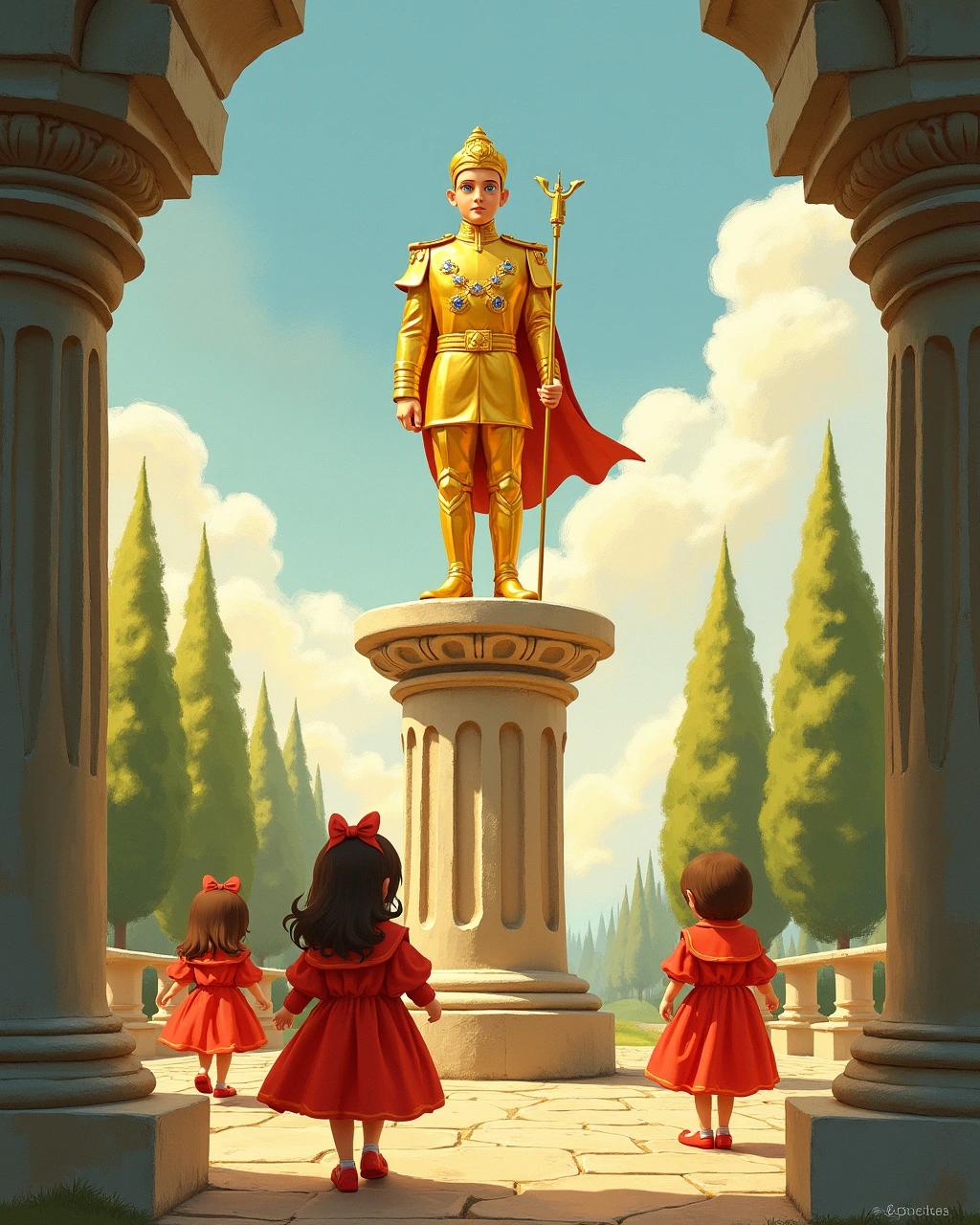
In a certain city, on a high pedestal, stood the statue of the Happy Prince. The Prince was gilded—entirely so—with thin sheets of gold. Instead of eyes, he had sapphires, and a large scarlet ruby glittered upon his sword.

Truly, this was an exceedingly beautiful prince!

"He is as elegant as a weathercock on a tower!" remarked one of the local dignitaries, who wished to gain fame for his refined understanding of art. "But, of course, the weathercock is far more useful," he added, fearing lest anyone suspect him of not guarding the people's interests.

And indeed, he did not guard them.

"Look, take the Happy Prince as an example," said a tender mother to her little boy, who kept crying to be given the moon. "The Happy Prince never throws tantrums."

"Oh, I am very, very glad that there is still at least one happy person in the world," whispered a gloomy misanthrope, contemplating the magnificent statue.

"Truly, he looks like a veritable angel!" exclaimed schoolchildren, emerging orderly from church in bright crimson dresses and white aprons.

"How do you know all this?" asked the mathematics teacher. "You have never seen a single angel."

"Yes, but we often see them when we dream," replied the schoolchildren.

The mathematician frowned and looked sternly at them. He did not approve of these childish dreams.

One night, a swallow flew over that city. Her companions had already departed for Egypt seven weeks prior, but she remained behind. She stayed because she was head over heels in love with a slender, graceful reed. The reed reciprocated her affection.

The swallow noticed the reed in spring, early in the morning, while chasing a fat, golden fly, and was so enchanted by the reed's graceful stature that she forgot about the fly and entered into conversation with the reed.

"Oh, my heart burns with passion for you!" exclaimed the swallow, who had a habit of doing everything straightforwardly, without any beating around the bush. And the reed bowed low in response.

Then the swallow began circling above her, occasionally touching the water with her wing and leaving silvery ripples in her wake. Thus she manifested her passion.

And this relationship lasted between them all summer long.

"What a foolish attachment!" chirped the other swallows. "After all, the reed has nothing to her name—and a multitude of relatives!"

Indeed, the entire river was full of reeds.

But then autumn arrived, and all her companions set off on their journey.

The swallow felt lonely. She was already beginning to tire of her connection with the reed.

"Oh, she is forever silent," said the swallow, "and it seems to me, isn't she perhaps a coquette? No wonder she flirts so with every breeze..."

Indeed, as soon as a breeze swept by anywhere, the reed immediately began exchanging pleasantries with it.

"Moreover, she has such homebody tendencies. Meanwhile, traveling is my passion, and my wife ought to love traveling."

So one day the swallow said to her:

"Come, let us fly away from here."

But the reed only shook her head; she was too attached to her native place.

"Oh, you have played with my love!" cried the swallow. "I am departing for the pyramids. Farewell!"

And she flew away.

All day long she flew and flew. By nightfall, she arrived in the city.

"Where might I settle here?" she asked. "Has the city not cared to receive me worthily?"

Then she saw the statue on the high column.

"There now, excellent. I shall stay here: a splendid location, and plenty of fresh air."

And she nestled right at the feet of the Happy Prince.

"I have a golden bedroom!" she said, looking around with dignity. And just as she settled down to sleep and tucked her head under her wing, suddenly a heavy drop of water fell upon her.

"What wonders are these!" she exclaimed. "There is not a single cloud in the sky. The stars are so clear and pure—where could rain possibly come from?... This northern climate is simply unbearable."

But then another drop fell.

"What good is this statue if it cannot even protect one from rain? I shall look for a warmer spot, somewhere near a chimney pot."

But before she could unfold her wings, a third drop fell. The swallow raised her eyes upward and saw—oh, what did she see!

The eyes of the Happy Prince were filled with tears. Tears rolled down his gilded cheeks.

And so beautiful was his golden face in the moonlight that the little swallow was filled with pity.

"Who are you?" she asked.

"I am the Happy Prince."

"But in that case, why are you weeping?... I am soaked through by your tears..."

"When I was alive and possessed a human heart, I did not know what tears were," answered the Happy Prince. "I did not know because my dwelling was the palace of Sans-Souci, where sorrow was forbidden entry. During the day I amused myself with my companions in the garden, and in the evening I led the dances in the Great Hall. The garden was surrounded by a very high wall, and it never even occurred to me to ask what happened beyond it. Everything around me was so beautiful, and the courtiers called me the Happy Prince. Yes, I was happy, if happiness exists in pleasures. Thus I lived, and thus I died. And now, since I am no longer alive, they have placed me here, so high that my gaze perceives all that is lowly, wretched, and abominable in my capital. And though my heart is now made of tin, nothing remains for me but to weep, to weep endlessly!"

"Ah! So you are not entirely made of gold!" said the swallow to herself. She was sufficiently well-bred not to voice this aloud.

"There, far away, in that alley yonder, stands a poor, crooked little house," continued the statue in a quiet, melodious voice. "One window is open, and I can see a woman at a table. Her face is worn out, her hands rough and red, pricked all over with needles, for she is a seamstress. She is embroidering passion-flowers in beads onto the hem of a silk dress which one of the queen's favorite maids of honor will wear tonight at the court ball. And in the corner, on the bed, a little boy lies tossing in fever, constantly begging to be given an orange. His mother has nothing but river water, and she bursts into tears every moment. Swallow, little swallow! Will you not carry her the ruby from my sword? My feet are chained to the pedestal, and I am unable to move from my place."

"I am expected in Egypt," replied the swallow. "My companions are now flying along the Nile and conversing with the magnificent lotuses. Soon they will go to sleep in the tomb of the great king. There he himself rests—in a painted coffin. He is clad in yellow fabric and embalmed with fragrant herbs. Around his neck hangs a chain of pale green jade, and his hands are dry as autumn leaves..."

"Swallow, swallow, little swallow! Can you not stay with me for just one more night? The boy's thirst is so great, the mother's grief so profound!"

"I do not much care for boys," answered the swallow. "When I settled by the river this summer, both sons of the seamstress threw stones at me. Of course, how could they hit! We swallows are too swift for that. Moreover, I have been famous for my agility since childhood, but—you must agree yourself, this nevertheless testifies to disrespect."

But the Happy Prince was so sorrowful that the little swallow felt sorry for him.

"The climate here is very harsh," she said, "but so be it, I will stay for you one more night."

"Thank you, little swallow," said the moved Prince.

And so the swallow pulled the great ruby from the Prince's sword and flew with it over the city rooftops.

She flew past the cathedral bell tower, where there were white marble angels. She flew past the castle and heard the sounds of dancing. Then a beautiful young woman came out onto the balcony together with her lover.

"What wonderful stars," he said to her, "and how intoxicating is the power of love."

"I hope my dress will be ready in time for the court ball," she replied to him. "I ordered it to be covered with bead embroidery, but seamstresses are so lazy..."

She flew over the river and saw lanterns on the ship masts. She flew over the Ghetto and saw old Jews—and finally approached the poor little house and peered inside. The boy lay feverishly sprawled across the bed, and his mother had slightly dozed off—she was so exhausted! The swallow crept into the room and left the great ruby on the table, beside the thimble.

Then she began circling above the bed, fanning the boy's face

with its little wings.

"Oh, how cold I am!" said the boy. "This must be for the best."

And he sank once more into slumber.

Meanwhile, the swallow returned to the Happy Prince and told him all that she had done.

"Curiously enough, I feel quite warm now, although the weather has grown rather bad."

"That is because you have done a good deed!" explained the Happy Prince.

The little swallow pondered over his words and immediately fell asleep.

This always happened to her: as soon as she began to think, drowsiness would overcome her.

At dawn she flew to the river to bathe.

"What wonders!" exclaimed a professor of ornithology who happened to be by the sea. "A swallow in winter!"

And he wrote a detailed letter about this matter to the local newspaper. Everyone read this letter: it was full of such complicated words that nobody understood them.

"To Egypt tonight!" thought the swallow, and this idea threw her into nervous excitement.

She visited all the monuments in the city and sat for a long time on the church roof.

Wherever she appeared, the sparrows looked at her with astonishment and chirped to one another:

"What a stranger! What a stranger! What a stranger!"

Thus she amused herself on the last day of her stay in this city.

"Swallow, swallow, little swallow! Will you not stay with me one more night?" asked the Happy Prince.

"Egypt awaits me," answered the swallow. "Tomorrow my companions will fly to the Second Cataract. There, among the reeds, rest the hippos, and upon a great granite throne sits the god Memnon. All night long he gazes at the stars, and when the morning star shines, he utters a cry of delight. At noon, yellow lions come down to the river to drink. Their eyes are like green beryls, and their roaring drowns out the roar of the cataract."

"Swallow, swallow, little swallow!" replied the Happy Prince. "Yonder, at the far end of the city, I see a young man in a high attic. He bends over a table covered with papers, and beside him lies a bunch of dried violets. His curls are wavy, his lips red as a pomegranate, and his eyes large and dreamy. He must finish a play for the theater director, but he lacks inspiration. The fire has gone out in his confinement, and the youth has grown weak from hunger."

"Well, I will stay with you one more night!" agreed the swallow, who after all had a kind heart. "Where is your other ruby?"

"I have no more rubies. My eyes are all that remain to me now. These eyes are made of the rarest sapphires and were brought from India a thousand years ago. Pluck one of them out and take it to the young man. Let him sell it to a jeweler and buy himself food and fuel. Then he will be able to finish his work."

"This I will never do, dear Prince," pleaded the swallow, bursting into tears. "I have not the strength to deprive you of your sight..."

"Swallow, swallow, little swallow! Do as I command," said the Prince.

The swallow had to pluck out the Prince's eye and fly to the distant attic. It was easy for her to get in, for the roof was full of holes. Slipping through one of these holes, the swallow found herself inside the garret.

The young man sat with his head in his hands and did not hear the rustling of the swallow's wings; but when he raised his eyes, he noticed beside the dried violets a beautiful sapphire.

"So I am beginning to be valued and understood!" he cried. "This must be from some important admirer. Well, now we shall apply ourselves to our drama; now just hold on!" And immediately he grew cheerful.

The next day the swallow flew to the harbor. She perched on the mast of a large ship and saw sailors unloading certain goods.

"And I am going to Egypt!" cried the swallow, but no one understood her.

Only in the evening, by moonlight, did she fly back to the Happy Prince.

"I have come to wish you good night," she said. "I am setting off for Egypt."

"Swallow, swallow, little swallow!" implored the Happy Prince. "Stay with me only one more night. Only one!"

"It is winter now," answered the swallow, "and soon cold snow will fall here. But in Egypt the sun plays so warmly upon the green palms, and crocodiles lie in the marsh lazily looking around. My companions have already built their nest in the Temple of Baalbek, and white doves watch them and coo. No, Prince, do not ask me; I must fly to Egypt, yet certainly I shall never forget you, and next spring I will bring you back two precious stones to replace those you gave to people. The ruby shall be redder than a rose, and the sapphire bluer than the high heavens..."

"Ah, down there in the square stands always a little girl selling matches. Today she dropped them into a gutter, and they were lost. You see, she is weeping. Her father will beat her severely if she returns without money. Pluck out my other eye and take it to her; then her father will not beat her."

"No indeed," answered the swallow. "I will stay with you one more night, but I will not pluck out your eye, for then you would be completely blind."

"Swallow, swallow, little swallow! Do as you are told," said the Prince.

There remained nothing for her but to pluck out his other eye and fly away with it to the distant square. She soon found the little match-girl and dropped the precious stone into the palm of her tiny hand.

"What a lovely piece of glass!" exclaimed the little girl, and ran home laughing.

The swallow returned to the Happy Prince.

"Now you are quite blind," she said, "and I will stay with you for life."

"No, dear swallow, you must set off for Egypt at once."

"No, I wish to stay with you forever," she said, and fell asleep at the Prince's feet.

The next day she climbed onto his shoulder and began to tell him what she had seen in foreign lands.

She told him of the beautiful ibises, who stand in long phalanx along the banks of the Nile and catch golden fish with their beaks; of the Sphinx, who is as old as the world, lives in the desert, and knows everything; of merchants who walk slowly beside their camels with amber pipes in their mouths; of the Lord of the Mountains of the Moon, who is blacker than ebony and worships a great crystal; of the great green serpent who sleeps upon a palm tree—the serpent has twenty priests, and they feed him honey cakes; of pygmies who travel across the lake on broad smooth leaves and are forever at war with fireflies.

"Ah, dear swallow," said the Happy Prince, "you tell me always of such wonderful things. But the most wonderful thing of all is human suffering. Fly then, my friend, over the whole city, and afterward return here and tell me of everything you see."

The swallow set out on her journey and soon noticed that the rich were making merry in their splendid houses while the poor stood at the gates. She flew into dark alleys and saw there the pale faces of thin children gazing listlessly at the black streets. Under a bridge they jumped over one another to warm themselves a little.

"We are hungry," they kept saying. "Hungry, hungry!"

"Be off with you!" shouted a watchman at them, and they found themselves again in the rain.

She returned to the Happy Prince and told him all she had seen.

"And yet I am covered with fine gold!" said the Prince. "Take it off me, leaf by leaf, and give it to the poor. Living people always believe that gold can bring them happiness."

And leaf by leaf, the swallow removed the beautiful gold, until the Happy Prince became gray and dull.

Leaf by leaf she gave the gold to the poor, and the children's faces grew rosy, laughter rang in the streets, and merry games began.

"Now we have plenty of bread!" cried the children.

Snow fell, and after the snow came frost. The streets became like silver—they shone and glittered so. Long icicles, like crystal daggers, hung from the roofs. Everyone put on furs, and boys in red caps began skating. It grew colder and colder for the poor swallow, but she would not leave the Happy Prince, for she loved him very much. In the backyard of a bakery she picked up crumbs—whenever the baker turned away for a moment—and tried to warm herself by flapping her wings. But one day she realized that her end had come.

She had strength enough left to climb once more onto the Happy Prince's shoulder and whisper to him:

"Farewell, my dear Prince! Will you allow me to kiss you

your hand?

"My friend, I am very glad that at last you will reach Egypt," said the Prince. "You have lingered here too long already. Kiss me straight on the lips; I have grown so fond of you during this time."

"No, it is not to Egypt that I fly," said the swallow. "I am departing for the Abode of Death. Is not Death akin to Sleep?"

And she kissed the Happy Prince on the lips and fell dead at his feet.

At that moment a terrible crack sounded within the statue, as though something inside had burst.

It was his tin heart that had split in two.—Such severe frosts had stood.

The next day, early in the morning, the mayor walked with his councilors below, in the square. Glancing up at the statue, he exclaimed:

"Good heavens! How terribly the Happy Prince looks!"

"Indeed, it is terrible," said the councilors, who always agreed with the mayor in everything.

And they rushed headlong to look at the Happy Prince more closely.

"The ruby has fallen from his sword-hilt, his eyes are gone too, and he is no longer golden," said the mayor. "Truly, he is no better than the poorest beggar."

"No, truly, he is no better than the poorest beggar!" said the councilors.

"And here lies a dead bird upon his pedestal," continued the mayor. "We must certainly issue an order that birds shall not dare to die here..."

And the town clerk drew up a document to that effect.

Then they pulled down the statue of the Happy Prince.

"Since he no longer possesses beauty, he is of no use at all," said the university professor of aesthetics to his students.

Then the statue was melted down, and the mayor held a great council as to what ought to be done with the metal.

"Naturally, we must cast another statue," said one city councilor, "and, of course, it should be my monument."

"No, mine!" said another, and they all quarreled among themselves.

When I saw them last, they were still continuing to quarrel.

"What a marvel!" said the chief master of the city foundry. "This broken tin heart will not yield to the fire. One might as well throw it away!..."

And they threw it onto a heap of rubbish, where the dead swallow lay.

"Bring Me the two most precious things that exist in this city," said God to one of His angels, and the angel brought Him the tin heart and the dead bird.

"Your choice is right," said God, "for in My garden of Paradise this little bird shall forever sing praises to Me, and in My city of gold the Happy Prince shall glorify Me..."