
 Verified text
Introduction
A thousand years and more ago, when in the south of Europe the sciences and arts had already reached a fairly high level of development, when the bright light of Christianity spread ever further north,—in the far north, in Scandinavia (then called Normandy), the people still wandered in the darkness of primeval ignorance and idolatry. To the Franks and Romans, the wild inhabitants of the north, called Normans (from the words Nord and Mann), were known only by their audacious raids: a horde of northern barbarians would swoop down upon the flourishing southern coast in their light longships, with a battle cry, seize everything of value, and vanish from sight once more. It is no wonder that to the well-bred, effeminate southerners these uninvited guests appeared as robbers, monsters, almost offspring of the dark force. But were they truly so?
The surviving folk tales of the Scandinavians depict them in an entirely different light.
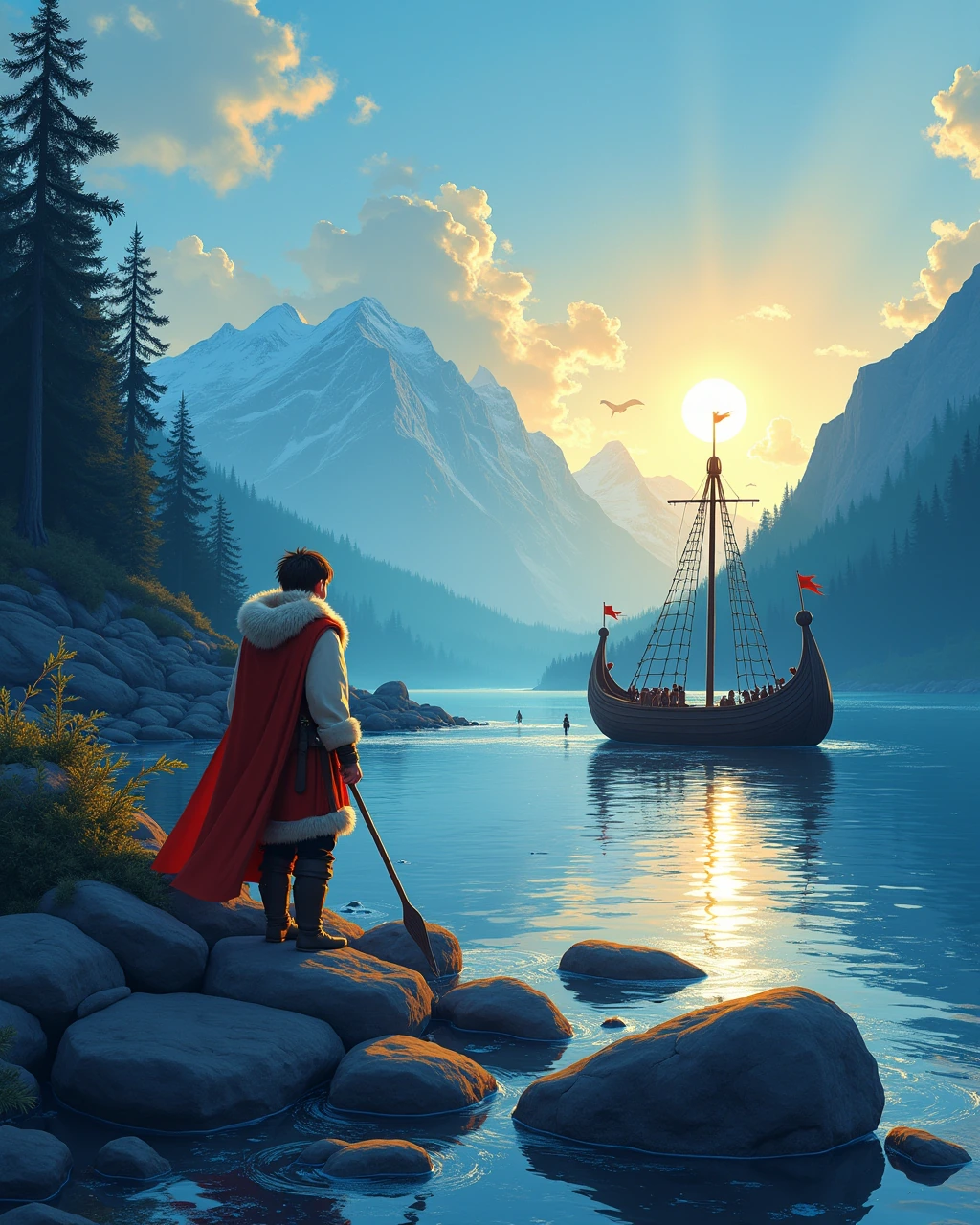
Of the three present-day Scandinavian states—Norway, Sweden, and Denmark—the foremost place at that time belonged to Norway. There the mountains were higher and steeper, the forests denser and richer in all kinds of beasts, the rivers swifter and more abundant in every sort of fish. With its entire western side it bordered the open sea, where it was indented by countless rocky bays. The harshness of polar winds was tempered there by the warm currents of the Gulf Stream washing its shores. To this stern yet majestic nature corresponded the tribe that grew up within it. Hunting, fishing, cattle-breeding, and, in part, agriculture constituted the occupations of the Normans in peacetime. But the proximity of the open sea naturally fostered in them a spirit of daring and enterprise, while the inspired songs of the skalds (folk singers, gusli players) could not fail to inflame the younger generation toward similar feats upon the boundless sea. And so, swift-flying longships were equipped, manned by crews armed from head to toe, fearless—and woe to the foreigners upon whose shores this formidable fleet landed!
Yet these were not mere pirates, hardened plunderers of others' goods. They were valiant warriors who, at any cost, needed to unfold their heroic might, to display their youthful prowess. To the southerners, understandably, these daredevils could be nothing but enemies, robbers; but for the Normans themselves, the blessed south was by no means a hostile land, merely a desired arena for martial strength. Among themselves they were bound by the closest friendship, by unwavering loyalty; for the common cause they shed their blood without hesitation, surrendering their lives without complaint. Having returned from their wanderings beneath their native roof, each of them became once again a peaceful citizen, a good family man.
The land of the Normans was divided into several small, mutually independent states. The bulk of the population consisted of bonders, peasants, free tillers of the soil.
The konung, or king, was elected by them at the thing, the popular assembly. The setting of the Norman royal court bore considerable resemblance to that familiar to us from our native byliny concerning the princely court of Vladimir-Solnyshko. Just as the Kievan prince was always surrounded by his princes and boyars, so too did the Norman kings have their retinue of jarls, counts. In the royal dining hall, exactly as in the prince's gridnitsa, merry feasts of mighty heroes took place, and the songs of the skald-gusli players resounded. Of all games, both there and here, the most beloved was checkers-chess. Among the good young fellows, both there and here, blood-brotherhoods were formed for life and death, with only this difference in ritual: the Kievan heroes, being already Christians, exchanged breast crosses, whereas the Norman knights, faithful to the ancient pagan custom, mingled their blood by letting it flow from their palms onto the earth into one common pit. A similar likeness existed also in the fabulously intricate shape of the ships of both peoples, with only this difference again: among the pagan Normans, this form was directly dictated by their fantastical beliefs. The father of gods was regarded by them as the all-wise Odin, the source of spiritual power, whereas the thunderer Thor represented the source of physical strength. But their most beloved god was Odin's son, Balder, god of goodness and light, equally beautiful in spirit and body. The most splendid temples were erected to him, the most abundant sacrifices offered to him. A deep, childlike-simple faith in the ultimate triumph of good forces over evil, guiding all actions of the Normans, permeates thoroughly all their folk tales as well, illuminating them with a mystically magical light.
Just as our native Kievan byliny have long been forgotten in the place of their origin and are remembered only in the distant outskirts of our homeland—in the provinces of Olonets, Arkhangelsk, Perm, and Siberia—so too the sagas, the tales of the Scandinavians, have survived solely on the remote island of Iceland. They were written there some 800 years ago under the title Edda. Of all these sagas, the most poetic is "Frithiofsaga," first recorded likewise in Iceland at the end of the thirteenth or beginning of the fourteenth century. The hero of this saga, Frithiof (from two Icelandic words: Frid and Thiofr, meaning together "peace-thief"), lived, according to scholars, at the end of the seventh or beginning of the eighth century. The saga is told partly in prose, partly in verse. Despite, however, all its merits, it would hardly have attained worldwide fame had not the most renowned of Swedish poets, Tegnér (born 1782, died 1846), rendered it into modern Swedish, reworking it from beginning to end and thereby creating, as it were, an entirely new poem. Each of the twenty-four songs of Tegnér's poem is composed in its own distinctive metrical form, best suited to its content, and, owing to their musicality, most of these songs have even been set to music. First printed in 1825, the poem underwent six editions in Sweden within the first fifteen years alone. But its circle of admirers was not confined to Sweden: it was soon translated into nearly all European languages, including German no fewer than fifteen times. Into Russian it was translated in 1841 by our academician Ya. K. Groth, and he accomplished this so masterfully that our foremost critic Belinsky, so strict toward mediocre works, spoke of it in the most enthusiastic terms:
"What majestic figures, what power, what energy of feeling, what freshness of colors, what wonderfully poetic coloring! This is a completely new, original world, full of infinity, grand and gloomy like the distance of the ocean, like the eternally stern sky of the north resting upon gigantic pines..."
In the present prose retelling we were inevitably compelled to limit ourselves to a condensed transmission of the poem's content, omitting a significant portion of the delightful mythological comparisons and pictures of Norman daily life. But in order to give our readers at least some notion of the poem's versified beauties, we have allowed ourselves to include almost entirely, in Academician Groth's verse translation, one song ("Frithiof's Temptation").
I. Frithiof and Ingeborg
Upon the land of Hilding, a free "bonde," grew side by side a little tree and a little flower: a slender young oak and a tender rose. That young oak was Frithiof, that rose—Ingeborg.