Literary tale

The Tale of Tsar Saltan

A young prince, born under miraculous circumstances and cast away by jealous rivals, uses magical aid to build a prosperous kingdom and ultimately reunites with his father, exposing the deceit that separated them.

PDF

The Tale of Tsar Saltan

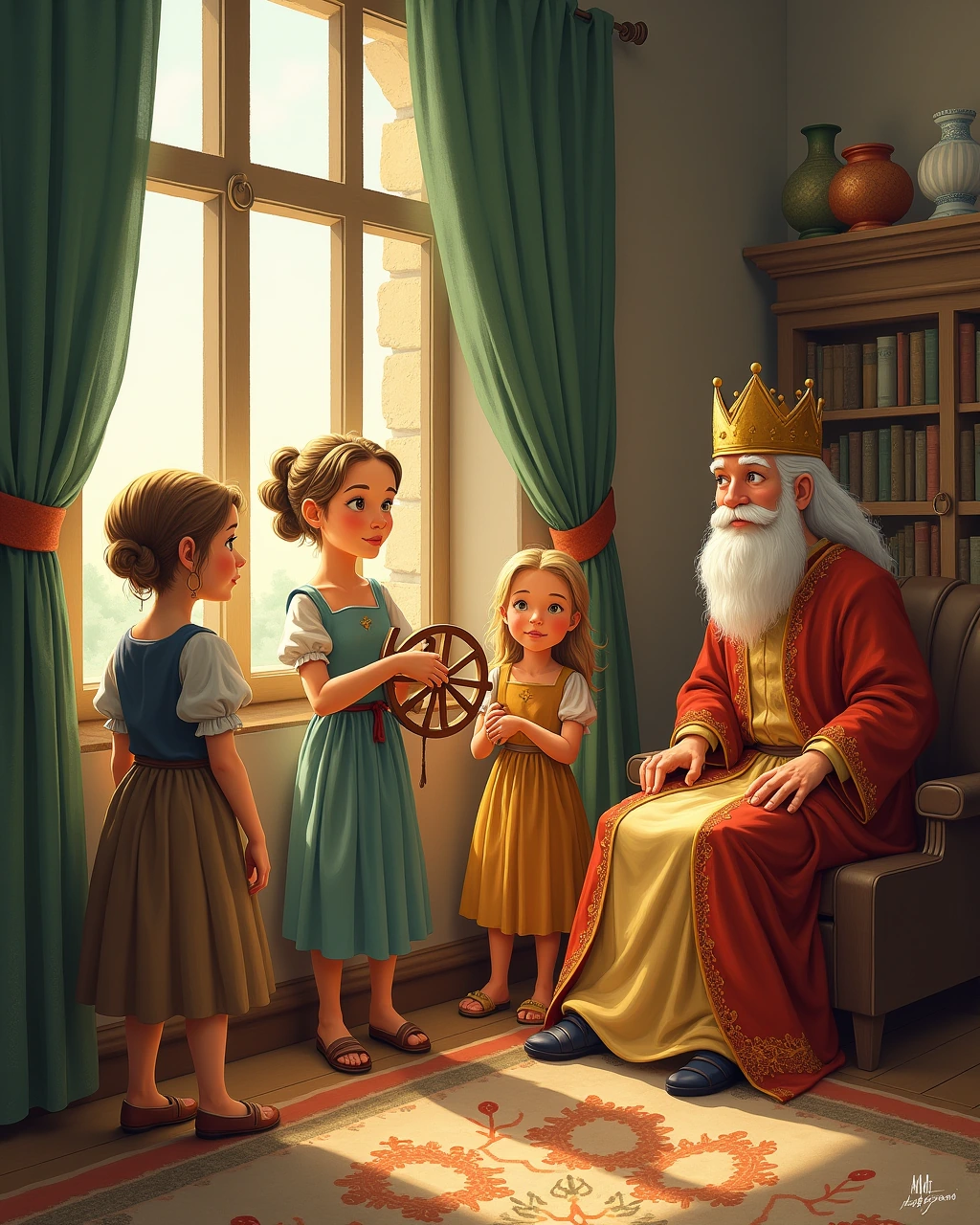
Three maidens under the window

Spun late in the evening.

"If I were a tsaritsa,"—

Says one maiden,—

"For all the baptized world

I would prepare a feast."

"If I were a tsaritsa,"—

Says her sister,—

"For the whole world alone

I would weave bolts of linen."

"If I were a tsaritsa,"—

The third sister spoke,—

"For our father-tsar

I would bear a bogatyr."

She had barely finished speaking

When the door creaked softly,

And into the lighted chamber enters the tsar,

The sovereign of that land.

During the entire conversation

He had stood behind the fence;

The speech of the last one above all

Had pleased him.

"Greetings, fair maiden,"—

He says,—"be tsaritsa

And bear a bogatyr

For me by the end of September.

And you, dear sisters,

Leave the lighted chamber,

Follow after me,

After me and after your sister:

Let one of you be a weaver,

And the other a cook."

Out to the entryway went the tsar-father.

All set off for the palace.

The tsar did not delay long:

That same evening he was wed.

Tsar Saltan at the honorable feast

Sat with the young tsaritsa;

And afterward the honorable guests

Laid the newlyweds upon

A bed of elephant ivory

And left them alone.

In the kitchen the cook fumes,

By the loom the weeper weeps,

And they envy

The sovereign's wife.

But the young tsaritsa,

Not delaying matters far,

From the first night conceived.

In those times there was war.

Tsar Saltan, taking leave of his wife,

Mounting his good horse,

Advised her to take care of herself,

Loving him.

Meanwhile, as he far away

Fights long and fiercely,

The time of childbirth approaches;

God gave her a son an arshin tall,

And the tsaritsa over her child

Is like an eagle over her eaglet;

She sends a messenger with a letter

To gladden the father.

But the weaver and the cook,

With their gossip-baba Babarikha,

Wish to destroy her,

Order the messenger intercepted;

Themselves they send another messenger

With this, word for word:

"The tsaritsa bore in the night

Neither a son nor a daughter;

Neither a mouse nor a frog,

But some unknown little beast."

When the tsar-father heard

What the messenger brought him,

In anger he began to rage

And wished to hang the messenger;

But, softening this time,

He gave the messenger such an order:

"Wait for the tsar's return

For a lawful decision."

The messenger rides with the charter,

And finally arrives.

But the weaver and the cook,

With their gossip-baba Babarikha,

Order him robbed;

They ply the messenger drunk

And into his empty bag

Stuff another charter—

And the drunken messenger brought back

That same day such an order:

"The tsar commands his boyars,

Without wasting time in vain,

Both the tsaritsa and the offspring

Secretly to cast into the abyss of waters."

There was nothing to be done: the boyars,

Having grieved for the sovereign

And the young tsaritsa,

Came in a crowd to her bedchamber.

They announced the tsar's will—

Her evil fate and her son's,

Read the decree aloud,

And the tsaritsa at that very hour

Was placed in a barrel with her son,

Sealed with pitch, rolled,

And launched into the Ocean—

So, they say, commanded Tsar Saltan.

In the blue sky stars shimmer,

In the blue sea waves lash;

A cloud moves across the sky,

A barrel floats upon the sea.

Like a bitter widow,

The tsaritsa weeps and struggles within it;

And the child grows there

Not by days, but by hours.

A day passed, the tsaritsa wails...

But the child urges the wave:

"You, my wave, my wave!

You are playful and free;

You splash wherever you wish,

You wear away sea stones,

You drown the shore of the earth,

You lift up ships—

Do not destroy our souls:

Cast us out upon the dry land!"

And the wave obeyed:

Right then onto the shore

It gently carried the barrel

And quietly receded.

Mother and infant are saved;

She feels the earth beneath her.

But who will lift them from the barrel?

Will God truly abandon them?

The son rose to his feet,

Pressed his head against the bottom,

Strained a little:

"How might we make here

A window to the courtyard?"—he said,

Knocked out the bottom and stepped out.

Mother and son are now free;

They see a hill in a wide field,

The blue sea all around,

A green oak above the hill.

The son thought: a good supper

Would be needed by us, however.

He breaks a bough from the oak

And bends it into a taut bow,

From a cross takes a silken string

And strings it on the oaken bow,

Breaks off a slender reed,

Sharpens it into a light arrow

And goes to the edge of the valley

By the sea to seek game.

As soon as he approaches the sea,

He hears something like a moan...

Clearly the sea is not calm;

He looks—he sees a dire sight:

A swan struggles amidst the billows,

A kite circles above her;

That poor thing splashes so,

Stirs and lashes the water around...

That one has already spread his claws,

Sharpened his bloody beak...

But just then the arrow sang,

Struck the kite in the neck—

The kite shed blood in the sea,

The prince lowered his bow;

He looks: the kite sinks in the sea

And moans not with a bird's cry,

The swan swims nearby,

Pecks the evil kite,

Hastens its imminent doom,

Beats it with a wing and drowns it in the sea—

And afterward to the prince

She speaks in the Russian tongue:

"You, prince, my savior,

My mighty deliverer,

Do not grieve that for my sake

You shall eat nothing for three days,

That the arrow is lost in the sea;

This sorrow—is no sorrow at all.

I shall repay you with goodness,

Serve you later:

You saved not a swan,

You kept alive a maiden;

You killed not a kite,

You shot a sorcerer.

Forever I shall not forget you:

You will find me everywhere,

But now you must return,

Do not grieve and lie down to sleep."

Away flew the swan-bird,

And the prince and tsaritsa,

Having spent the whole day thus,

Decided to lie down fasting.

Then the prince opened his eyes;

Shaking off the dreams of night

And wondering, before himself

He sees a great city,

Walls with frequent battlements,

And behind the white walls

Shine the onion domes of churches

And holy monasteries.

He quickly wakes the tsaritsa;

She gasps!.."Can this be?"—

He says,—"I see:

My swan is amusing herself."

Mother and son go toward the city.

As soon as they stepped within the enclosure,

An deafening peal of bells

Rose from all sides:

People pour out to meet them,

The church choir praises God;

In golden carriages

A splendid court meets them;

All loudly hail them

And crown the prince

With a prince's cap, and as their head

Proclaim him over themselves;

And in the midst of their capital,

With the tsaritsa's permission,

That same day he began to rule as prince

And was named: Prince Gvidon.

The wind roams upon the sea

And drives a little ship;

It runs through the waves

On swollen sails.

The sailors wonder,

Crowd upon the little ship,

On a familiar island

They see a miracle in reality:

A new city with golden domes,

A harbor with a strong customs post;

Cannons fire from the harbor,

Ordering the ship to dock.

The guests dock at the customs post;

Prince Gvidon invites them as guests,

Feeds them and gives them drink

And orders them to give account:

"What trade do you, guests, conduct

And where do you sail now?"

The sailors in reply:

"We have traveled around the whole world,

Traded in sables,

In black-fox furs;

And now our term is up,

We sail straight east,

Past the island of Buyan,

To the realm of glorious Saltan..."

Then the prince said to them:

"A good journey to you, sirs,

Across the sea, the Ocean,

To the glorious Tsar Saltan;

From me, give him my bow."

The guests depart, and Prince Gvidon

From the shore with a sorrowful soul

Watches their distant flight;

He looks—above the flowing waters

A white swan swims.

"Greetings, my beautiful prince!

Why are you quiet, like a gloomy day?

What has saddened you?"—

She says to him.

The prince sadly answers:

"Grief and longing consume me,

Overpowering the young man:

I would wish to see my father."

The swan to the prince: "So that is the grief!

Well, listen: do you wish to fly

Over the sea after the ship?

Then be, prince, a mosquito."

And she waved her wings,

Splashed the water with noise

And sprinkled him

From head to foot entirely.

Then he shrank to a point,

Turned into a mosquito,

Flew away and buzzed,

Overtook the vessel on the sea,

Quietly descended

Onto the ship—and hid in a crack.

The wind merrily rustles,

The vessel merrily runs

Past the island of Buyan,

Toward the realm of glorious Saltan,

And the desired land

Is now visible from afar.

Now the guests disembarked on shore;

Tsar Saltan invites them as guests,

And after them into the palace

Flew our daring fellow.

He sees: shining entirely in gold,

Tsar Saltan sits in the hall

Upon the throne and in the crown

With a sad thought upon his face;

And the weaver and the cook,

With their gossip-baba Babarikha,

Sit beside the tsar

And gaze into his eyes.

Tsar Saltan seats the guests

At his table and asks:

"Oh you, guest-lords,

How long have you traveled? Where to?

Is life beyond the sea good or bad?

And what miracle is there in the world?"

The sailors in reply:

"We have traveled around the whole world;

Life beyond the sea is not bad,

But in the world there is such a miracle:

In the sea there was a steep island,

Unsuitable for landing, uninhabited;

It lay as an empty plain;

Upon it grew a single oak;

But now stands upon it

A new city with a palace,

With golden-domed churches,

With towers and gardens,

And Prince Gvidon rules within it;

He sent you his bow."

Tsar Saltan wonders at the miracle;

He says: "If I remain alive,

I shall visit the wondrous island,

Stay awhile with Gvidon."

But the weaver and the cook,

With their gossip-baba Babarikha,

Do not wish

To let him go And visit the wondrous isle.

"What a marvel, truly, yes,"— Winking slyly at the rest, Says the cook with cunning air,— "There's a city by the sea! Know this now, no trifle small: In the woods a pine stands tall, Underneath that pine a squirrel; Songs she sings while shells she whirls, Cracking nuts both day and night, But these nuts are not just right: Shells of purest gold they bear, Kernels—emeralds bright and clear; That is what they call a wonder."

Tsar Saltan admires the thunder Of such marvels, while the gnat Fumes with rage upon his mat— And he stings the auntie straight Right into her eye, her right. Pale the cook becomes with fright, Faints and loses sight of light. Servants, gossip, sister dear Shout and chase the gnat in fear. "Cursed you tiny buzzing fly! We will get you!..." But awry He escapes out through the pane, Calmly flies across the main Back unto his own domain.

Once again the prince walks near By the blue sea, holding dear Every wave within his sight; Look—a swan all pure and white Swims atop the flowing tide. "Greetings, prince so fair and pride! Why so quiet, like a day Cloudy, gloomy, gray? Say, What has made your heart so sad?" Thus she speaks to him, so glad.

Prince Gvidon makes this reply: "Sorrow eats my soul, I sigh; I would fain acquire a sight Of some wonder, strange and bright. Somewhere stands a pine tree high, With a squirrel beneath the sky; Truly, 'tis no trifling thing— Songs this little creature sing, Cracking nuts both day and night, But these nuts are not just right: Shells of purest gold they bear, Kernels—emeralds bright and clear; Yet perhaps men tell a lie."

To the prince the swans make cry: "People speak the truth, indeed, Of this squirrel and her seed; I know well this miracle; Cease, my prince, my soul, be still, Do not grieve; with joyful heart Gladly shall I play my part, Serve you as a friend should do."

With his spirit renewed anew Prince Gvidon goes homeward bound; Scarcely steps on spacious ground— What behold? Beneath a pine Tall and green, for all to sign, Sees he now a squirrel there Cracking golden nuts with care, Taking out an emerald green, Gathering the shells so sheen, Laying them in equal piles, Singing with a whistle smiles Before all the gathered folk: "In the garden, midst the oak."

Prince Gvidon stands struck with awe. "Well, my thanks," he softly saw, "Ay, the swan—may God above Grant her joy and endless love."

For the squirrel then builds the prince Crystal halls without a hint Of delay; sets guards around, And commands a clerk be found Strict account of nuts to keep. Profit for the prince, for her esteem deep.

Wind across the ocean blows, Pushing forth the ship that goes; Running swiftly through the foam With its sails uplifted home, Past the steep and rocky isle, Past the city vast and wide mile: Cannons from the harbor roar, Bid the vessel touch the shore.

Guests arrive at border gate; Prince Gvidon invites them straight, Feeds and gives them drink to cheer, Then demands their answer clear: "What goods do you merchants trade? Whither now your course is laid?"

Sailors thus in turn respond: "We have circled lands beyond, Traded horses strong and fleet, All Don stallions, swift of feet; Now our term has come to end, Far away our paths extend: Past the Isle of Buyan free, To Saltan's great monarchy..."

Then the prince addresses them: "Fair winds blow your diadem O'er the ocean wide and grand To Tsar Saltan's mighty land; Tell him this: Prince Gvidon sends To the Tsar his humble bends."

Guests bow low before the prince, Step outside and start hence. To the sea the prince makes way— There the swan already play Waves among. The prince implores: "My soul yearns, it ever soars... Draws me forth and bears away..." Once again she without delay Sprinkles him completely o'er: Into fly transformed once more, Prince takes flight and settles down 'Twixt the sea and heavens crown On the ship—and slips inside Through a crack where he can hide.

Wind blows merrily aloft, Ship runs merrily, soft and oft Past the Isle of Buyan free, To Saltan's great monarchy— And the longed-for land appears Visible from far, clears. Guests step out upon the sand; Tsar Saltan bids them come to hand, And behind them to the hall Flies our daring hero small.

Sees he: glowing all in gold, Tsar Saltan sits, brave and bold, On his throne with crown aglow, Sadness on his face below. While the weaver, Babarikha, And the squinting cook, old vixen, Sit around the tsar with glare, Looking like foul toads in air.

Tsar Saltan seats guests with grace At his table, asks their case: "Oh, you honored guests so dear, Long have traveled? Whither here? Is life good beyond the sea, Or what marvels may there be?"

Sailors thus in turn reply: "We have circled earth and sky; Life beyond the sea is fine; But one marvel shines divine: On the sea an island lies, On that island city rise With gold-domed churches bright, Towers, gardens in their light; Before palace grows a pine, Beneath it a house of shine; There lives tame a squirrel small, Such a trickster after all! Songs she sings while shells she cracks, Nuts she gnaws along her tracks, But these nuts are not just right: Shells of purest gold they light, Kernels—emeralds bright and clear; Servants guard her, hold her dear, Serve her in each task assigned— Even clerk of strictest mind Set to count her nuts with care; Army renders honor there; From the shells they coin their money, Send it forth where sun is sunny; Maidens pour the emerald green Into vaults, unseen, unseen; All within that isle are rich, No poor dwellers, none in ditch; Palaces everywhere stand; Rules there Prince Gvidon the land; He sends you his greeting bland."

Tsar Saltan wonders at the tale. "If alive I shall not fail, I will visit wondrous isle, Stay with Gvidon for a while." But the weaver, cook so sly, With the gossip Babarikha nigh, Do not wish to let him go Visit wonders down below.

Smiling slyly under breath, Speaks the weaver, plotting death: "What is wondrous in all this? Squirrel cracks some stones, I miss? Throws out gold and heaps up green Emeralds? That's no novel scene, Cannot us amaze, I vow, Whether true or false, allow. Other wonders exist still: Sea swells up with angry will, Boils, raises a howling cry, Rushes on the beach so dry, Spreads in noisy, surging race, And appear upon that place, Scaled like fire, burning bright, Thirty-three bold knights in might, All young giants, handsome, tall, Equal chosen, one and all, With them Uncle Chernomor. This is wonder, nothing more, One may rightly say, explore!"

Wise guests silent stay their tongue, Choose no argument among. Tsar Saltan wonders at the sight, While Gvidon burns with angry spite... Buzzes he and lands just so On the auntie's left eye, low; Weaver turns pale instantly: "Ay!" And blind becomes her eye; All shout loud: "Catch her, catch tight, Crush her now with all your might... Just you wait! Hold still a bit, Hold on..." But the prince does flit Out the window, calm and free, Flying back across the sea To his own domain with glee.

Prince walks by the blue sea shore, Eyes fixed on the waves once more; Look—a swan all pure and white Swims atop the flowing light. "Greetings, prince so fair and pride! Why so quiet, like a tide Gloomy, cloudy, gray? Say, What has made your heart stray?" Thus she speaks to him today.

Prince Gvidon makes this reply: "Sorrow eats my soul, I sigh— Wonder wondrous I desire To bring home, my heart's own fire." "And what wonder seeks your mind?" —"Somewhere sea swells unconfined, Ocean boils, raises a cry, Rushes on the beach so dry, Splashes in its noisy race, And appear upon that place, Scaled like fire, burning bright, Thirty-three bold knights in might, All young giants, handsome, tall, Equal chosen, one and all, With them Uncle Chernomor."

To the prince the swan says more: "This, my prince, disturbs your soul? Grieve not, dearest, reach your goal; I know well this miracle too. These sea-knights are brothers true, Born of me, my kin so dear. Do not sorrow, have no fear; Go await your brothers' cheer."

Prince departs, forgetting pain, Climbs the tower, looks again On the sea; suddenly the main Stirs around with might and strain, Splashes in its noisy race, Leaving on the sandy place Thirty-three bold knights in might; Scaled like fire, burning bright, March the warriors row by row, And with hair all silver-glow Uncle leads them, marching prior, Guiding them toward the city higher.

From the tower Prince Gvidon flies, Meets these guests with joyful eyes; People rush in haste to see; Uncle speaks to prince so free: "The swan sent us here to thee With command and decree: Guard your glorious city well, Patrol rounds where people dwell. Henceforth daily we shall come Together, never staying dumb, From the sea beneath your walls high, So soon meet beneath the sky; Now 'tis time for us to roam; Earthly air feels heavy home." All return then to their foam.

Wind across the ocean blows, Pushing forth the ship that goes; Running swiftly through the foam With its sails uplifted home, Past the steep and rocky isle, Past the city vast and wide mile: Cannons from the harbor roar, Bid the vessel touch the shore.

Guests arrive at border gate; Prince Gvidon invites them straight, Feeds and gives them drink to cheer, Then demands their answer clear: "What goods do you merchants trade? Whither now your course is laid?"

Sailors thus in turn respond: "We have circled lands beyond, Traded steel of finest grain, Purest silver, gold again; Now our term has come to end, Far away our paths extend: Past the Isle of Buyan free, To Saltan's great monarchy."

Then the prince addresses them: "Fair winds blow your diadem O'er the ocean wide and grand To Tsar Saltan's mighty land; Tell him this: Prince Gvidon sends To the Tsar his humble bends."

Guests bow low before the prince, Step outside and start hence. To the sea the prince makes way— There the swan already play Waves among. Again he cries: "My soul yearns, it ever flies... Draws me forth and bears away..." Once again she without delay Sprinkles him completely o'er: Now he shrinks to size much more, Turns into a bumblebee, Flies and buzzes wild and free; Catches up the ship at sea, Softly settles, quietly, On the stern—and hides in glee.

Wind blows merrily aloft, Ship runs merrily, soft and oft Past the Isle of Buyan free, To Saltan's great monarchy, And the longed-for land appears Visible from far, clears. Guests step out upon the sand; Tsar Saltan bids them come to hand, And

After them to the palace

Flew our daring hero.

He sees, all shining in gold,

Tsar Saltan sits in the chamber

On the throne and in the crown,

With a sad thought on his face.

And the weaver with the cook,

With their gossip, old woman Babarikha,

Sit around the tsar—

All three looking with four eyes.

Tsar Saltan seats the guests

At his table and asks:

"Oh you, guest-lords,

How long have you traveled? Where to?

Is it good beyond the sea or bad?

And what miracle is there in the world?"

The shipmen in reply:

"We have traveled all around the world;

Life beyond the sea is not bad;

But here is what miracle there is in the world:

An island lies upon the sea,

A city stands upon the island,

Every day a wonder happens there:

The sea swells up turbulently,

Boils over, raises a howl,

Rushes onto the empty shore,

Splashes out in swift course—

And remain upon the shore

Thirty-three bogatyrs,

Glowing in golden mail,

All young beauties,

Daring giants,

All alike, one as good as another;

Old uncle Chernomor

Comes out of the sea with them

And leads them out in pairs

To guard that island

And patrol it—

And no guard is more reliable,

Nor braver, nor more diligent.

And Prince Gvidon sits there;

He sends you his greetings."

Tsar Saltan marvels at the wonder.

"If only I stay alive,

I shall visit the wondrous island

And stay with the prince."

The cook and the weaver

Not a peep—but Babarikha,

Smiling, says:

"Who can surprise us with this?

People come out of the sea

And walk about on patrol!

Whether they speak truth or lie,

I see no wonder here.

Are there such wonders in the world?

Here goes a truthful rumor:

Beyond the sea there is a tsarevna,

Such that one cannot turn one's eyes away:

By day she dims the light of God,

By night she illuminates the earth,

The crescent moon shines beneath her braid,

And a star burns upon her forehead.

And she herself is majestic,

She swims forth like a peahen;

And when she speaks,

It is like a little river murmuring.

One may say justly,

This is a wonder, truly a wonder."

The wise guests are silent:

They do not wish to argue with an old woman.

Tsar Saltan marvels at the wonder—

And though the tsarevich is angry,

He spares the eyes

Of his old grandmother:

He buzzes around her, circles her—

Lands right upon her nose,

The bogatyr stung her nose:

A blister rose upon her nose.

And again alarm arose:

"Help, for God's sake!

Guard! Catch him, catch him,

And crush him, crush him...

Just you wait! Wait a little,

Hold on!.." But the bumblebee through the window,

And calmly to his own domain

Across the sea he flew.

The prince walks by the blue sea,

Does not take his eyes off the blue sea;

Look—upon the flowing waters

A white swan swims.

"Greetings, my beautiful prince!

Why are you quiet, like a gloomy day?

What has saddened you?"—

She says to him.

Prince Gvidon answers her:

"Sorrow and anguish consume me:

People marry; I look,

Only I walk unmarried."

—"And whom do you have in mind?"

—"Well, in the world,

They say, there is a tsarevna,

Such that one cannot turn one's eyes away.

By day she dims the light of God,

By night she illuminates the earth—

The crescent moon shines beneath her braid,

And a star burns upon her forehead.

And she herself is majestic,

She steps forth like a peahen;

She speaks sweet words,

Like a little river murmuring.

Only, really, is this true?"

The prince awaits the answer in fear.

The white swan is silent

And, having thought, says:

"Yes! Such a maiden exists.

But a wife is not a mitten:

You cannot shake her off a white hand,

Nor tuck her behind your belt.

I will serve you with advice—

Listen: about all this

Think it over properly,

So as not to regret it later."

The prince before her began to swear

That it was time for him to marry,

That about all this

He had thought it over properly;

That with a passionate soul

For the beautiful tsarevna

He was ready to go on foot from here

Even to thrice-nine lands away.

The swan then, sighing deeply,

Said: "Why so far?

Know, your fate is near,

For that tsarevna—is I."

Then she, flapping her wings,

Flew above the waves

And from the height descended to the shore

Into the bushes,

Shook herself, brushed herself off

And turned into a tsarevna:

The crescent moon shines beneath her braid,

And a star burns upon her forehead;

And she herself is majestic,

She steps forth like a peahen;

And when she speaks,

It is like a little river murmuring.

The prince embraces the tsarevna,

Presses her to his white breast

And leads her quickly

To his dear mother.

The prince falls at her feet, imploring:

"Sovereign mother!

I have chosen a wife for myself,

A daughter obedient to you,

We both ask permission,

Your blessing:

Bless your children

To live in harmony and love."

Above their bowed heads

The mother with a miraculous icon

Sheds tears and says:

"May God reward you, children."

The prince did not linger long,

Was married to the tsarevna;

They began to live and thrive,

And await offspring.

The wind roams across the sea

And drives the little ship;

It runs through the waves

On swollen sails

Past the steep island,

Past the great city;

Cannons fire from the pier,

Ordering the ship to dock.

The guests dock at the outpost.

Prince Gvidon invites them as guests,

He feeds them and gives them drink

And orders them to give account:

"What trade do you conduct, guests,

And where are you sailing now?"

The shipmen in reply:

"We have traveled all around the world,

We traded not in vain

With unspecified goods;

But our path lies far:

Homeward to the east,

Past the island of Buyan,

To the realm of glorious Saltan."

The prince then said to them:

"A good journey to you, lords,

Across the ocean sea

To the glorious Tsar Saltan;

And remind him,

Your sovereign:

He promised to visit us as guests,

But has not yet gathered himself—

I send him my greetings."

The guests depart, and Prince Gvidon

This time remained at home

And did not part with his wife.

The wind merrily rustles,

The vessel merrily runs

Past the island of Buyan

To the realm of glorious Saltan,

And the familiar land

Is now visible from afar.

Now the guests came ashore.

Tsar Saltan invites them as guests.

The guests see: in the palace

The tsar sits in his crown,

And the weaver with the cook,

With their gossip, old woman Babarikha,

Sit around the tsar,

All three looking with four eyes.

Tsar Saltan seats the guests

At his table and asks:

"Oh you, guest-lords,

How long have you traveled? Where to?

Is it good beyond the sea, or bad?

And what miracle is there in the world?"

The shipmen in reply:

"We have traveled all around the world;

Life beyond the sea is not bad,

But here is what miracle there is in the world:

An island lies upon the sea,

A city stands upon the island,

With golden-domed churches,

With towers and gardens;

A fir tree grows before the palace,

And beneath it a crystal house;

A tame squirrel lives therein,

And what a wonder-worker she is!

The squirrel sings songs

And gnaws nuts all the while;

And the nuts are not simple,

The shells are golden,

The kernels—pure emerald;

The squirrel is cherished, guarded.

There is yet another wonder:

The sea swells up turbulently,

Boils over, raises a howl,

Rushes onto the empty shore,

Splashes out in swift course,

And appear upon the shore,

In mail, glowing like fire,

Thirty-three bogatyrs,

All daring beauties,

Young giants,

All alike, one as good as another—

With them uncle Chernomor.

And no guard is more reliable,

Nor braver, nor more diligent.

And the prince has a wife,

Such that one cannot turn one's eyes away:

By day she dims the light of God,

By night she illuminates the earth;

The crescent moon shines beneath her braid,

And a star burns upon her forehead.

Prince Gvidon rules that city,

Everyone diligently praises him;

He sends you his greetings,

And he reproaches you:

He promised, they say, to visit us as guests,

But has not yet gathered himself."

Then the tsar could endure no longer,

He ordered a fleet equipped.

But the weaver with the cook,

With their gossip, old woman Babarikha,

Do not wish to let the tsar go

To visit the wondrous island.

But Saltan does not heed them

And immediately silences them:

"What am I? A tsar or a child?"—

He says, not joking:—"

I depart today!"—Then he stamped,

Went out and slammed the door.

Under the window Gvidon sits,

Silently gazing at the sea:

It does not roar, does not lash,

Only barely, barely trembles,

And in the azure distance

Ships appeared:

Across the plains of the Ocean

Sails the fleet of Tsar Saltan.

Prince Gvidon then leaped up,

Cried out thunderously:

"My dear mother!

You, young princess!

Look over there:

Father is coming here."

The fleet already approaches the island.

Prince Gvidon raises his telescope:

The tsar stands on the deck

And looks at them through the telescope;

With him the weaver and the cook,

With their gossip, old woman Babarikha;

They marvel

At the unfamiliar land.

Suddenly the cannons fired;

In the bell towers they rang;

Gvidon himself goes to the sea;

There he meets the tsar

With the cook and the weaver,

With their gossip, old woman Babarikha;

He led the tsar into the city,

Saying nothing.

Now all enter the chambers:

At the gates armor gleams,

And stand before the tsar's eyes

Thirty-three bogatyrs,

All young beauties,

Daring giants,

All alike, one as good as another,

With them uncle Chernomor.

The tsar stepped into the wide courtyard:

There under the tall fir tree

The squirrel sings a song,

Gnaws a golden nut,

Takes out a little emerald

And lowers it into a pouch;

And the great courtyard is sown

With golden shells.

The guests proceed further—hurriedly

They look—and what do they see? The princess—a wonder:

Beneath her braid the moon shines,

And upon her forehead

The star burns;

And she herself, so majestic,

Steps forth like a peahen,

Leading her mother-in-law.

The Tsar looks—and recognizes...

His heart leaps within him!

"What do I see? What is this?

How!"—and his breath catches...

The Tsar floods with tears,

He embraces the Tsaritsa,

And his son, and the young woman,

And they all sit down at the table;

And a merry feast begins.

But the weaver, with the cook,

With their gossip, old woman Babarikha,

Scatter into the corners;

They are found there with great difficulty.

Then they confess to everything,

Repent, burst into tears;

The Tsar, for such joy,

Sends all three home.

The day passes—the Tsar Saltan

Is laid to sleep, half-drunk.

I was there; I drank mead and beer—

And only wetted my mustache.