
Literary tale

Sausage Stick Soup

Four mice embark on a quest to learn how to make soup from a sausage skewer, only to discover that the recipe is a metaphor for imagination, truth, and the absurdity of seeking literal solutions to figurative problems.

PDF

Sausage Stick Soup

What a feast they gave us yesterday at the palace! said an old mouse to another mouse who had not been fortunate enough to attend the royal banquet. I sat twenty-first from our old mouse king, which is not so bad at all! And what was not served at the table! Moldy bread, ham rind, tallow candles, sausage—and then it all began again. There was so much food that we seemed to have eaten two dinners! And what a wonderful mood everyone was in, how freely the conversation flowed, if you only knew! The atmosphere was utterly homely. We gnawed everything clean except for the sausage sticks—those on which sausages are fried; these later became the topic of discussion, and someone suddenly remembered sausage-stick soup. It turned out that everyone had heard of this soup, but no one had ever tasted it, let alone cooked it themselves. And so a splendid toast was proposed to the mouse who would manage to cook sausage-stick soup, meaning she could become the headmistress of the shelter for the poor. Well, tell me, isn't that cleverly devised? And the old mouse king rose from his throne and declared aloud that he would make queen the young mouse who cooked the most delicious sausage-stick soup. He set the term—one year and one day.

"Well, the term is sufficient," said the other mouse. "But how does one cook this very soup, eh?"

Yes, how does one cook it? All the mice asked this, both young and old. Each would not have minded becoming queen, but none had any desire to wander across the wide world to find out how this soup is prepared. And without this, there is no way: sitting at home, one cannot invent the recipe. But not every mouse can leave her family and native corner; moreover, life abroad is not too sweet: there one cannot taste a crust of cheese, nor smell ham rind; sometimes one must even go hungry, and worse still, fall into a cat's claws.

Many candidates for queenship were so troubled by all these considerations that they preferred to stay home, and only four mice, young and nimble but poor, began preparing for departure. Each chose one of the four cardinal points—perhaps at least one would be lucky—and each stocked herself with a sausage stick, so as not to forget along the way the purpose of the journey; besides, the stick could serve as a traveling staff.

At the beginning of May they set out, and in May of the following year they returned, but not all of them, only three; of the fourth there was neither sight nor sound, and the appointed term was already approaching.

"In every barrel of honey there is always a spoonful of tar," said the mouse king, but nevertheless ordered all the mice from the surrounding area to be summoned.

They were commanded to assemble in the royal kitchen; here, separately from the others, stood side by side the three traveler mice, and in place of the missing one, the courtiers placed a sausage stick draped in black crape. All present were ordered to remain silent until the travelers had spoken and the mouse king announced his decision.

Well, now let us listen.

2. WHAT THE FIRST MOUSE SAW AND LEARNED DURING HER JOURNEY

"When I set out to wander across the wide world," began the little mouse, "I, like many of my contemporaries, imagined that I had long since chewed up and swallowed all earthly wisdom. But life showed me that I was grievously mistaken, and it took a whole year and one day to comprehend the truth. I went north and first sailed by sea on a large ship. I was told that cooks must be inventive, however, our cook apparently had no need whatsoever for this: the ship's holds were bursting with loin, salted beef, and excellent moldy flour. Life was delightful, nothing to complain about. But judge for yourselves—could I possibly learn there how to cook sausage-stick soup? For many days and nights we sailed and sailed, tossed and drenched by waves; but finally the ship arrived at a distant northern port, and I disembarked.

Ah, how strange all this is: to leave one's native corner, board a ship that soon becomes one's native corner, and suddenly find oneself hundreds of miles from home, in a completely unfamiliar land! Dense forests surrounded me, spruce and birch, and how terribly they smelled! Unbearable! Wild herbs emitted such a spicy scent that I kept sneezing and sneezing and thinking about sausage. And the huge forest lakes! Approach the water closely—it seems transparent as crystal; step farther away—and suddenly it is dark as ink. White swans swam in the lakes; they held themselves upon the water so motionlessly that at first I took them for foam, but then, seeing how they flew and walked, I immediately understood they were birds; after all, they belong to the goose tribe, evident from their gait, and one cannot deny one's own kin! So I hastened to seek out my own relatives—the forest and field mice—though, to tell the truth, they know very little about feasting, and that was precisely why I had traveled to foreign lands. When they heard here that one could cook soup from a sausage stick—and talk about this spread throughout the entire forest—everyone thought it impossible; well, how could I know that that very night I would be initiated into the secret of sausage-stick soup.

Then several elves approached me, and the noblest among them, pointing to my sausage stick, said:

'This is exactly what we need. The tip is excellently sharpened!'

And the longer he looked at my traveling staff, the more he admired it.

'I might perhaps lend it to you for a time, but not forever,' I said.

'Of course, not forever, only for a time!' they all cried, snatched the sausage stick from me, and danced off with it straight to the spot where tender green moss grew; there they planted it. The elves, evidently, also wished to have their own May pole, and my sausage stick suited them as though it had been made to order. They immediately began decorating it and adorned it splendidly. Let me tell you, what a spectacle that was!

Tiny spiders wound the pole with golden threads and embellished it with fluttering flags and translucent fabrics. The fabric was so fine and in the moonlight shone with such dazzling whiteness that my eyes grew dizzy. Then the elves gathered multicolored pollen from butterflies' wings and sprinkled it over the white cloth, and instantly thousands of flowers and diamonds sparkled upon it. Now my sausage stick was unrecognizable—surely there was no other such May pole in the entire world!

Then, as if from beneath the earth, appeared countless elves. They wore no clothing, yet they seemed to me even more beautiful than the most lavishly dressed. I too was invited to view all this splendor, but only from afar, because I was too large.

'Just as we did moments ago,' said the noblest elf with a smile. 'You saw everything yourself, but hardly recognized your own sausage stick.'

'Ah, that is what they are talking about,' I thought, and told them everything plainly: why I had set out traveling and what was expected of me back home.

'Tell me,' I concluded my story, 'what benefit will the mouse king and our entire great kingdom derive from my having seen all these wonders? After all, I cannot shake them out of the sausage stick and say: "Here is the stick, and here is the soup!" One cannot be satisfied with such a dish, except perhaps after dinner.'

Then the elf ran his tiny finger over the petals of a blue violet, then touched the sausage stick and said:

'Look! I touch it, and when you return to the mouse king's palace, touch with this traveling staff of yours the warm royal breast—and instantly violets will bloom upon the staff, even if outside the fiercest cold reigns. Thus you will not return home empty-handed. And here is something else for you.'

But before the little mouse showed this 'something else,' she touched the stick to the warm breast of the mouse king—and indeed, at that very moment a lovely bouquet of violets grew upon the stick. They fraganced so strongly that the mouse king ordered several mice standing nearer the hearth to thrust their tails into the fire, so as to fill the room with the smell of singed fur: for mice do not like the scent of violets; to their delicate sense of smell it is unbearable.

'And what else did the elf give you?' asked the mouse king.

'Ah,' replied the little mouse, 'he simply taught me one trick.'

Then she turned the sausage stick—and all the flowers

instantly disappeared. Now the mouse held a simple stick in her paw and, raising it above her head like a conductor, said:

"Violets delight our sight, smell, and touch," said the elf, "but taste and hearing remain."

The mouse began to conduct, and at that very moment music was heard, yet nothing like the music that had sounded in the forest during the elves' festival: this music immediately reminded everyone of noises in an ordinary kitchen. What a concert it was! It began suddenly—as if the wind had suddenly howled in all the chimneys at once; water in all the pots and kettles suddenly boiled over, hissing and spilling across the edges, while the poker clanged against the copper cauldron. Then silence fell just as abruptly: only the dull muttering of a kettle could be heard, so strange that one could not tell whether it was boiling or had just been set on the fire. Water bubbled in the small pot, and in the large one too—and they bubbled without paying the slightest attention to each other, as though gone mad. And the mouse waved her stick faster and faster. The water in the pots bubbled, hissed, and foamed; the wind howled wildly, and the chimney pipe hummed: ooo-ooo-ooo! The mouse became so frightened that she even dropped the stick.

"What a soup!" exclaimed the mouse king. "And what will there be for the second course?"

"That is all," answered the mouse, and she curtsied.

"Well, that will suffice," decided the mouse king. "Now let us hear what the second mouse has to say."

3. WHAT THE SECOND MOUSE TOLD

"I was born in the palace library," began the second mouse. "Neither I nor my entire family ever once managed to visit the dining hall in our whole lives, not to mention the pantry. I saw the kitchen for the first time only during my journey, and now again here. To tell the truth, in the library we often went hungry, but in return we acquired great knowledge. And when rumors reached us about the royal reward for sausage-stick soup, my old grandmother found a certain manuscript. She herself could not read this manuscript, indeed, but she heard others reading it and remembered such a phrase: 'If you are a poet, you will be able to cook soup even from a sausage stick.' Grandmother asked me whether I possessed any poetic gift. I knew of no such thing within myself, but grandmother declared that I must absolutely become a poetess. Then I asked what was needed for this—for becoming a poetess was no easier than cooking soup from a sausage stick. Grandmother had listened to countless books in her lifetime and said that three things were required for this: reason, imagination, and feeling.

'Obtain all these,' she concluded, 'and you will become a poetess, and then you will surely be able to cook soup even from a sausage stick.'

And so I set off westward and began wandering through the world in order to become a poetess.

I knew that in every undertaking reason is the most important, while imagination and feeling hold only secondary significance—so first of all I resolved to acquire reason. But where to seek it? 'Go to the ant and gather wisdom from him,' said the great king of the Jews; I had heard this even in the library; I did not stop once until finally I reached a large anthill. There I hid myself and began gathering wisdom.

What a respectable people these ants are, and how wise they are! With them everything is calculated down to the smallest detail. 'To work and to lay eggs,' say the ants, 'means to live in the present and care for the future'—and that is exactly how they act. All ants are divided into nobles and workers. Each one's position in society is determined by his number. The ant queen bears number one, and all ants are obliged to agree with her opinion, for long ago she swallowed all earthly wisdom. It was very important for me to learn this. The queen spoke so much and so wisely that her speeches even seemed overly clever to me. She claimed, for instance, that nowhere in the whole world was there anything higher than their anthill, whereas right beside it stood a tree far taller; this, of course, no one could deny, so one simply had to keep silent. Once, in the evening, one ant climbed very high up the trunk and lost his way on that tree; true, he did not reach the very top, but he climbed higher than any other ant had ever climbed. And when he returned home and began telling that there existed something in the world even higher than their anthill, the other ants considered his words insulting to the entire ant race and sentenced the insolent fellow to wear a muzzle and endure long-term solitary confinement. Soon afterward another ant climbed the tree, made the same journey, and likewise told of his discovery, but more cautiously and somewhat vaguely; and because he was a highly respected ant, moreover one of the nobles, they believed him, and when he died, they erected a monument to him made of eggshell—in honor of science.

'I often had occasion to see,' continued the mouse, 'how ants carry eggs on their backs. Once an ant dropped an egg, and however hard he tried to lift it, he could not succeed. Two other ants hurried over and, sparing no effort, began helping him. But they nearly dropped their own burdens, and when they came to their senses, they abandoned their comrade in distress and ran away, because after all, one's own property is dearer to everyone than another's. The ant queen saw in this additional proof that ants possess not only heart but also reason. 'Both these qualities place us, ants, above all rational beings,' she said. 'Reason, however, stands first, and I am endowed with it more than anyone!' With these words the queen majestically rose onto her hind legs, and I swallowed her; she differs so much from the rest that it was impossible to mistake her. 'Go to the ant and gather wisdom from him!'—and thus I absorbed wisdom together with the queen herself.

Afterward I approached closer to the great tree that grew beside the anthill. It was a tall, spreading oak, undoubtedly very old. I knew that upon it lived a woman called a dryad. She is born, lives, and dies together with the tree. About this I had heard even in the library, and now with my own eyes I saw the forest maiden. Noticing me, the dryad cried out loudly: like all women, she was very afraid of us mice; but she had far weightier reasons for this than others: for I could gnaw through the roots of the tree upon which her life depended. I spoke to her kindly and warmly and calmed her, and she placed me upon her tender hand. Learning why I had set out to wander through the world, she hinted that perhaps that very evening I might obtain one of those two treasures I still needed to find. The dryad explained that the spirit of imagination was her good friend, that he was as beautiful as the god of love, and that he rested for long periods beneath the shade of green branches, while the branches rustled above them both louder than usual. He calls her his beloved dryad, she said, and her oak his beloved tree. This knotted, mighty, magnificent oak had pleased him greatly. Its roots plunge deep into the earth, while its trunk and crown stretch high toward the sky; it knows both snowy cold blizzards and fierce winds and hot rays of the sun.

'Yes,' continued the dryad, 'up there, on the treetop, birds sing and tell tales of foreign lands. Only one branch on this oak has withered, and upon it a stork has built its nest. This is very beautiful, and moreover one can listen to the stork's stories about the land of pyramids. The spirit of imagination likes all this very much, and sometimes I myself tell him about life in the forest: about the time when I was still very small and my tree barely rose above the ground, so that even nettles shielded it from the sun, and about everything that has happened since then until today, when the oak has grown strong and sturdy. And now listen to me: hide beneath the woodruff and keep your eyes wide open. When the spirit of imagination appears, at the first convenient opportunity I will pluck a feather from his wing. And you pick up that feather—no poet possesses a better one! And you will need nothing more.'

'The spirit of imagination arrived, the feather was plucked, and I received it,' continued the mouse. 'I had to lower it into water and keep it there until it softened, and then I gnawed it, although it was not too digestible. Yes, it is not easy nowadays to become a poet; first one must digest many things. Now I have acquired not only reason but also imagination, and with them I already have nothing

It was worth finding even a feeling in our own library. There I heard a great man say that there exist novels whose sole purpose is to spare people unnecessary tears. They are a kind of sponge, soaking up feelings. I recalled several such books. They always seemed especially appetizing to me because they were so read and greasy that they must have absorbed an entire sea of feelings.

Returning to my homeland, I went home, to the library, and immediately set to work on a large novel—or rather, on its pulp, or, so to speak, its essence; as for the rind, that is, the binding, I did not touch it. When I had digested this novel, and then another, I suddenly felt something stirring inside me. Then I nibbled off a little piece from a third novel—and became a poetess. That is exactly what I told everyone. I began suffering headaches, colic in my stomach—in short, pain everywhere! Then I started wondering: what could I possibly tell about a sausage stick? And instantly my head began spinning with a great multitude of all sorts of sticks—yes, the ant queen evidently possessed an extraordinary mind! First, for no reason at all, I suddenly remembered the man who, taking a magic wand into his mouth, became invisible; then I remembered the helpful stick, then the saying "happiness is not a stick, you cannot take it in your hands"; then—"every stick has two ends"; finally, everything I fear "like a dog fears a stick," and even "stick discipline"! Thus, all my thoughts concentrated on every conceivable kind of stick and wand. If you are a poet, then manage to sing the praises of even a simple stick! And now I am a poetess, no worse than others. Henceforth I shall be able to treat you every day to a tale about some little stick—that is my soup!

"Let us hear the third," said the mouse king.

"Squeak, squeak!" came from behind the door, and into the kitchen shot like an arrow a little mouse, the fourth in order—the very one everyone considered lost. In her haste she knocked over the sausage stick wreathed in black crape. She had run day and night, traveled by freight train which she had barely managed to board, and still nearly arrived too late. Along the way she lost her sausage stick, but kept her tongue, and now, all ruffled, she pushed forward and immediately began speaking, as though only she had been awaited, only she wished to be heard, as though the whole world hinged upon her alone. She chattered without cease and appeared so unexpectedly that no one managed to stop her in time, and the mouse succeeded in speaking to the end. Well, let us listen too.

4. WHAT THE FOURTH MOUSE TOLD, WHO SPOKE AFTER THE SECOND

"I headed straight for a huge city. What it is called, however, I do not remember: I have a poor memory for names. Straight from the station, together with confiscated goods, I was delivered to the town hall, and from there I ran to the jailer. He told many stories about prisoners, especially about one who had landed in prison for words carelessly spoken. A loud case had been cooked up, but on the whole it was not worth a cracked egg. 'All this story is simply soup made from a sausage stick,' declared the jailer, 'but for this soup the poor fellow may well have to pay with his head.' Naturally, I became interested in the prisoner, and seizing a moment, slipped into his cell: for there is no locked door in the world beneath which a mouse cannot find a crack. The prisoner had large shining eyes, a pale face, and a long beard. The lamp smoked, but the walls were already accustomed to this and could not become blacker. The prisoner scratched pictures and verses on the wall, white on black, but I did not examine them. Evidently he was bored, and I was a welcome guest for him, so he lured me with bread crumbs, whistled, and spoke kind words to me. He must have been very glad to see me, and I felt affection for him, and we quickly became friends. He shared his bread and water with me, fed me cheese and sausage—in short, I lived magnificently there, but most pleasant of all was that he grew very fond of me. He allowed me to run over his hands, even crawl into his sleeves and climb up his beard; he called me his little friend. And I loved him very much too, for true love must be mutual. I forgot why I had set out to wander the world, and forgot my sausage stick in some crack—probably it lies there still to this day. I decided not to leave my new friend: for if I left him, the poor fellow would have no one left in the world, and this he could not endure. However, I remained, but he did not. When we saw each other for the last time, he looked so sorrowful, gave me a double portion of bread and cheese rinds, and sent me a parting air kiss. He departed—and did not return. Nothing more ever came to my knowledge about him.

I remembered the jailer's words: 'They cooked up soup from a sausage stick.' He too first lured me to himself, and then put me in a cage that spun like a wheel. It was simply terrible! You run and run, yet never move an inch, and everyone mocks you.

But the jailer had a lovely little granddaughter with golden curls, radiant eyes, and a perpetually laughing mouth.

'Poor little mouse,' she said once, peeping into my nasty cage, then she slid back the iron bolt—and I immediately leapt onto the windowsill, and from there jumped into the rain gutter. 'Free, free, free again!' I rejoiced, and in my joy even forgot why I had come here.

However, it grew dark, night approached. I settled for the night in an old tower where lived a watchman and an owl. At first I was somewhat afraid of them, especially the owl—she greatly resembles a cat, and besides, she has one great flaw: like a cat, she eats mice. But who among us does not make mistakes! This time I made a mistake too. The owl turned out to be a very respectable and educated personage. She had seen much in her long life, knew more than the watchman, and almost as much as I. Her owlets took every trifle too much to heart. 'Do not cook soup from a sausage stick,' the old owl would instruct them in such cases, 'do not make noise over trifles,'—and would scold them no more! She was a very tender mother. And I immediately felt such trust toward her that I even squeaked from my crack. This greatly flattered her, and she promised me her protection. Henceforth she would allow no animal to eat me, she said, and would rather do it herself, closer to winter, when there would be nothing more to eat.

The owl was very clever. She proved to me, for example, that the watchman could not blow his horn if he did not have a horn hanging at his belt. And yet he struts and imagines himself no worse than an owl! But what can one expect from him! He carries water in a sieve! Soup from a sausage stick!... Then I asked her to tell me how to cook this soup. And the owl explained: 'Soup from a sausage stick is merely a proverb; everyone understands it in their own way, and everyone thinks they are right. But if one examines everything properly, there is no soup at all.' 'No soup?' I exclaimed in amazement. What news! Yes, truth is not always pleasant, but it stands above all. The old owl said the same. I thought and thought and understood that if I brought home the highest thing there is in the world, namely truth, it would be far more valuable than any sort of soup. And I hurried home to present to you as soon as possible the highest and best—truth. Mice are an educated people, and the mouse king is more educated than all his subjects. And he can make me queen in the name of truth.

'Your truth is a lie!' cried the mouse who had not yet had her turn to speak. 'I can cook this soup, and I shall cook it!'

5. HOW THEY COOKED THE SOUP...

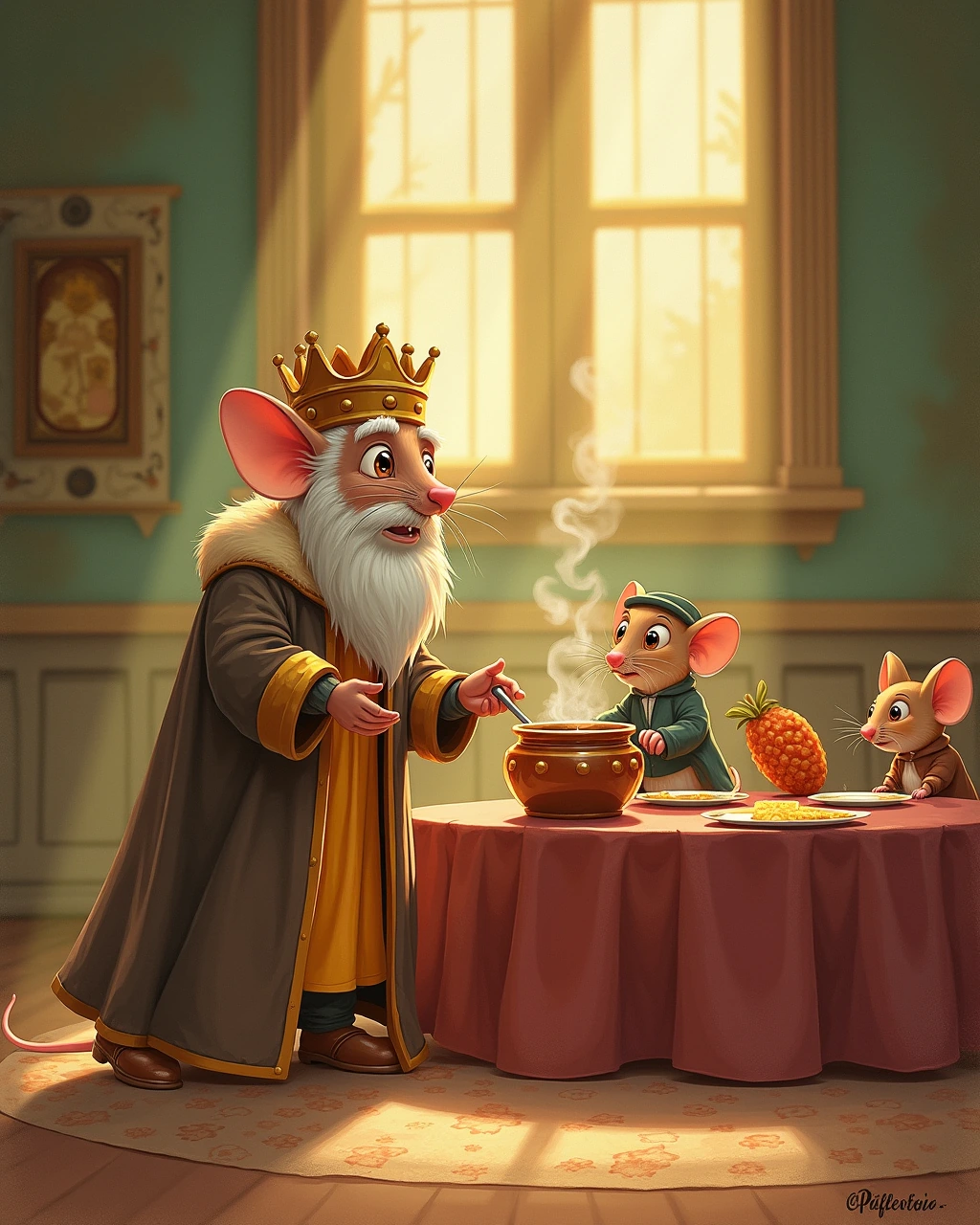
'I traveled nowhere,' said the third mouse. 'I remained in my homeland—that is safer. There is no need to wander the wide world when everything can be obtained at home. And so I stayed! I did not consort with all sorts of riffraff to learn how to cook soup, I did not swallow ants nor pester owls. No, I reached everything myself, by my own wit. Please put the pot on the stove. Like this! Pour in water, and fill it well. Good! Now kindle the fire, and make it hotter. Very good! Let the water boil, let it bubble white and vigorous! Throw the sausage stick into the pot... Do not

Will you now, Your Majesty, deign to dip your royal tail into the boiling water and stir the soup with it slightly! The longer you stir, the richer the broth will become—after all, it is very simple. And no seasonings are needed—just sit there and stir with your little tail! Like this!

"Could this not be entrusted to someone else?" asked the mouse king.

"No," replied the little mouse, "it absolutely cannot. For all the power lies in the royal tail!"

And so the water began to boil, and the mouse king perched beside the cauldron and stretched out his tail—this is how mice usually skim cream from milk. But as soon as the royal tail was touched by the hot steam, the king instantly jumped down to the floor.

"Well, you shall be queen!" he said. "As for the soup, let us wait until our golden wedding day. How the poor folks in my kingdom will rejoice! But never mind, let them wait and lick their lips for now; they will have plenty of time for that."

The wedding was celebrated, yet many mice grumbled on their way home:

"Well, is this really sausage-stick soup? It looks more like mouse-tail soup!"

They felt that certain details recounted by the three mice had been presented, on the whole, quite well, but perhaps everything ought to have been told altogether differently. We, they said, would have told it thus and so.

However, this is criticism, and critics are always wise after the fact.

This story traveled throughout the world, and opinions about it were divided; yet the story itself remained unchanged thereby. It is true in every detail from beginning to end, including the sausage stick. Only do not expect gratitude for the tale—you will never receive it anyway!