
Literary tale

Iron Hans

A young prince, after accidentally freeing a cursed wild man named Iron Hans, is cast out to learn humility and the value of hard work before proving his worth through secret heroic deeds to reclaim his status and win a princess.

PDF

Iron Hans

Once upon a time there lived a king who had a great forest near his castle, and in that forest all kinds of game dwelled. Once he sent a huntsman into that forest to shoot him a wild goat, but the huntsman did not return. "Perhaps some misfortune has befallen him?" said the king, and on the next day he sent out two more huntsmen to search for him; but they too did not return.

Then on the third day the king gathered all his huntsmen and said: "You must search the entire forest and do not return to me until you have found those three." But none of these returned either, nor did a single dog from the pack they had taken with them come back home.

From that time on, no one dared to enter that forest, and it fell silent, mute and lonely; only occasionally an eagle would rise above it or a hawk take flight.

Thus many years passed, and suddenly a foreign huntsman appeared before the king, asked to enter his service, and undertook to venture into that dangerous forest.

The king did not wish to give consent and said: "That forest is unclean, and I fear that you will fare no better there than those who perished in it, and you will not emerge from it." The huntsman replied: "Sire, I wish to try at my own risk, and I have never known fear."

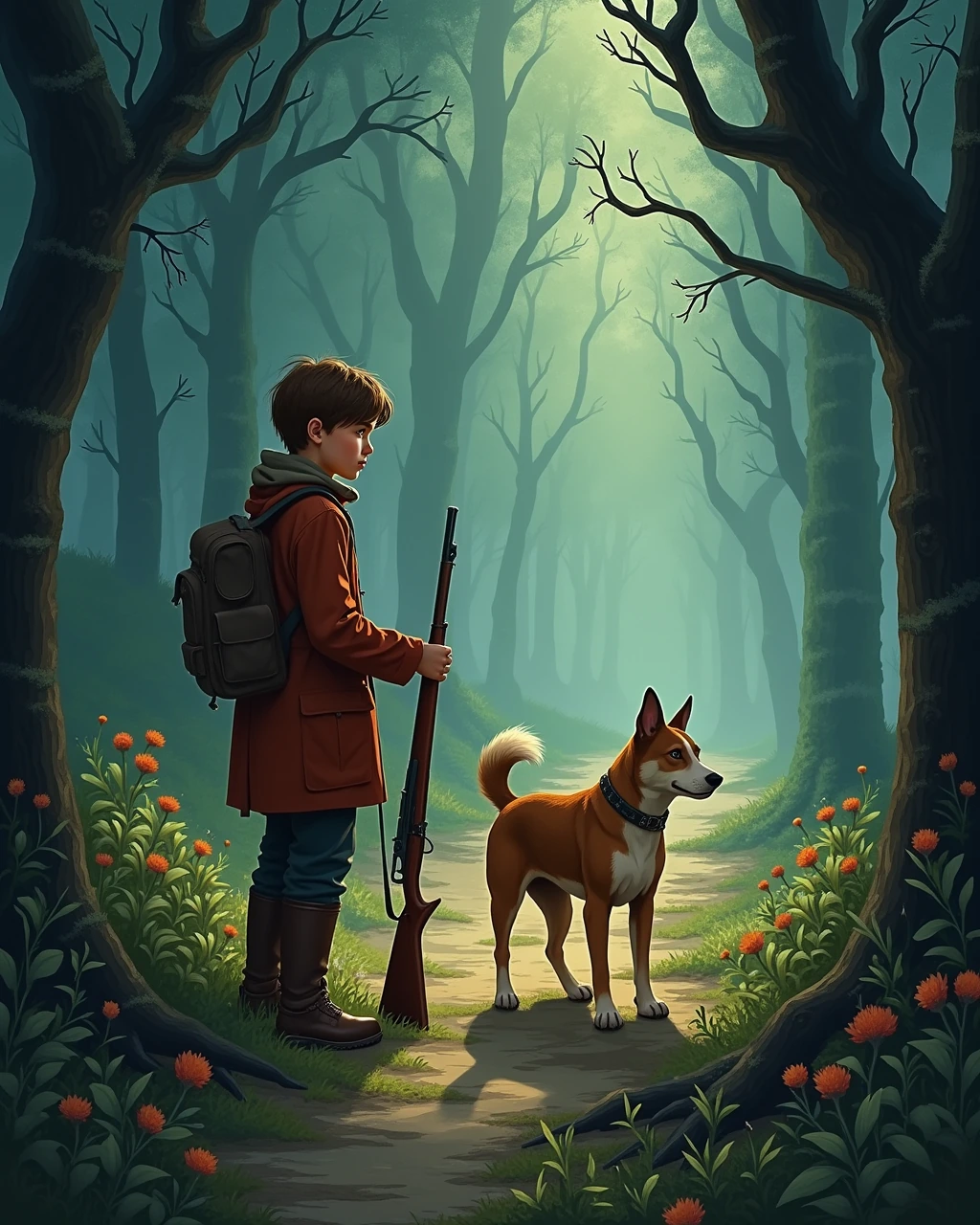
So he went into the forest with his dog. Soon afterward the dog picked up the scent of a beast and wanted to pursue the trail; but hardly had it run two steps when it found itself before a deep pool and could not advance another step, and from the pool a bare hand emerged, seized the dog, and dragged it down into that same pool.

Seeing this, the huntsman returned, brought three more men with him, and made them bail out the entire pool with buckets. When they had bailed it down to the bottom, they saw at the bottom a wild man, dark-skinned as rusty iron, and so overgrown with hair that it hung down to his knees. They bound him with ropes and led him to the castle. Everyone marveled at that wild man, and the king ordered him to be placed in an iron cage in his courtyard and, under penalty of death, forbade anyone to open the cage door, while he gave the key into the queen's keeping.

And from that time on everyone could freely enter that forest.

The king had a little son about eight years old, who once was playing in the courtyard, and during play his golden ball fell into that cage. The boy ran up to the cage and said to the wild man: "Give me back my ball." "I will only give it back," replied the other, "when you open the door for me." "No," said the boy, "I will not do that: the king has forbidden it," and he ran away.

On the next day he came again and demanded his ball. The wild man answered him: "Open the door," but the boy refused to do so.

On the third day, when the king had gone hunting, the boy came once more and said: "Even if I wanted to, I cannot open it—I do not have the key." The wild man said to this: "It lies under your mother's pillow; there you can get it."

The boy, eager to regain his ball, waved aside all caution and brought the little key.

The door opened stiffly; while unlocking it, the boy even pinched his finger, and when he had opened the door, the wild man stepped out of the cage, handed him the ball, and hurried away. The boy became frightened. He began shouting after the wild man: "Do not go away, wild man, or I shall get into trouble because of you."

The other returned, lifted him up, set him upon his shoulder, and quickly departed into the forest.

When the king returned and saw the empty cage, he asked the queen how this could have happened. She could explain nothing, began searching for the little key, but it had vanished. She called for her son, but there was no answer.

The king sent people out to search, but they could not find the prince. Then the king guessed what had happened, and great sorrow reigned at the royal court.

When the wild man returned again to his dense forest, he set the boy down and said to him: "You will never see your father and mother again, but I will keep you with me; you freed me, and I must have mercy on you. If you carry out everything I command you, you will live well. I have plenty of every kind of treasure and gold—more than anyone else in the world."

He made the boy a little bed of moss, and the boy fell asleep on it, and the next morning the wild man led him to a spring and said: "See, this gold-bearing spring is bright and clear as crystal; you must sit beside it and watch carefully that nothing falls into the spring, otherwise it will be defiled. Every evening I will come here to see whether you are carrying out my command."

The boy sat down by the spring and began admiring the golden fish and golden snakes that darted within it, and he kept watch constantly so that nothing might fall into that spring.

And while he was sitting thus, suddenly his finger began to hurt so much that involuntarily he dipped it into the water.

He quickly withdrew it from the water, but saw that his finger was entirely gilded, and however hard he tried to rub off that gold from his finger, all was in vain.

In the evening the wild man returned (and his name was Iron Hans), looked at the boy, and said: "What has become of the spring?" "Nothing," replied the boy, holding his hand with the gilded finger behind his back so that the other would not see it. But Iron Hans said: "You dipped your finger in the water; this time I will let it pass, but beware—drop nothing more into it."

Early the next morning the boy sat again over the spring and guarded it.

And again his finger began to hurt; he passed it through his hair, and then, as ill luck would have it, a hair from his head fell into the spring. He quickly pulled that hair out, but the hair too was completely gilded.

Iron Hans came and already knew what had happened. "You dropped a hair into the spring," he said, "and once more I will let this pass, but if a third time something similar occurs, the spring will be defiled and you will no longer be allowed to remain with me."

On the third day the boy sat by the spring and did not dare move, although his finger hurt very much. But boredom tormented him, and he began looking into the water as into a mirror. He bent lower and lower to examine his eyes properly, and suddenly strands of his long hair, slipping from his shoulders, touched the water.

He quickly jumped to his feet, but already all the hair on his head was gilded and shone like the sun. One can imagine how frightened the boy was! He wrapped a handkerchief around his head so that the wild man might not see his hair.

But when the other came, everything was already known to him. "Take the handkerchief off your head," he said.

Then the golden hair cascaded down onto the boy's shoulders, and however hard he tried to excuse himself, he could do nothing.

"You have failed the test," said the wild man to him, "and you can no longer remain here. Go out into the wide world and learn what poverty is. But since your heart is not wicked and I wish you well, I grant you one thing: should you fall into need, come to the forest and cry: 'Iron Hans!'—and I will come out to you and help you. My strength is great, far greater than you think; and I have plenty of silver and gold."

So the prince left the forest and walked along beaten and unbeaten paths, farther and farther, until finally he arrived at a large city. He sought work but could find none, nor had he learned any trade by which to earn his living.

Finally he went to the castle and asked whether they wished to take him into service. The court servants themselves did not know for what purpose he might be useful to them, but he pleased them, and they told him to stay. At last the cook took him on: to carry wood and water and rake out the ashes.

Once, when no one else was at hand, the cook ordered him to carry food to the royal table, and since the youth did not wish to show the king his golden hair, while serving the dishes he did not remove his cap from his head.

No one had ever dared appear before the king in such a manner, and he said: "When you appear at the royal table, you must take off your little cap." "Ah, sire," said the boy, "I cannot remove it, because I have a festering scab on my head." Then the king summoned the cook, scolded him, and asked how he could take such a lad into his kitchen. "Drive him out immediately!" But the cook took pity on the boy and exchanged him with the gardener's boy.

Thus the prince had to plant and water in the garden, dig and rake, and endure wind and bad weather.

One summer day, when he was working alone in the garden, the day was so hot that he removed his cap to cool his head a little.

And so they shone

his hair in the sun, so that its rays even reached the princess's bedchamber, and she jumped up in her bed to see what was shining so brightly.

Then she saw the youth and cried out to him: "Hey, lad! Bring me a bouquet of flowers."

He hastily pulled his little cap down over his head, picked some wild field flowers, and tied them into a bunch.

As he began climbing the stairs with it, he met the gardener. "What made you think of picking such wretched flowers for the princess? Go bring others at once, and choose the most beautiful and the rarest."—"Ah, no!" said the youth. "Wild flowers smell better and will please her more."

When he came into her room, the princess said: "Take off your little cap; you should not stand before me wearing a hat." He answered her the same: "I dare not take it off—my whole head is covered in scabs." But she grabbed hold of his little cap and tore it off, and his golden hair tumbled down onto his shoulders, so that it was a delight to behold.

He tried to run away, but the princess held him by the hand and gave him a full handful of gold coins. He left the princess, yet paid no attention to this gold; he brought it to the gardener and said: "Give it to your children, let them play with it."

The next day the princess summoned him again, ordering him to bring a bouquet of field flowers, and when he appeared with the flowers, she immediately grabbed his cap and tried to tear it off, but he held it fast with both hands.

Again she gave him a handful of gold coins, and again he passed them on to the gardener's children.

And on the third day the same thing happened; she could not tear the cap from his head, and he would not take any money from her.

Soon afterward, war broke out in that land.

The king gathered his troops, but did not know whether he would succeed in defeating the enemy, who was strong and had a large army.

Then the youth said: "I am grown up now and also wish to go to war; just give me a horse." The other servants laughed at him and said: "Once we have ridden away, go look for a horse yourself: we will leave you a horse in the stable."

When they had departed, he went to the stable and barely managed to drag a horse out for himself: the horse was scrawny and lame in one leg. Nevertheless, the youth mounted it and rode toward the dense forest.

Having reached the forest edge, the youth shouted three times: "Iron Hans!"—and so loudly that the forest echoed in response.

Immediately the wild man appeared before him and asked: "What do you desire?"—"I desire a good horse to ride to war."—"You shall receive what you desire," answered Iron Hans, "and even more than you ask for."

He returned into his forest, and shortly afterward a groom came out of the forest leading a horse by the reins, a horse that flared its nostrils and was hard to restrain; and behind the groom followed an entire troop of armored knights clad in iron, their swords gleaming in the sun. The youth handed over his three-legged horse to the groom, leaped onto the swift steed, and rode at the head of the troop.

When they approached the battlefield, most of the king's army had already been slain, and the rest were nearly preparing to retreat.

Then the youth charged with his armored knights, swept like a storm upon the enemies, and crushed everything that dared oppose him. The enemies tried to flee, but he pursued them relentlessly everywhere and only ceased when not a trace of the enemy remained.

But instead of going to the king, he led his troop by roundabout paths back to the forest and once again called forth Iron Hans. "What do you desire?" asked the wild man. "Take back your horse and your armored knights, and return my three-legged horse to me."

Everything happened just as the youth wished, and he rode back to the castle on his three-legged horse.

When the king returned home, his daughter came out to meet him and congratulated him on the victory. "It was not I who conquered," said the king; "the victor was some strange knight who came to my aid with his troop."

The daughter wished to know who this strange knight was, but the king himself did not know. He said: "I saw him chase after the enemy, and then he vanished from my sight."

The princess asked the gardener about his helper; the gardener laughed and said: "He has just now returned home on his three-legged horse."

And the other servants all laughed at him and shouted: "Look, our hero rides in on Lamey!" They also asked him: "Behind which fence were you lying hidden?" But he answered them: "I distinguished myself better than anyone, and without me things would have gone badly for you." Well, they laughed even harder.

The king said to his daughter: "I will arrange a great festival, which shall last three days, and at that festival you shall throw a golden apple: perhaps that strange knight will come and pick up your apple."

When news of that festival was spread, the youth went to the forest and called forth Iron Hans. "What do you desire?" asked the latter. "I desire to obtain the princess's golden apple."—"Consider it yours!" said the wild man. "And furthermore: you shall receive from me red armor and arrive at the festival on an excellent chestnut horse."

When the day of the festival arrived, the youth mingled among the crowd of knights and was recognized by no one.

The princess came out to the knights and threw them the golden apple; but only the youth succeeded in catching it, and as soon as he had seized it, he immediately disappeared.

On the second day, Iron Hans dressed the youth in white armor and gave him a dapple-gray horse. Again the apple fell to him, and as soon as he grasped it, he galloped away with it.

The king grew angry at this and said: "Such behavior is not permitted! He must appear before me and declare his name." And he issued this command: "If the knight who catches the apple attempts to gallop away again, he must be pursued, and if he does not willingly return, he is to be slashed and stabbed."

On the third day of the festival, the young prince received black armor and a black horse from Iron Hans and again caught the apple. When he intended to gallop away with it, the king's men chased after him, and one rider approached so closely that he wounded his leg with the point of his sword.

The young prince nevertheless escaped from them, but his horse flew so wildly that his helmet fell from his head, and they saw that his hair was golden. With this knowledge they returned and reported everything to the king.

The next morning the princess asked the gardener about the youth. "He is working in the garden," he replied. "Such an odd fellow—he was at the festival too and returned very late in the evening: he showed us three golden apples that he won at the festival."

The king summoned him, and he appeared once again wearing his little cap, but the princess immediately tore it off, and his golden hair fell in soft curls onto his shoulders, and he was so handsome that everyone marveled.

"Are you the knight who appeared at the festival all three days in armor of different colors and caught all three apples?" asked the king. "Yes," answered the youth, and he took three golden apples from his pocket and handed them to the king. "And if you need further proof, here is the wound your people inflicted upon me during their pursuit. I am also the knight who helped you achieve victory over your enemies."—"If you are capable of such deeds, then you are no gardener's helper: tell me, who is your father?"—"My father is a mighty king, and I have as much gold as my heart desires."—"I see," said the king, "and I am indebted to you. What can I do to please you?"—"Yes, that lies within your power: give me your daughter in marriage."

Then the princess laughed and said: "He gets straight to the point! Well, I have long suspected from his golden hair that he is no ordinary worker," and, stepping up to him, she kissed him.

Both his father and mother arrived for the betrothal and could not rejoice enough, for they had already lost all hope of ever seeing their son again.

And when everyone was seated at the wedding feast, suddenly the music fell silent, the doors swung open, and a most majestic king entered the hall with a numerous retinue.

He walked directly up to the youth, embraced him, and said: "I am Iron Hans and was enchanted in the form of a wild man, but you have freed me from the spell. All the treasures I possess must now pass to you..."

What joy there was then, what noise and merriment—what sweetness at the feast, and just as much of a hangover!